Exclusive: Thousands of North Carolina ballots set to be rejected after GOP imposed strict new rules, data shows
 Prefer us on Google
to see more of our voting rights news coverage when you search.
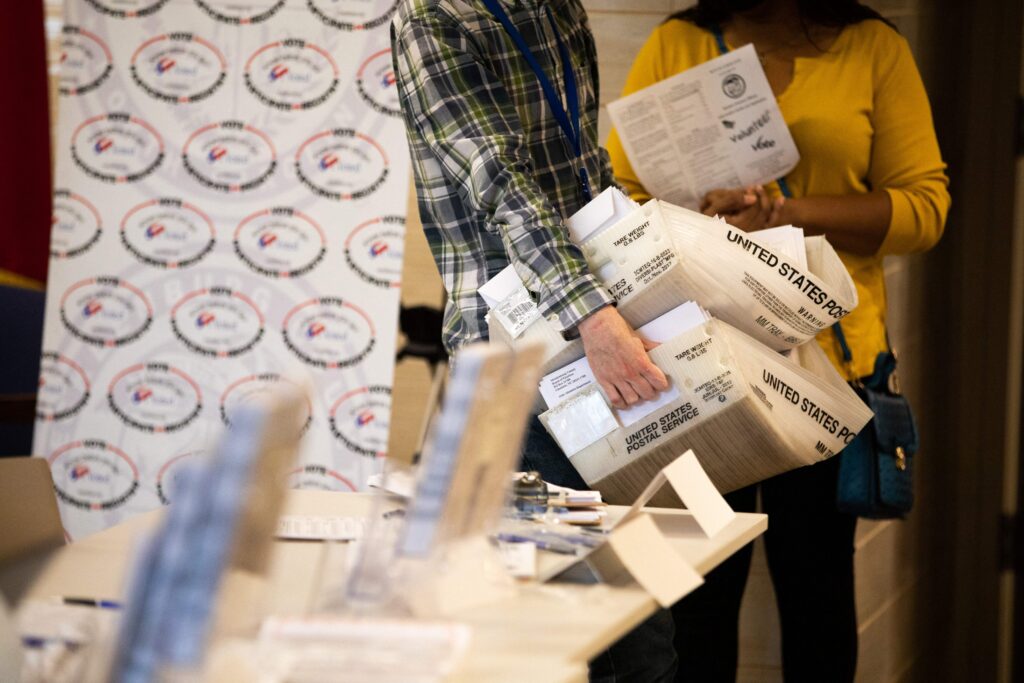
Thousands of North Carolina midterm ballots are set to be rejected over minor technical issues after a federal court upheld strict new Republican-backed rules for mail voters, according to data shared exclusively with Democracy Docket.
Some Democratic strongholds are seeing rejection rates as high as 7-8%, the data show.
The findings offer an unusually stark example of how Republican-backed voting restrictions, especially those targeting mail ballots, can directly cause large numbers of eligible voters to be disenfranchised.
Get updates straight to your inbox — for free
Join 350,000 readers who rely on our daily and weekly newsletters for the latest in voting, elections and democracy.
A federal judge ruled late Monday to uphold North Carolina’s strict GOP-championed absentee ballot rules on the eve of the state’s mail ballot request deadline.
Working with the Southern Coalition for Social Justice, Common Cause North Carolina compiled data from 27 of the state’s 100 counties, using absentee review monitors — everyday voters and volunteer advocates — as well as attorneys.
The data reveals ballots are so far being rejected at a rate of around 3% in the wake of the new GOP-backed rules.
Some of those rejections were likely not down to the new rules — ballots can be rejected for numerous reasons. But the 3% rate is double the rejection rate the state saw in its 2022 election, strongly suggesting that the new rules are having a major impact.
If 3% of mail ballots statewide end up being rejected, it would lead to an estimated 3,942 ballots being thrown out, Democracy Docket calculated.
The figure is based on the number of mail ballots — around 188,000 — cast in 2022, the last midterm year, reduced by 30% due to a decrease in requested mail ballots this year.
“If the trends hold, we’re looking at thousands of votes that could be spoiled because of this new guidance,” Common Cause North Carolina State Director Sailor Jones told Democracy Docket.
Those voters would be disenfranchised unless they come back to cure them — something few voters end up doing.
Under the new rules, voters are required to place their ballot inside, and seal, an inner envelope. That envelope then gets put into an outer envelope. A separate new rule limits who can assist voters with their ballots to “near-relatives.”
The envelope sealing requirement has faced the most scrutiny as voters, particularly those with mobility constraints, may struggle to maneuver their ballot into the small envelope container, leading to the inner envelope being left unsealed. Advocates say it’s this requirement that’s likely leading to higher rates of rejections.
“It is hard to see this as anything but a tactic to really make it more difficult to vote at a moment where the people who are hurt most are older, disabled voters and voters who have historically relied on mail-in voting to cast a ballot,” Jones said.
In larger counties, like Mecklenburg and Forsyth — both Democratic strongholds — the rejection rate is as high as 7-8%, according to the data. But rejection rates are high in some smaller counties too. In Alexander, one of the state’s least populated counties, 6.67% of all ballots were spoiled as of an Oct. 6 count.
To Jones, the rules are part of a “systematic effort to make voting by mail more difficult.”
And some people are choosing not to vote by mail altogether this year, with voters, advocates and election officials citing fear that votes will be spoiled. Absentee ballot requests have dropped 32% compared to this time of year in 2022, as of data from Tuesday.
The North Carolina State Board of Elections, which since last year has been controlled by the GOP, celebrated Monday’s ruling.
In a statement, Executive Director Sam Hayes, a former GOP aide to a top state lawmaker, said the opinion “does not change how they [voters] cast their ballots or the instructions they have already received.”
That’s because the board already changed how voters cast ballots when it voted Sept. 4 to impose the rules on the morning the state’s first absentee ballots were sent out, leaving election workers and voters scrambling.
In his ruling in the challenge to the rules, U.S. District Judge Thomas Schroeder, a George W. Bush appointee, scolded plaintiffs* for delaying the lawsuit.
“Moreover, election integrity and chain-of-custody concerns with absentee ballots, which have been recognized to be susceptible to fraud and tampering, support the state’s interest,” Schroeder concluded.
Schroeder, who said it was too late to change election rules with voting underway, wrote that voters should still be able to ensure their ballots are counted if they follow the cure process or if a non-curable deficiency is found in time.
Voters seeking to vote absentee must request a ballot by 5 p.m. Tuesday.
*The Elias Law Group (ELG) represents the plaintiffs in this case. ELG Firm Chair Marc Elias is the founder of Democracy Docket.