Why California is ground zero in Trump’s bid to rig the midterms
 Prefer us on Google
to see more of our voting rights news coverage when you search.
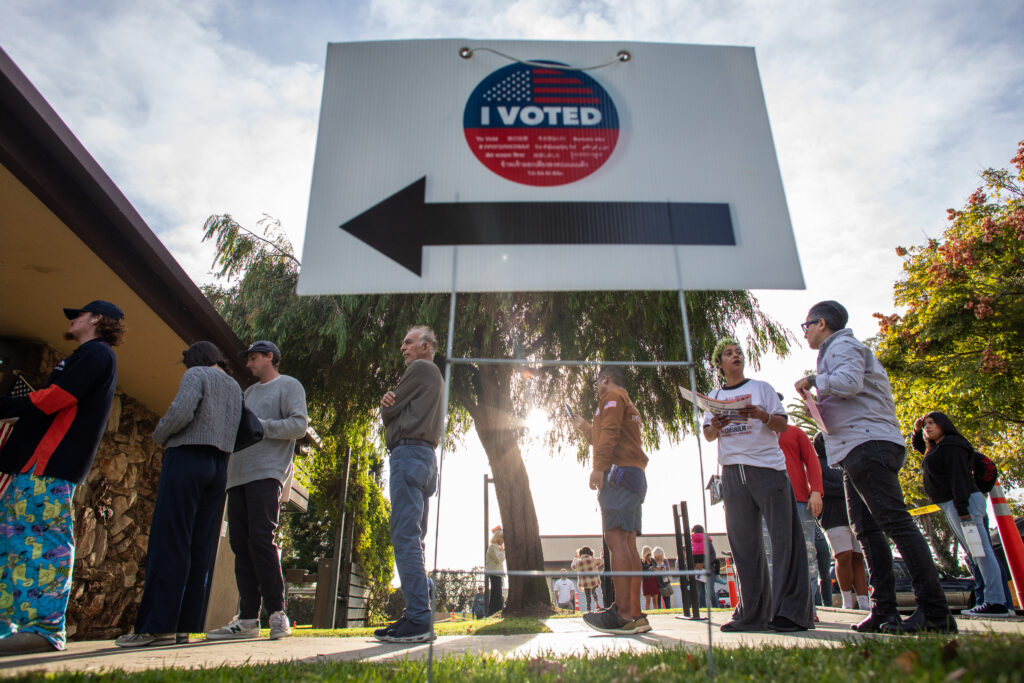
California has long occupied a special place on President Donald Trump’s list of election grievances.
Asked recently why he was urging his supporters to vote by mail while continuing to claim the method is rife with fraud, Trump singled out one state.
Get updates straight to your inbox — for free
Join 350,000 readers who rely on our daily and weekly newsletters for the latest in voting, elections and democracy.
“Start off by taking a look at California,” Trump said. “There is a lot of cheating in vote-by-mail. All over.”
It was far from the first time that Trump had falsely gone after the nation’s largest and most prominent state — which on Thursday became the target of an extraordinary federal lawsuit aiming to bar California officials from counting the ballots of 20,000 people alleged to be noncitizens*.
But during Trump’s second term, these attacks have gone beyond rhetoric — they have increasingly been backed by the machinery of the federal government. Among the Trump administration’s efforts in the Golden State have been criminal investigations, voter data demands, attempts to restrict mail voting, fights over congressional maps and now Thursday’s dangerous lawsuit.
And California’s election system offers Trump another political opening after Election Day.
Because so many Californians vote by mail, ballots postmarked by Election Day are accepted for up to seven more days, and voters have additional time to cure certain signature problems. That means close races can remain unresolved long after the polls close.
The extended count could create a window for Trump to attack still-changing results, as he has before. And it could let him attempt further federal intervention, including potential emergency lawsuits, ballot seizures or other efforts to halt the counting process, before races are certified.
It all means that, less than three weeks before the midterms, California has emerged as perhaps the most prominent battleground for the administration’s effort to exert federal control over elections.
The president’s anti-voting escalation takes aim at a state with unmatched electoral scale.
California has more than 23 million registered voters, making it the largest electorate in the country, and nearly 90% of its voters have cast ballots by mail in recent elections. Its 52-member congressional delegation is the nation’s largest, giving the outcome of its elections potentially enormous consequences for control of the U.S. House. It’s also one of the bluest states in the nation.
That combination — size, political importance, progressive politics, and an expansive vote-by-mail system — has made California a popular target of Trump and anti-voting activists.
After winning the presidency in 2016, but losing the popular vote, Trump falsely claimed that millions of people had voted illegally, and separately alleged “serious voter fraud” in California. Three years later, he again falsely claimed the state had admitted that a million illegal votes were cast, badly mischaracterizing a settlement involving inactive voter registrations in Los Angeles County.
By 2024, Trump was telling audiences that “if Jesus Christ came down and was the vote counter,” Trump would win California — a state he has repeatedly lost by enormous margins.
Earlier this year, Trump again alleged fraud over the state’s slow vote count. When Republican Los Angeles mayoral candidate Spencer Pratt slipped from second to third place during the ongoing count, Trump said the election was “rigged.”
But California’s trickling results were not evidence of fraud — rather they were the result of the state’s pro-voter policies. State law gives officials ample time to verify millions of mail ballots, process ballots arriving after Election Day that were mailed on time, and allow eligible voters to fix certain problems.
Then Trump disclosed something more consequential: He had personally asked Bill Essayli, the top federal prosecutor in Los Angeles — who is now involved in the new lawsuit — to investigate California’s elections while his endorsed gubernatorial candidate, Steve Hilton, was at risk of not qualifying for the November general election.
“I called up the very powerful and very good U.S. attorney in California, and I said, ‘Do me a favor. Take a look, they are trying to steal that election, too,’” Trump said in June.
Essayli’s office had announced “multiple election fraud investigations” days after the primary. Trump later falsely claimed his intervention was responsible for Hilton advancing to the general election; in reality, Hilton advanced as additional lawful ballots were counted.
The administration has simultaneously targeted the mechanics of voting in California.
Trump directed the U.S. Postal Service (USPS) to impose new nationwide requirements on mail ballots, including specially approved envelopes and voter-specific barcodes. USPS would then potentially refuse to deliver noncompliant ballots. As a state where mail voting dominates elections, California would have been particularly harmed by the change — had federal courts not blocked the restrictions before the midterms.
The DOJ also went after California’s new congressional map. After Trump pushed Republican-led Texas to redraw its congressional districts mid-decade, California voters approved Proposition 50, temporarily replacing the map drawn by the state’s independent commission with one created by the legislature. The DOJ then sued California in a failed effort to block the map from being used in 2026.
But the most direct attempt at federal intervention came this week.
The DOJ sued California Thursday and asked a federal judge to bar election officials from counting mail ballots from more than 20,000 people until their citizenship could be verified. The DOJ had given state officials just 48 hours to review the list before suing.
The lawsuit takes the administration’s election campaign beyond demands for voter records or election rule changes: The federal government is now asking a court to prevent a state from tabulating ballots belonging to a federally identified group of voters during an election that is already underway.
The administration’s confrontation with California also extends far beyond voting.
Los Angeles became the first city where Trump deployed National Guard troops over a governor’s objections after protesters took to the streets to oppose his administration’s aggressive immigration raids. Trump ultimately sent roughly 4,000 Guard members and hundreds of Marines, prompting California to sue in a case that wrestled with the limits of presidential authority to use the military domestically.
While that fight did not concern election administration, it did establish California as a major arena where Trump would test federal power against a resistant state government — a confrontation that has since increasingly spread to elections.
So far, Trump’s attacks have followed a strikingly consistent pattern: When California election results move against him or his preferred candidates, he alleges fraud.
What has changed in 2026 is that Trump now has loyalists installed across the federal government. They are willing to turn those allegations into probes, lawsuits and other schemes to spread chaos.
*The Elias Law Group (ELG) is representing pro-voting groups who have asked the court to be added as intervenor-defendants to DOJ’s lawsuit against California. ELG firm chair Marc Elias is the founder of Democracy Docket.