Postal Service overstepped its powers with mail voting rules, pro-voter groups tell appeals court
 Prefer us on Google
to see more of our voting rights news coverage when you search.
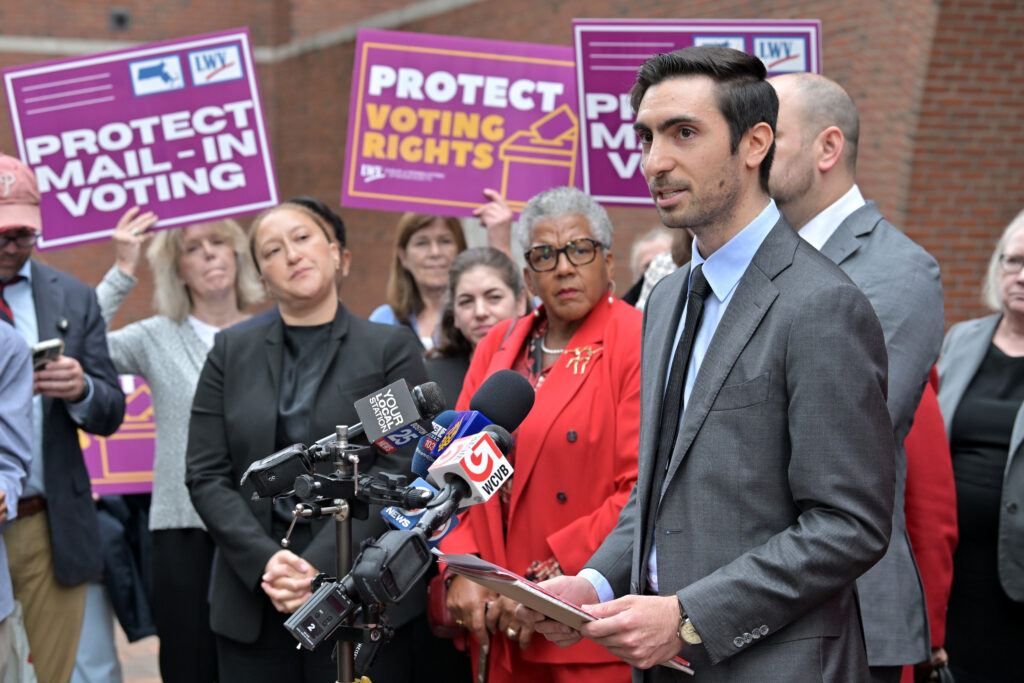
The U.S. Postal Service’s new mail voting rules overstep the authority granted to it by Congress, pro-voting groups argued in a brief asking a federal appeals court to keep the rule frozen before the upcoming elections.
“This is not a mere ‘envelope design’ or labeling rule, but a barrier to ballot transmission,” the League of Women Voters of Massachusetts (LWVM) and other pro-voting groups wrote in a brief filed on Monday with the 1st Circuit Court of Appeals.
The pro-voting groups’ argument heavily relies on the major questions doctrine, a legal interpretive tool often favored by the U.S. Supreme Court’s conservative majority. The doctrine heavily scrutinizes federal agency actions that lack clear authority from Congress. The Justice Department has separately appealed the mail voting restrictions case to the Supreme Court.
No federal law, the voting groups noted, “authorizes USPS to deem otherwise mailable matter nonmailable – power Congress reserved.”
The USPS rule that the Justice Department is looking to reinstate for November would require states to adopt certain mail ballot envelope designs and upload personal voter data to a federal portal for clearance to receive mail ballots.
Get updates straight to your inbox — for free
Join 350,000 readers who rely on our daily and weekly newsletters for the latest in voting, elections and democracy.
A federal district court judge has halted the rule during ongoing legal challenges, saying it is likely unconstitutional and could disenfranchise millions of mail voters.
The voting groups dug deep into colonial history, arguing the Founders deliberately gave Congress and not the president the power over the Postal Service given historical abuses from English monarchs.
“The Postal Service’s history also supports this. The Founders understood that the Crown’s discretionary control over the mail was ‘dangerous in the extreme,’” they added.
The pro-voting groups said the rule isn’t just unlawful – it’s unconstitutional.
“USPS claims not only authority to decide what is mailable, but also the unprecedented authority to alter election administration by refusing to deliver mail ballots that states send their eligible voters,” they wrote.
“This assertion of federal power over state election processes lacks the explicit, unambiguous authorization the major questions doctrine requires,” they said.
States have argued it will be difficult to comply with the rule with fewer than 60 days until Election Day. A critical component – the federal portal for uploading mail voter data – is not complete. The Justice Department made no mention of when it would be complete in its appeal to the Supreme Court, but claimed in its filing with the 1st Circuit that it would be “functional” by this week.
A whistleblower report from a USPS employee last week said the postal service is rushing to get the portal online, and adopting certain measures in the process like a “zero-percent failure policy” that could lead to thousands of mail ballots being rejected.
Meanwhile, North Carolina has already begun sending out mail ballots to voters and at least two dozen more states are expected to send out millions more over the next few weeks.
The pro-voting groups said in Monday’s brief that lifting the block would “upend state election processes,” while the government hasn’t shown any irreparable harm.
“Indeed, they offer no evidence the Rule could deliver any benefit for the November elections,” they wrote. “States cannot meet the Rule’s requirements in the time remaining before they must send out ballots under state laws—a timeline USPS’s own unreadiness only compresses—and any rushed compliance attempt guarantees data-entry errors and mis-scans that, under the Rule, doom ballots by the batch.”