Justice Department asks Supreme Court to lift block on USPS mail voting restrictions
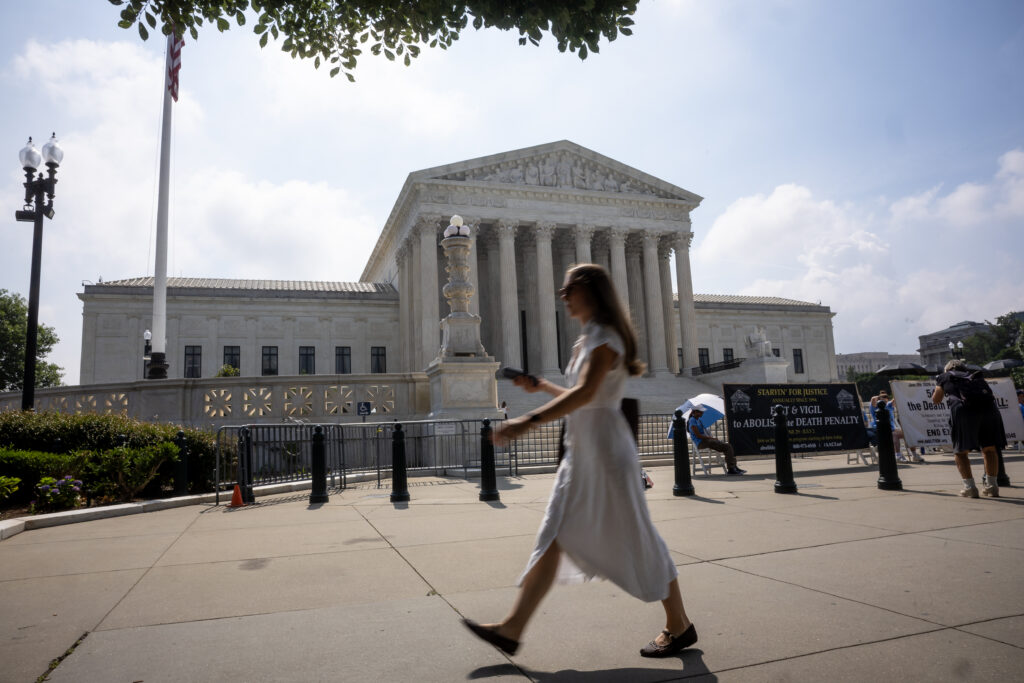
The U.S. Justice Department (DOJ) asked the U.S. Supreme Court to lift a lower court’s block on the U.S. Postal Service’s (USPS) new rules restricting mail voting.
The DOJ’s request comes less than a day after it filed a similar ask with the 1st Circuit Court of Appeals. In this latest filing, DOJ argues the Supreme Court should immediately intervene because the Postal Service needs time to implement the rule to prevent potential fraud in mail voting before the November midterms.
“The injunction bars the Postal Service from verifying that mailed envelopes comply with the Rule’s requirements for the upcoming elections, nullifying the Postal Service’s efforts to address the risk that the federal mails will be used to perpetrate voter fraud,” the brief reads.
The Justice Department made that argument despite vanishingly few instances of mail voting fraud being uncovered during past elections in dozens of audits and investigations. Nearly one-third of Americans voted by mail in 2024.
Get updates straight to your inbox — for free
Join 350,000 readers who rely on our daily and weekly newsletters for the latest in voting, elections and democracy.
District Court Judge Indira Talwani blocked the Postal Service from implementing the mail voting restrictions in an order Friday. The Supreme Court’s ruling on the matter could determine whether millions of Americans are able to vote by mail this November.
One of the unresolved issues of the case is whether the USPS itself has the time and resources necessary to implement its own new rule ahead of the midterms
Under the new USPS rule, written to comply with President Donald Trump’s executive order on mail voting, states’ mail ballot envelopes must include certain design changes, such as new logos and barcodes. The rule also requires states to submit personal information on voters who’ve requested mail ballots to a federal online portal. States that fail at either requirement would not receive mail ballots from USPS.
But during Thursday’s hearing with the district court that issued the preliminary injunction against the rule, the Trump administration could not answer basic questions about whether the portal was complete or when it would come online.
In its appeal to the First Circuit, DOJ said that the portal would be functional “by next week” – though there is no mention of this timeline for portal completion in the appeal to the Supreme Court.
The Supreme Court filing also makes no mention of a whistleblower report from a USPS employee from last week who said the postal service’s rushed attempt to complete the portal, despite the court block, could disenfranchise millions of voters.
The DOJ also argues in its Supreme Court appeal that it needs to implement the mail voting restrictions immediately because the district court’s injunction currently prohibits the Postal Service from verifying rule compliance for the states that have voluntarily decided to go along with it.
The Justice Department argued that blocking the rule now could cause more confusion later were it to take effect because several states are beginning to mail out ballots without receiving Postal Service approval. North Carolina and Alabama are two states that are in the process of sending out mail ballots and have voluntarily sought to comply with the new USPS rule despite the fact that it’s currently blocked.
“Because the district court’s injunction prohibits the government from verifying compliance with the Rule’s requirements, it will permanently bar the Rule’s operation with respect to any ballots mailed before a stay issues,” the DOJ brief reads. “In fact, because the injunction bars USPS from training its employees to conduct the verification process, it will effectively continue to delay implementation of the Rule for a brief period even after a stay is issued, underscoring both the irreparable harm on the government and the need for an immediate stay.”
But as the League of Women Voters of Massachusetts, which are challenging the rule, have argued, asking states to overhaul their mail voting process less than two months before Election Day would create chaos and confusion for voters. Many other states have either already finalized their ballot envelope designs and mail voting lists or are in the process of mailing them out.