Seizing ballots would be an illegal attack on democracy. Trump might try anyway
 Prefer us on Google
to see more of our voting rights news coverage when you search.
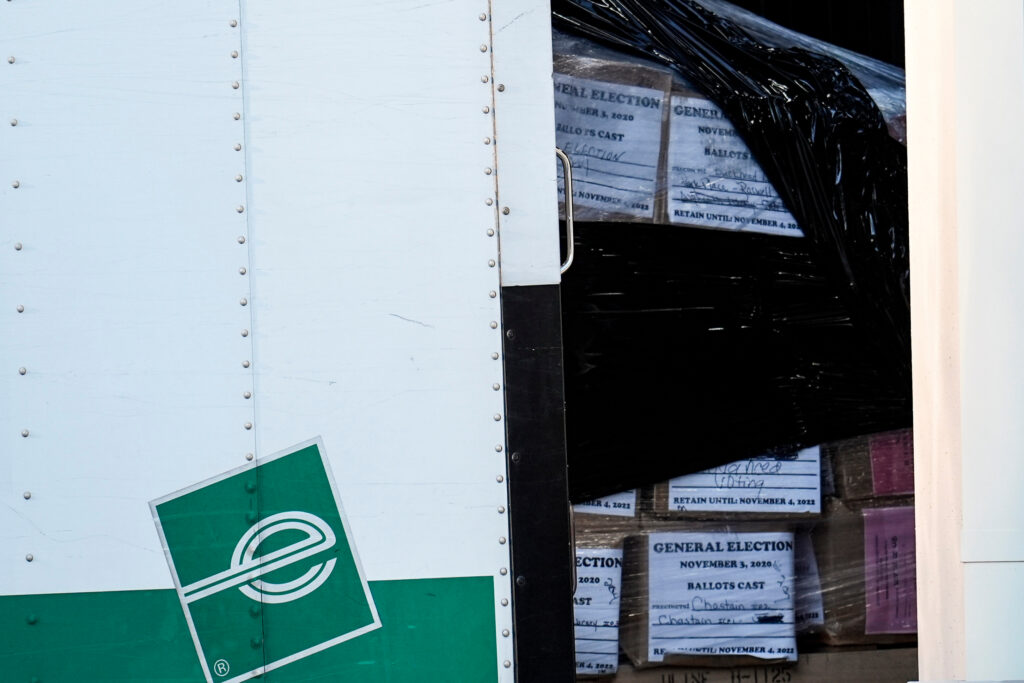
President Donald Trump has no legitimate grounds to order the seizure of ballots or voting machines during this year’s midterm elections.
But the dismal reality is he may try anyway.
Were the president or one of his locally elected allies to do that, they wouldn’t just be attempting to sway a single election outcome or even a handful of races. Rather, the aim would be chaos itself — to disrupt or delay the election’s certification, damage the public’s confidence in American democracy and manufacture a false pretense to set aside unfavorable results in races across the country.
And Trump has a history of resorting to desperate measures to stave off electoral losses: He refused to concede the 2020 presidential election. Instead, he asked Georgia’s secretary of state to “find” him “11,780 votes,” then whipped his supporters into a riot on Jan. 6, 2021.
Since his return to the White House, Trump has said that he “should have” authorized a plan to seize voting machines in 2020 — a draft executive order, never issued, directed the Defense Secretary to do so at the time. And Trump has repeatedly refused to rule out attempting to take over elections by declaring a national emergency before Election Day.
In January, the FBI seized 2020 election materials — including ballots — from a Fulton County, Georgia, election facility after obtaining a warrant by attesting to debunked election claims. Weeks later, Riverside County Sheriff Chad Bianco, an outspoken Trump supporter, seized 650,000 ballots from California’s redistricting referendum last year, based on similar specious conspiracy theories.
And on Oct. 15, the Department of Justice (DOJ) filed an extraordinary lawsuit against California, demanding the state disenfranchise 20,000 voters it alleges, without evidence, are noncitizens. In a court filing in a separate case seeking documents about the administration’s plans to meddle in the midterms, Democrats warned that the department’s demands in California suggest it will “attempt to engage in warrant-based ballot seizure.”
Numerous legal experts have argued that federal laws bar such a move.
Asked whether Trump would order federal law enforcement to seize ballots or other election equipment, White House spokeswoman Lauren Bis declined to answer directly and instead attacked the “radical left” for opposing stricter voting rules.
Snatching election equipment is hardly the only stunt Trump or his allies may pull in his desperate attempt to prevent a Republican washout in November. With its California lawsuit, the administration may be following through on threats to pursue criminal charges against state election officials. And it’s also planning to deploy 1,000 election monitors.
But swiping ballots or tabulators could cause the most damage to U.S. democracy and the electorate’s faith in this year’s vote counts.
Breaking the chain
What makes federal ballot seizures so dangerous is that they would disrupt the chain of custody, the strict procedures that ensure election materials are handled properly by the correct people at every step of the election process.
Election officials maintain constant documentation of ballots starting when they are first printed and continuing until well after they are finally counted. Every time a ballot changes hands — from the neighborhood polling place to a county office, for example — the transfer is documented, usually with two or more witnesses.
Get updates straight to your inbox — for free
Join 350,000 readers who rely on our daily and weekly newsletters for the latest in voting, elections and democracy.
The goal is to ensure that there is no opportunity for tampering with the vote — that no single person is ever alone with the ballots.
Of course, mistakes and disruptions sometimes break the chain of custody. A power outage can turn off security cameras or an absent-minded election worker can forget to lock a door for a few hours.
In those rare cases, courts weigh the possibility that some ballots may have been compromised against the damage of disenfranchising voters. Sometimes, courts say the tampering risks are small and the votes are still counted. But occasionally judges will deem the ballots so compromised that they can no longer be counted.
“These cases typically involve concerns that very specific ballots were exposed to irregular handling or potential tampering,” James Alcorn, director of the election law program at William & Mary Law School, said at a recent press briefing.
In “very rare” extreme cases, judges order new elections, Alcorn added.
If law enforcement officials were to seize ballots this year, it would break the chain of custody and put every vote taken away from election officials at risk of going uncounted. With enough ballots excluded, a judge could then conclude the only equitable option is to redo the specific races involved. Even if a redo doesn’t change the outcome, it would prevent the winner from being seated in Congress for months.
In bitter irony, disrupting the chain of custody would enable the very kind of “Deep State” vote-count rigging that the pro-Trump conspiracy theorists say they fear.
Trust can’t be reforged so easily
Unlike most of Trump’s schemes to put his thumb on the electoral scale for Republicans, the administration has a track record of relative success with ballot seizures.
Prior to the Fulton County raid and Bianco’s ballot grab, the Office of the Director of National Intelligence obtained and probed Puerto Rico’s voting machines at the White House’s behest for anomalies related to the 2020 election — even though the island’s residents can’t vote in federal elections.
Critically, all three of those investigations focused on past elections.
“A warrant issued for materials pertaining to an election long past is very different from a warrant issued for materials pertaining to elections still going on,” Justin Levitt, a Loyola Marymount University law professor and former DOJ voting section attorney, told Democracy Docket earlier this year.
The DOJ’s remit is to investigate and prosecute crimes, Levitt noted. As such, it has no reason to seize election-related equipment or ballots before a count can be completed and certified.
Moreover, it was a “complete anomaly” that a federal magistrate judge issued the warrant in Fulton County, Levitt said, pointing to the criticism heaped upon that decision. “I think the attention that it has gotten is going to give magistrates a lot of pause further on.”
Those federal interventions also put election administrators and judges on notice. As this DOJ has racked up losses in election-related cases across the country, the administration has also skirted — if not openly defied — court orders restraining its actions.
Those failed attempts make it harder to catch officials off guard. They’ve had time to prepare countermeasures and legal arguments against such a seizure.
For that reason, David Becker, executive director of the Center for Election Innovation & Research and a former DOJ voting rights attorney, believes seizures are unlikely.
“The DOJ has been able to get one warrant in Fulton County nine months ago,” he told Democracy Docket. “Since then, it has tried to get other evidence. It has been unable to get a warrant. It has had subpoenas blocked by Trump-appointed judges. The warrant that was issued was about an election that happened five years ago, not an election that was ongoing and being certified.”
When the California Supreme Court ruled that Bianco’s seizure was completely illegal and ordered the ballots returned, Justice Goodwin Liu used a concurring opinion to warn administrators to ready themselves for attempted seizures. He urged them to prepare plans to file a motion to quash or other court order if presented with a search warrant for election materials.
Since then, California has passed a new law aimed at preventing anyone, including law enforcement, from seizing ballots.
In a recent Slate essay, Rick Hasen, a law professor and director of UCLA’s Safeguarding Democracy Project, warned that the DOJ might try seizing ballots wherever a House or Senate race is close. And a judge who doesn’t understand the importance of chain of custody could grant such a search warrant.
To that end, Hasen’s group has circulated a white paper on the topic to “thousands of judges nationwide,” in hopes of educating the judiciary about these risks. The paper urges judges who might see warrant applications for ballots to consider ordering that copies of the ballots be turned over to avoid breaking the chain of custody.
“Particularly if ballots are seized during an ongoing election, public trust in our elections, which has already significantly decreased in recent years, risks further serious erosion,” the white paper states.
And as more attention is paid to the threat of ballot seizures, people — from elected officials to members of the public — are wising up.
The purpose of the FBI’s Fulton County raid wasn’t to uncover any evidence of wrongdoing in 2020 — numerous lawsuits and audits already settled that question — Fulton County Commissioner Dana Barrett (D) recently told 60 Minutes.
“It was, in my opinion, political theater aimed at undermining the 2026 and 2028 elections,” she said.