DHS Secretary Mullin threatens to prosecute election chiefs who refuse voter roll demands
 Prefer us on Google
to see more of our voting rights news coverage when you search.
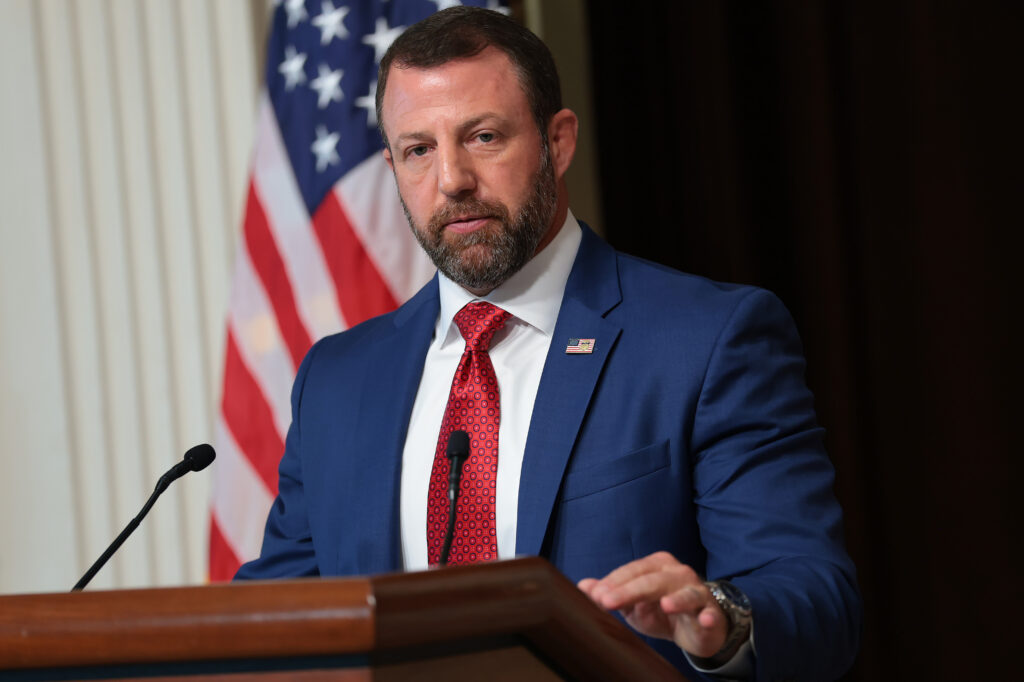
Homeland Security Secretary Markwayne Mullin threatened top election officials in all 50 states and D.C. with criminal charges if they do not comply with the Trump administration’s demands to feed their voter rolls through a flawed federal database.
Mullin’s threats came just hours after President Donald Trump resurrected debunked claims of fraud in the 2020 election during a primetime address as part of his ongoing efforts to undermine U.S. elections before the upcoming midterms.
In its totality, Mullin’s speech amounted to a major escalation in the Trump administration’s attempt to assert federal control over state voter rolls and their election procedures.
Get updates straight to your inbox — for free
Join 350,000 readers who rely on our daily and weekly newsletters for the latest in voting, elections and democracy.
Alongside his threats Friday, Mullin claimed that the database in question had identified over 250,000 noncitizens registered to vote in California, New Jersey, Nevada and Pennsylvania.
At no point during the speech did Mullin specify how DHS obtained those four states’ voter registration data, though many states offer public versions of their rolls for sale or download. He also did not claim that any of the alleged registered noncitizens voted in U.S. elections.
The secretary only said that the department identified the noncitizens using the Systematic Alien Verification for Entitlements (SAVE), a database originally designed to help states check the citizenship status of people applying for government benefits. The Trump administration has now retrofitted it into a broader citizenship check, but critics say the new version is deeply defective and regularly misidentifies eligible voters.
Mullin’s threat came a week after the Department of Justice (DOJ) sent all state election chiefs letters warning they could face criminal prosecution over possible noncitizen voting. The department’s notice angered both Republican and Democratic officials.
Moments before his speech, DHS announced that Mullin also sent letters to the secretaries of state in those states warning them about the alleged noncitizens on their rolls.
In the letter, Mullin also demanded that secretaries of state “respond within two weeks and confirm their intentions to collaborate with DHS in order to ensure free, fair, and honest elections.”
“Pay attention to what Mullin did not provide: any evidence to back up his wild numbers or even an explanation as to where those numbers came from,” Wendy Weiser, a vice president at the Brennan Center for Justice, said in a social media post Friday.
“They are almost certainly false or wildly overstated. This administration has a poor track record with false allegations of election improprieties,” she added.
David Becker, executive director of the Center for Election Innovation & Research, echoed her sentiments.
During a call with journalists Friday morning, Becker said he had attended a White House briefing the previous day during which an official said that the “250,000 noncitizens” figure was based on comparisons with commercial data. Such data is less detailed than voter records, often making exact identifications impossible, Becker explained.
“That 250,000 number is an irresponsible number to share given the opaque methodology that they claimed here,” he said.
In recent months, federal courts have repeatedly ruled that the executive branch has very limited authority to demand access or changes to states’ rolls. Despite those rulings, Mullin threatened that state election officials who do not collaborate with the Trump administration and feed their voter rolls through the SAVE database could face criminal charges.
“The states who choose not to participate with the SAVE program and they choose not to participate in secure elections, we will make sure that we make those states a priority to look at who voted in their states and will hold them, the election officials, accountable,” Mullin said.
Starting with former Homeland Security Secretary Kristi Noem, Trump’s DHS appointees have endeavored to transform the SAVE database into a new system to monitor and directly shape state voter registration lists. And under Mullin, the department has taken several steps to force states to use the database to purge voters from their rolls.
The database, however, has repeatedly falsely identified eligible voters as noncitizens. It particularly falsely flagged naturalized citizens as ineligible to vote.
A federal judge in Washington, D.C., last month barred the DHS from continuing to use the database to surveil and force removals from state voter rolls.
U.S. District Judge Sparkle Sooknanan, who was appointed by former President Joe Biden, found that the Trump administration violated several federal laws in refashioning SAVE into a centralized master citizenship database by pooling the private information of millions of Americans — including Social Security records — held by agencies across the federal government into DHS.
Mullin attacked Sooknanan over her ruling, calling her an “activist” judge opposed to secure elections. He also appeared to conflate the SAVE America Act — a massive anti-voting bill pushed by Trump — with the similarly named database.
“Currently, we’re getting pushback from activist judges that are saying that, hold on, the SAVE Act, or the SAVE program — they are trying to put a hold or a stop to,” Mullin said. “Currently, because of the SAVE program, we have a pending appeal because activist judges are saying, what? They don’t want to secure our elections?”
In her order, Sooknanan warned that the Trump administration “haphazardly” threatened “the sacred right to vote” by adopting the expanded SAVE system knowing that it would falsely flag eligible voters as potential noncitizens.
After falsely alleging that foreign governments can hack voting machines and voter registration systems, Mullin announced that DHS, with the Department of Commerce, would soon make new “security enhancements” on voting machines “mandatory” by conditioning state grants on their adoption.
“If these states want a grant, and they want to be reimbursed to run federal elections, they are going to have to implement security issues, just security issues,” he said. “We’re saying the machines have to be secured and that your voter registration list needs to be scrubbed.”
Mullin’s announcement appears to be separate from the DHS’s new threat to withhold terrorism-prevention funding from states unless they adopt several anti-voting policies, including sending their voter rolls through the SAVE database.