DOJ threatens charges against state officials in voter records fight
Thirty states facing U.S. Justice Department (DOJ) lawsuits over voter records have been ordered to preserve all 2024 election files under a “litigation hold” — or risk criminal sanctions.
“The purpose of this letter is to notify you of your obligations to take reasonable steps to conduct a litigation hold and preserve and retain all hard copy documents and electronically stored information … which may be relevant, or likely to lead to the discovery of admissible evidence,” the DOJ’s letter to the states reads.
The new demand was issued despite the fact that no federal judge has granted DOJ access to voter files in any of the 30 states the agency is suing. The Justice Department is currently 0-23 in its lawsuits against the states and has also lost one in an appeals court.
Get updates straight to your inbox — for free
Join 350,000 readers who rely on our daily and weekly newsletters for the latest in voting, elections and democracy.
Justice Department spokeswoman Kiersten Pels confirmed to The New York Times that they sent the demand letters out to all 30 of “the states we are in active litigation against.”
The letter says DOJ is enforcing election rules under the Civil Rights Act of 1960, but judges have ruled that the civil rights law does not authorize the agency to receive states’ voter files in this manner.
Still, the Justice Department is threatening legal action against the states.
“Your failure to preserve relevant data may constitute spoliation of evidence, which may subject you to civil and criminal sanctions,” the letter reads.
The DOJ’s letter also informs its target states that they are under investigation due to failure to comply with the National Voter Registration Act and the Help America Vote Act for not turning over the unredacted voter files.
However, Utah Lt. Gov. Deidre Henderson (R), who is named in the DOJ’s lawsuit for the state’s voter records, said on social media that she wasn’t aware that her state was under investigation.
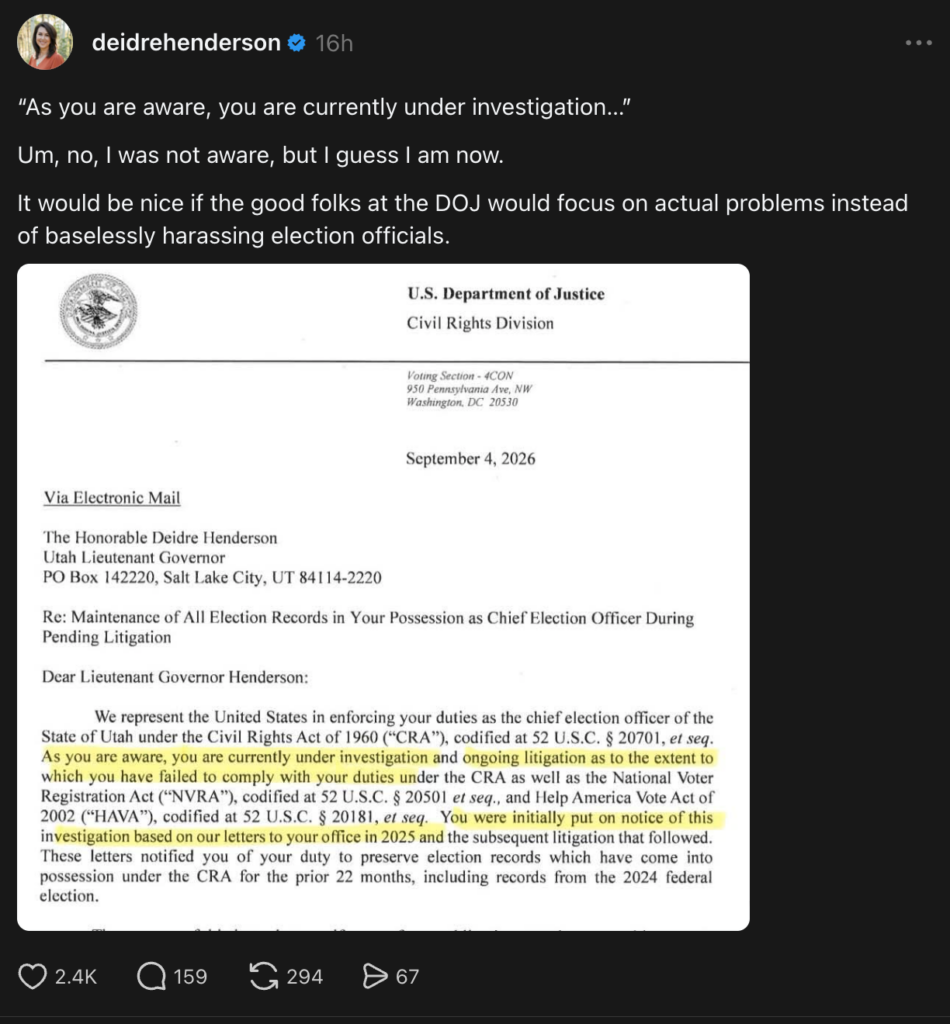
She also told the Salt Lake Tribune that she’s in communication with election chiefs from the other states DOJ sued about the new demand letters.
“If you cared about the security of the elections, you would not be threatening election officials with prison sentences,” she told the paper. “You would not be suing all of us, you would not be investigating all of us constantly.”