Election deniers say an obscure rule on Wi-Fi routers means Trump can decide how votes are counted. Here’s why they’re wrong
 Prefer us on Google
to see more of our voting rights news coverage when you search.
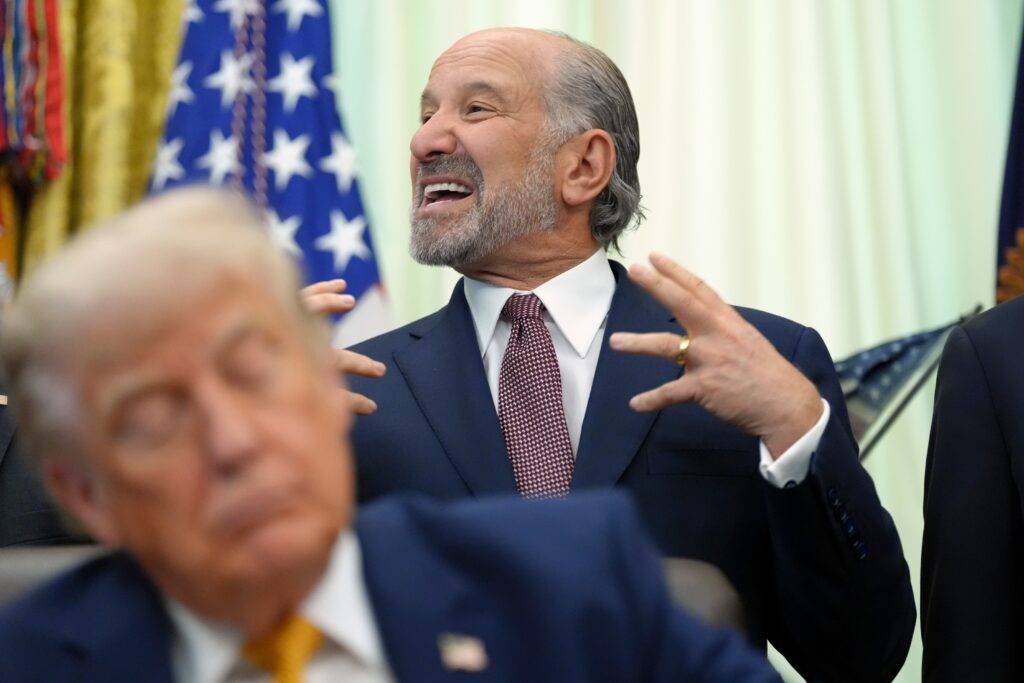
With Republicans facing increasingly dire prospects in the midterms, some of President Donald Trump’s most desperate supporters have urged him to declare a national emergency and seize control of the elections from the states.
But other MAGA allies say that’s not necessary, because — good news! — there already is a national emergency and it empowers Commerce Secretary Howard Lutnick to decide how votes are counted.
The scheme has circulated among election deniers for about a year now. But it cropped up again this week after convicted election denier Tina Peters reportedly discussed it with Trump in an Oval Office meeting. Soon after, anti-voting lawyer Cleta Mitchell promoted the idea on social media.
The convoluted plan rests on a dubious legal theory: that a little-used Commerce Department regulation on “Securing the Information and Communications Technology and Services Supply Chain” that mostly covers Wi-Fi routers and antivirus apps actually authorizes Lutnick to order sweeping changes to voting machine systems and mandate hand counts of ballots across the country.
This plot, however, is riddled with holes, not least of which is the Elections Clause. But even setting those constitutional concerns aside, the theory fails on its own terms: Voting machines probably aren’t included under the anti-hacking regulation. Even if they are, it’s too late for Lutnick to do anything this year given the rule’s slow-moving processes.
And even if it weren’t too late, most voting machines in the U.S. predate the regulation’s effective date, meaning they’re not covered.
Mitchell’s Web
The first string in this tangled web was spun in 2019, when Trump issued an executive order declaring cybersecurity threats from certain foreign adversaries a national emergency. At the time, the order was seen as primarily targeting Chinese cyberespionage and intellectual property theft broadly, and the telecom firm Huawei specifically.
The Commerce Department later issued a rule implementing the order, which was finalized in 2024. It empowered Commerce to review transactions involving “information and communications technology and services” (ICTS) from foreign adversaries like Russia and China that could “pose undue or unacceptable risk.”
While the executive order and that regulation focus on online technologies like cloud computing and internet-enabled devices, they both contain catch-all provisions that cover any “critical infrastructure.” That includes voting machines, Mitchell argues, citing a Department of Homeland Security (DHS) designation from 2017.
And given that almost all voting machines used in the U.S. contain components manufactured in China, Mitchell wants Lutnick to “exercise his legal authority and responsibility to immediately announce and implement a plan to ensure that the electronic voting systems used in the 2026 elections are NOT compromised or manipulated by enemies, foreign or domestic.”
Specifically, she said Lutnick should “heed the call” from Georgia’s GOP-controlled State Election Board and “immediately require the installation of the software upgrades available to close the vulnerabilities identified more than five years ago,” and also order “mandatory, pre-certification manual confirmation hand counts of ballots in 5% of the precincts and central count for each jurisdiction in the country.”
Unfortunately for Mitchell, there are more than a few flaws in that plan, starting with the Constitution, which assigns states the primary responsibility in administering elections.
Get updates straight to your inbox — for free
Join 350,000 readers who rely on our daily and weekly newsletters for the latest in voting, elections and democracy.
“The executive branch does not have power over elections. The founders were very clear about this: Article I, Sec. 4,” said David Becker, the executive director of the Center for Election Innovation & Research. “The Commerce secretary doesn’t have more power than the president. The president has zero power over elections in the United States.”
While Congress can pass laws on the “Times, Places and Manner” of federal elections, it almost undoubtedly did not intend to do so with the International Emergency Economic Powers Act or the National Emergencies Act — the two statutes, along with the president’s general delegation powers, that are cited by the regulation and executive order.
The U.S. Supreme Court, and its conservative justices in particular, has been loath to let federal agencies discover sweeping new authorities from less-than-explicit statutory text. “Congress, we have held, does not alter the fundamental details of a regulatory scheme in vague terms or ancillary provisions,” Justice Antonin Scalia wrote in an oft-cited 2001 case. “It does not, one might say, hide elephants in mouseholes.”
Tina’s Tinfoil Plan
But even if you ignore those structural weaknesses, what Peters calls “the Tina Plan” falls apart upon a cursory review of the regulations she wants Lutnick to deploy.
First, the executive order and rule cover ICTS transactions — not the underlying goods or services, but their purchase and importation. While the regulation broadly defines a “transaction” to include “use,” it has yet to be used to order a recall of already-purchased hardware.
The rule also specifies what constitutes ICTS, listing a number of internet-related technologies, like “mobile networks” and “routers, modems, and any other networking devices.” Although the definition of ICTS includes “critical infrastructure,” a long-standing canon of construction in jurisprudence holds that you give meaning to a word by its surrounding text — which would suggest the rule only covers networking hardware and software used by critical infrastructure to communicate online.
Notably, voting machines generally cannot connect to the internet.
That said, the text of the rule is quite broad, as industry observers have noted. In a public comment ahead of the rule’s finalization, the Motion Picture Association and Independent Film & Television Alliance worried the text was so expansive, it could arguably cover movies and TV.
“While [we] understand that the Proposed Rule is not intended to target the core business of the film and television industry,” the trade groups wrote, “we are concerned that the Proposed Rule is so broadly written that it would unintentionally sweep within its jurisdiction countless transactions that the industry undertakes every day.”
Still, it’s clear that the rule’s regulatory concern is a foreign adversary exporting hardware or software with hidden security vulnerabilities to facilitate hacking and the theft of U.S. intellectual property.
That’s reflected in the only two instances the regulation has been invoked so far. In 2024, Commerce put the kibosh on buying or licensing antivirus software and cybersecurity products from Kaspersky, a Russia-based antivirus software and cybersecurity company, because the “manipulation of Kaspersky software, including in U.S. critical infrastructure, can cause significant risks of data theft, espionage, and system malfunction.”
In 2025, Commerce imposed some limitations on the import and sale of “connected vehicle technology” — driverless cars — from Russia or China, although those only kicked in for model year 2027.
A third proposed rule on unmanned aircraft has been in the works for more than a year now, which highlights another problem with the election denier’s legal theory: It’s simply too late.
Election Day is 25 days away. Before Lutnick can take any public action, the regulation requires that he first coordinate with other federal agencies, giving them 21 days to respond to a proposed “Initial Determination” that a specific technology from an unfriendly country poses a real risk to the “critical infrastructure or the digital economy of the United States.”
Even assuming that Commerce already took those steps, it’s still too late because the “Initial Determination” doesn’t authorize the kind of “measures to remediate or mitigate the risks” that Mitchell and Peters want Lutnick to impose. That doesn’t happen until there is a “Final Determination.” And between the two determinations, the impacted parties get at least 30 days to respond.
So even if Lutnick served notice today that he was going after voting machines, it would be too late to force any changes ahead of the midterms.
And that’s not the Tina Plan’s only timing problem. The regulation’s effective date is Jan. 19, 2021. Most of the voting machines used across the country were purchased before then. Georgia, for example, first deployed its Dominion scanners in 2020.
As with the other hitches in the scheme highlighted here, one could try to explain this one away — that the broad definition of “transaction” includes “use,” and that means state and local election officials are still “transacting” today with voting machines they purchased a decade ago.
But to accept that interpretation — and all the others necessary to make the plan actionable ahead of Election Day — would require buying into a Russian nesting doll of specious constitutional, statutory and regulatory legal arguments.
That may work in the minds of election deniers, but it’s unlikely to work out in the real world.