Could Trump take over voting by declaring a ‘national emergency’?
 Prefer us on Google
to see more of our voting rights news coverage when you search.
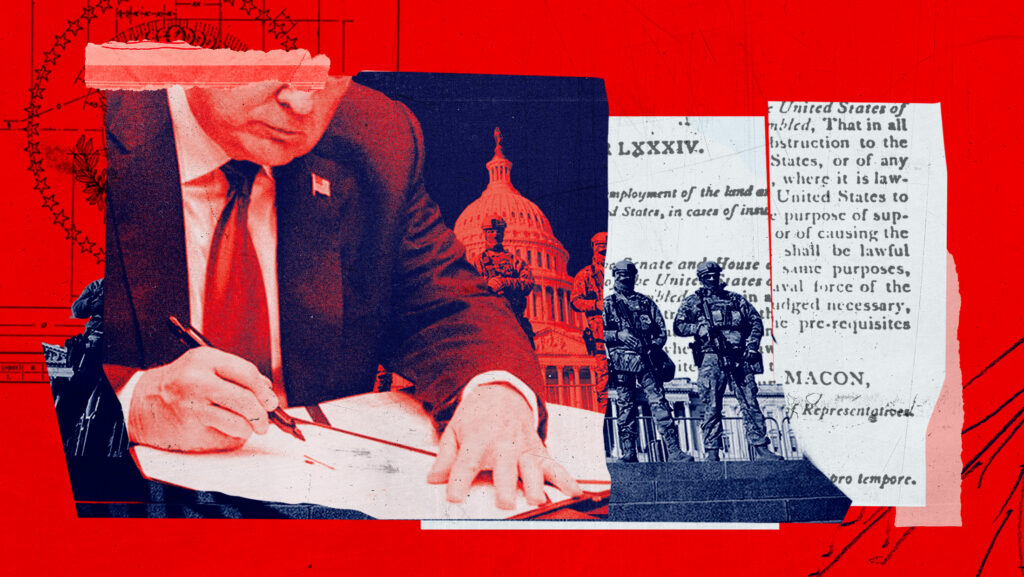
When lawyer and conspiracist Peter Ticktin appeared on far-right commentator Wayne Allyn Root’s podcast on Sept. 16, he made an alarming suggestion: President Donald Trump needed to seize control over elections from the states.
Trump is “going to have to declare martial law,” he said. “That’s the only thing that can happen.”
Voting machines had been compromised by America’s foreign adversaries, who were colluding with the Democratic Party to rig the midterms, Ticktin claimed, echoing longstanding conspiracy theories. An election takeover, he argued, was the only way for Republicans to win.
Though not an administration official, Ticktin is part of a growing MAGA chorus that wants Trump to declare a national emergency and take over elections. And Trump has hinted before about trying it — a risk that increases as the midterm forecast grows worse for Republicans.
In a recent interview with Time, Trump would not rule out declaring a national emergency or invoking the Insurrection Act to try to take control of voting in the midterms.*
It’s difficult to overstate how dangerous such a declaration would be for American democracy. It would mean a president is attempting to sidestep the Constitution, which empowers states to run elections, in order to prevent his party from losing.
To be sure, the emergency declaration likely wouldn’t accomplish what Trump wants it to.
There is “no federal statute — of all those 50 statutes that deal with national emergencies, none prescribe any powers to the president over elections,” election expert Rick Hasen told The New Republic in August.
Still, even if it had little legal or practical impact in empowering Trump, voting advocates worry that such an order could suppress voting nonetheless.
The real concern over an emergency order, Max Flugrath, a spokesman for Fair Fight Action, told Democracy Docket, is the “chaos it could cause — confusing voters, deterring people from the polls, and laying groundwork to dispute the results.”
David Becker, the executive director of the Center for Election Innovation & Research, sounded a similar note.
“It is really destabilizing to see people who violate their oath of office by even considering or speaking about such a thing,” Becker told Democracy Docket.
Get updates straight to your inbox — for free
Join 350,000 readers who rely on our daily and weekly newsletters for the latest in voting, elections and democracy.
Pushing a bad idea
Illegality aside, the people pushing the emergency declaration claim to have Trump’s ear.
Rumors first surfaced in February that a coalition of anti-voting activists — including Ticktin and conspiracy theorist Jerome Corsi — was coordinating with White House officials to pressure Trump to sign an emergency elections order. They had even circulated a draft version of the potential order.
That draft, which Ticktin previously said was based on a debunked theory that China manipulated votes to help former President Joe Biden win the 2020 election, called for Trump to unilaterally outlaw mail ballots and ban voting machines because they are supposedly susceptible to foreign interference.
Since then, other notable right-wingers have claimed during podcast and media appearances that they are advocating for the president to take over voting — whether that means banning voting machines, limiting mail voting, or something even more drastic.
When Trump called into Root’s show in August, the TV host pushed the president to use an emergency order to limit mail voting and require proof of citizenship and voter ID to cast a ballot.
“Let me put an idea in your head, okay? You have the right to declare a national security emergency for elections,” Root said, before outlining a convoluted, deeply questionable legal argument in support of such a declaration.
Trump signaled an openness to such a move.
“Let me just say stranger things have happened,” the president said. “I’ll leave it at that.”
In the weeks since that interview, the Supreme Court has blocked the U.S. Postal Service from imposing restrictions on mail voting outlined in Trump’s executive order from March.
But not all versions of the plan focus on mail ballots.
Another prominent backer of an emergency declaration is former Overstock CEO Patrick Byrne, who played a role in trying to help Trump overturn the 2020 election and maintains a close relationship with the White House. In April, he said that Trump should announce a national emergency to “run our election this year … and teach them how to run them in Iraq.” He later added that he hoped the president would declare an emergency “this summer.”
Tina Peters — the former GOP Colorado county clerk who was convicted for her role in a 2021 voting system breach — has also used her platform to push Trump to declare a national emergency. Since being released from prison in June, she has personally met with the president, along with other senior administration officials, and continued to spread conspiracies about voting.
Specifically, Peters suggests the Trump administration can ban voting machines and believes (wrongly) that the Department of Commerce can exert regulatory authority over ones with foreign-made components under an executive order from Trump’s first term that regulates how information and communications technology developed by foreign adversaries is used domestically.
But with Election Day rapidly approaching, election deniers are becoming increasingly worried that the deadline for Trump to take action has passed.
Instead, they’re shifting their focus to what Trump can do in the post-election period. That’s where Ticktin’s proposal comes into play.
Were Trump to declare martial law, he’d do it sometime around Election Day on Nov. 3, Ticktin recently told The Atlantic. That would give the Trump administration the power to seize voting machines in key races that could determine control of Congress.
“There’s got to be a hand count,” Ticktin said in an interview with Root. “We can use the machines as long as we have an audit and hand count of the ballots before certification. That’s something that there’s still time to do.”
Using an emergency declaration to seize voting machines would be even worse than simply trying to take control of election administration: It would invariably cause chaos as Americans vote and could lead to ballots going uncounted.
Fantasy or reality?
Though alarming, any attempt to declare a national emergency and take over elections would face a serious problem: It would never pass constitutional muster, virtually all legal scholars and voting rights advocates agree.
“Courts have made clear that the president has no power to control elections, and a fake emergency can’t change that,” Flugrath said.
It’s unlikely that any state would even entertain Trump’s attempt to take over voting, Becker noted.
“If the president were willing to violate the Constitution by purporting to declare a national emergency, or use some other mechanism to try to take over the elections, or postpone or cancel the elections, the first thing that would happen is the states would say, ‘Good luck with that,’” he said. “Because the federal government doesn’t run elections.”
But that doesn’t negate the chaos it would cause. Therein lies the risk.
“Add in DOJ monitors, the RNC’s new focus on voting machines, and the 2020 lies coming from our government — the chaos is the point,” Flugrath said.
This story has been updated to include additional information.