North Carolina early voting begins, with students targeted by suppression schemes
 Prefer us on Google
to see more of our voting rights news coverage when you search.
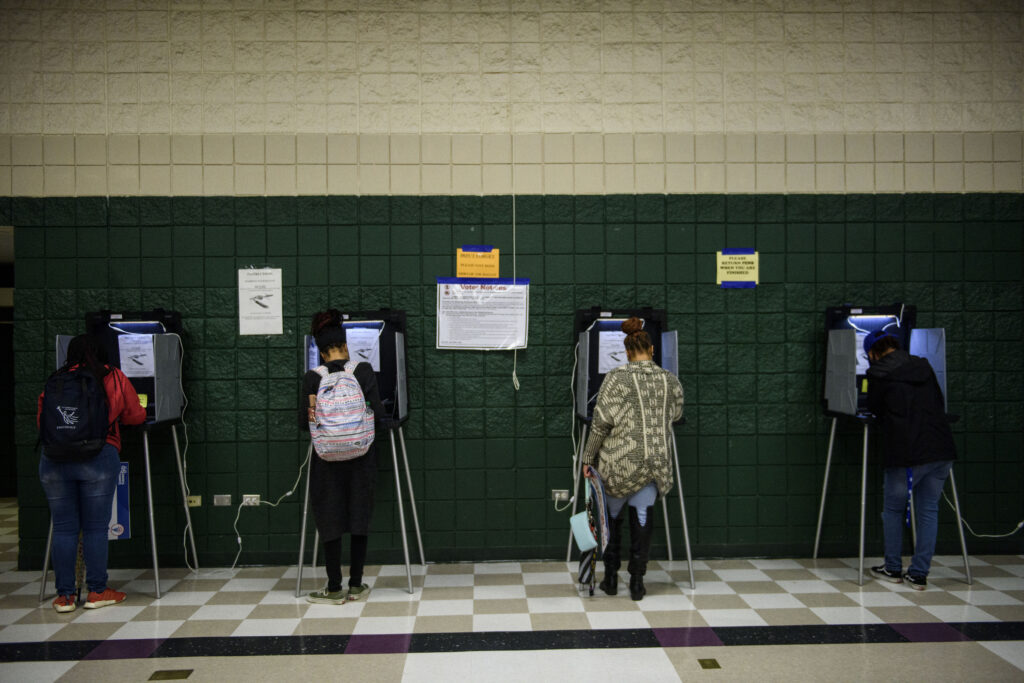
This summer, Shia Rozier watched her state’s top election officials vote against a polling place on her university campus — again. Sitting front row, she held a sign. It showed the distance, over a mile, between North Carolina A&T University and the closest place to vote off-campus.
Rozier got up at 4 a.m. and skipped class to attend the August board meeting. She stood up when Board Chairman Francis X. De Luca asked who in the room went to A&T. She sat, mouth open, when De Luca voted with the board’s Republican majority to cut her voting site.
Carolyn Bunker is one of two Democrats on the Guilford County Board of Elections, which initially voted against the University’s site before it was brought to the state board for reconsideration. She came to the meeting to advocate for students and said she witnessed De Luca multiple times threaten students with removal and arrest for asking why he voted against their site.
“To say ‘Hey, I’m gonna look you in the eye when I tell you no again,’ I think that’s a bit more painful than just ignoring our efforts,” Rozier recalled. “To acknowledge them and then to continue to dismiss them … It almost felt humiliating.”
The vote marked the second time the North Carolina State Board of Elections (NCSBE) denied students at the nation’s largest historically Black university, with over 15,000 students, a midterms voting site.
Get updates straight to your inbox — for free
Join 350,000 readers who rely on our daily and weekly newsletters for the latest in voting, elections and democracy.
Now, as early in-person voting begins across the battleground state, Rozier and some of her classmates will walk up to 45 minutes on a dirt path, across train tracks and through debris, to cast their ballots. Others will take shuttles. Most don’t have cars.
Voters across the nation face hurdles this fall. But in North Carolina, voting restrictions are embedded in the very fabric of the state, according to nearly a dozen voters, experts and election officials who spoke to Democracy Docket for this story.
Terence Everitt, a former Democratic state senator and now head of the North Carolina Voter Protection Alliance, said the state has been in the business of democratic backsliding since Republicans took hold of the legislature over 15 years ago.
“For me at least, voter suppression started long ago with this gerrymandering,” Everitt said.
Gerrymandering fractured students at NC A&T, for a time, into two separate congressional districts.
And this fall, the suppression has taken hold in new ways. NCSBE cut poll sites like Rozier’s, slashed Sunday voting hours in half, made it easier to reject mail ballots and has mailed batches of letters to thousands of people with conflicting information about their voting eligibility.
Ultimately, voters described the roadblocks as a feature, not a bug, of the state’s electoral system — one that’s littered with so much confusion that some may decide to stay home and not vote at all.
But Rozier and others said now is not the time to stop fighting.
“You might not do politics, but politics sure do be doing you,” Rozier said. “And it’s just a matter of what you’re doing about it.”
Voters pleaded for their poll sites. The board cut them anyway
The same day the NCSBE denied Rozier her campus voting site, they overhauled county poll site maps and significantly reduced Sunday hours across the state.
The move came after a massive voter opposition campaign. North Carolinians flooded board members’ inboxes, urging them not to erase critical poll sites. Bunker, of the Guilford County Board of Elections, received 65 emails in her inbox alone.
Students, attorneys, pastors, professors and social workers pleaded with the board to salvage voting access. Many described themselves as lifelong North Carolinians.
Some letters had specific requests, describing essential access points for voters without transportation or those with mobility constraints.
“Please do not take away the early voting sites for Guilford County/Greensboro Southside area. This would be devastating to elderly chronically ill people as myself,” Mildred King, 85, wrote.
“I am writing to ask you keep Washington Terrace in High Point as an Early Voting Site. I vote there and I know it is terribly important to the community,” another email, this one from Rev. Robert Travis, reads.
Others hit on the issue of democracy at its core.
“Haven’t we all come to see democracy depends on voting, and aren’t we done with Jim Crow laws?” Stephanie Benson, who identified herself as a voter of 50 years, wrote.
Although Washington Terrace was retained, the letters weren’t enough to convince the board entirely, which voted largely along its 3-2 party lines to slash voting access. Proponents of the cuts pointed to lacking resources and claimed the decision would not disenfranchise voters because there are still many poll site options.
Indeed, North Carolina will have more early voting hours this year than in 2022, according to a data analysis from Western Carolina University professor and prominent political analyst, Chris Cooper.
But this does not mean there are enough poll sites for all voters. Critically, voting site increases are not proportional to population growth across the state, which has gone up by 5.3% over the past four years. Poll site hours, in contrast, have increased by less than half that rate, at 2.4%.
And when it comes to Sunday voting, the numbers are clear. Only 17 counties will have at least one Sunday voting location, compared to 40 that had at least one Sunday voting location in 2022. In short, Sunday voting hours were more than cut in half.
One Anson County board member reasoned against Sunday voting because of his own religion, and because Chick-fil-A isn’t open that day. The argument left even Republican board members stunned and reminding him the country has no national religion.
And for generations of Black voters, faith and democratic participation are intrinsically intertwined. State Sen. Jay Chaudhuri (D) warned the cuts directly signal disenfranchisement during a call with reporters earlier this month.
“Souls to the polls is not a loophole; it is a tradition of faith,” Chaudhuri said. “And removing Sunday hours takes that option from Black churches and from every other voter who depends on it.”
Mail ballot requests plummet following last-minute restrictions
Lyn McCoy is a Guilford County resident and one of the over five dozen people who emailed her board, concerned about cuts to voting sites in predominantly Black neighborhoods.
Setting up for a voter engagement event at her home in Greensboro, McCoy told Democracy Docket about her midterm fears, running through a list of concerns from voter roll data tampering to troops at the polls. When asked how she would be voting, McCoy said it would never even occur to her to vote by mail, out of fear her ballot would be spoiled and rejected.
McCoy isn’t alone in this.
Over a month into mail voting, ballot requests are down nearly 33% from the same time this year in 2022, according to Tuesday morning data from NCSBE. While the decrease can not be entirely attributed to the new rules, hesitation like McCoy’s is likely contributing.
Pat, who asked Democracy Docket not to share her last name because she fears threats as a result of her advocacy efforts, shared similar fears. She outlined what she called the “six ways you can screw up the ballot.” Some are new, while others have been making voting harder for years.
Because of an eleventh-hour board vote the same day ballots were sent out in September, voters must seal their ballots in a new way and cannot rely on friends or neighbors to help them, with exceptions for voters with disabilities. The rules are currently being litigated* in federal court, with voting rights groups condemning them as “arbitrary disenfranchisement.”
One of the rules requires voters to seal and sign an inner envelope, as well as the outside envelope.
“If you’re old and have arthritis or rheumatism and you have tremors, it’s almost impossible to get the inside into the outside,” Pat said. “It’s like an eighth of an inch difference.”
Pat said she’s urging voters to tape the envelope to ensure it stays closed.
While it’s not new this year, North Carolina also requires two witnesses or a notary to vote by mail. It’s one of eight states with a witness signature requirement. Having cured ballots herself since 2020, Pat said she once saw a ballot get rejected because a voter left off the ZIP code for one of their witnesses.
The ballot also requires three first-class mail stamps that are 82 cents each, a “poll tax” by Pat’s account. She speaks about voting access in North Carolina, on weekly national Zoom calls with other activists, as a cautionary tale.
“I tell people, if you want to learn how to cheat, if you want to learn how to gerrymander, if you want to learn how to stop absentee voting, come to North Carolina,” Pat added. “We are the poster child for all this stuff.”
Siobhan Millen, a Democrat on the NCSBE, said in September that some local election officials told her up to 3% of ballots could be rejected as a result of the new envelope sealing requirement.
That reality is taking hold in Wake County. Board Member Gerry Cohen said of the 1,604 ballots received and counted so far this week, 47 had to be discarded.
“Three weeks in a row that exactly 2.5% of absentee voters failed to seal inner envelope,” Cohen wrote in a social media post.
And in Guilford County, the latest data shared with Democracy Docket similarly reveals a rejection rate — north of 2% for the past three weeks. Since Sept. 29, 20 ballots were rejected because the inner envelope was not properly sealed.
The NCSBE did not respond to Democracy Docket’s questions about how many absentee ballots have been spoiled or rejected so far across all counties in the general election.
The state won’t stop sending letters with conflicting information
Since cutting a deal with President Donald Trump’s Department of Justice, North Carolina has been flooding voter mailboxes with confusing letters — asking them to include additional identification information or risk casting a provisional ballot. Other voters received letters from an entirely separate state campaign to “repair” voter registration records.
Some voters received at least three letters, all providing different and, in some cases, conflicting information about what action voters needed to take and whether or not their responses would impact their ability to vote.
“People do get worried when they get those letters, especially elderly folks in the eastern part of the state,” Millen told Democracy Docket earlier this month.
Then, just this week, NCSBE said it’s sending letters to notify 1,392 registered voters marked by the Systemic Alien Verification Act (SAVE) database as potential non-citizens. The letters instruct voters to “voluntarily request removal from the voter rolls” or send in information that proves they are a U.S. citizen.
It’s not yet clear what will happen if a voter who receives one of these letters does not respond with the requested information.
And SAVE is notoriously inaccurate. Texas, the first state to enter the system, found 2,724 potential noncitizens through SAVE, a number later found to have at least a 21% error rate.
Meanwhile, 31,582 ballots have already been cast in North Carolina, as of Thursday.
Rozier, the student activist, said she’s all too familiar with the state’s deliberate confusion. She spent over an hour reviewing her sample ballot with a professor the first time she received it in the mail.
“So after you finish getting through your poll tax and you find your way to the polls and you walk 45 minutes there, now you have to go put on your PhD-level thinking cap in order to be able to even understand what the heck they’re talking about on your ballot,” Rozier said.
This year, the ballot is two pages long. It includes three amendments that multiple voters said they believe are deliberately vague.
Voters have until Oct. 20 to request a mail ballot and until Nov. 3 to return it. Early in-person voting runs through Oct. 31.
*The Elias Law Group (ELG) represents plaintiffs in this case. ELG firm chair Marc Elias is the founder of Democracy Docket.