North Carolina ballot rejection rate up to 6% with time to fix errors running out
 Prefer us on Google
to see more of our voting rights news coverage when you search.
North Carolina’s mail ballots face rocketing rejection rates — 5.85% of all ballots counted in the state’s 2026 midterms will not count if voters fail to take mandatory extra steps.
The rising rates follow the state GOP’s decision to implement a new envelope sealing rule. A majority of rejections are coming from the rule in large counties.
There are 3,672 ballots currently at risk, and some of the state’s most rural counties have rejection rates ranging from 16% to 30%. That’s according to newly released statewide data, compiled and analyzed by Common Cause North Carolina, which comes as the clock is ticking on ballot counting.
“The nearly 6% rate really translates into thousands of ballots that could make the difference in many key races here in the state, local and statewide,” Common Cause North Carolina’s State Director Sailor Jones told Democracy Docket.
The state has competitive races up and down the ballot, including a hotly contested U.S. Senate seat Democrats hope to flip.
Get updates straight to your inbox — for free
Join 350,000 readers who rely on our daily and weekly newsletters for the latest in voting, elections and democracy.
The statewide rejection rate represents those deemed “problem ballots,” flagged through Oct. 24. These include ballots that have been spoiled, those that are curable and those already cured, or fixed, by the voter. But a majority — 67% — of all the problem ballots have been spoiled.
In these instances, voters have to “start all over again,” as Jones put it. “And while it’s possible to fix or cure many of these ballots before the state deadline, many of these voters shouldn’t have had to.”
While comprehensive categorical data is not yet available, county monitors across the state report the newly instituted GOP-led rule — that an inner envelope with a voter’s ballot is fully sealed inside an outer envelope — has caused many of the rejections. A breakdown of rejection data from some of the state’s largest counties, including Wake and Guilford, supports this finding.
Notably, the envelope seal problem causes a spoiled ballot — one that is thrown out. That means voters cannot simply fix their ballot by submitting an attestation form, or “curing” it. They must instead submit an entirely new ballot or, alternatively, vote in person. These new ballots must get to an election site by 7:30 p.m. on Election Day.
With Nov. 3 less than a week away, time is running out. Voters can track the status of their mail ballot with the state’s BallotTrax site, but it’s also up to election officials and the U.S. Postal Service to deliver information on time.
“Anytime after October 30th is really this purgatory for fixing these ballots because you’re very reliant on the mail to do so,” Jones explained.
In Wake County, election data shared with Democracy Docket shows inner envelope problems were the culprit in 53% of all ballot rejections. In another large Democratic stronghold, Mecklenburg, local reports show hundreds of ballots rejected because of an inner envelope seal.
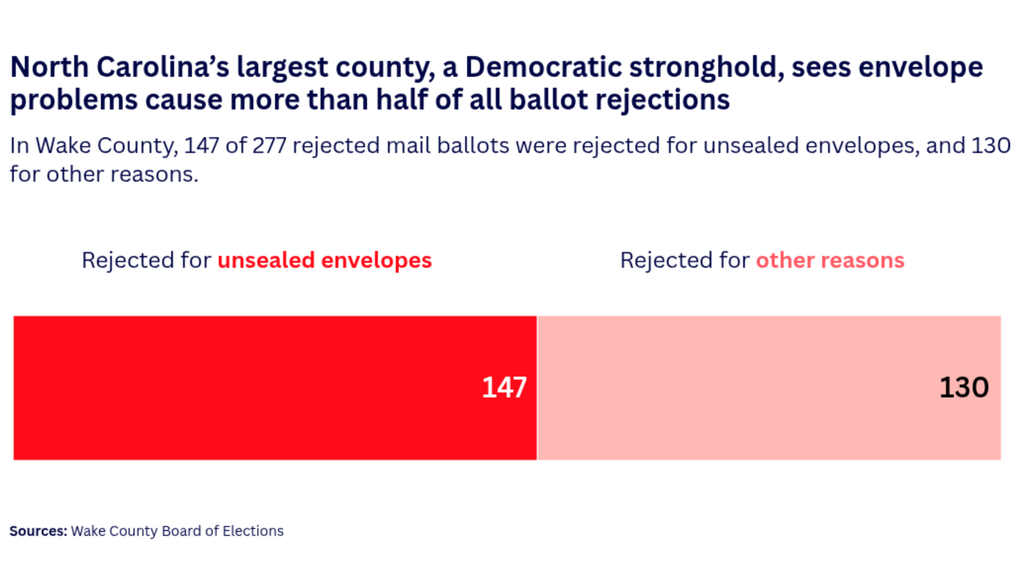
Jones said Wake County reveals the scope of the problems, where Deputy Director Spencer Berg told Democracy Docket that he has seen some voters have to resubmit their ballots four to five times over.
“It’s the largest county of urban population, great access to Wi-Fi and broadband, and those folks are still struggling to get those votes in and get those votes corrected,” Jones said. “So what hope do people in rural hubs with very little broadband access and lower information channels, fewer media resources, have to correct their ballots?”
Lacking access, rejection rates in many rural counties have soared. Anson County, with a population of around 20,000 near the border of South Carolina, has had problems with 33.3% of all ballots counted.
Some of the highest rejection rates can be seen in the Black Belt of the state, with a denser population of voters of color. Rejection rates are 21.4% in both Hertford and Northampton, rural counties with voters of color representing more than half of all those registered. Bertie and Robeson counties also have rates in the double digits.
“This is not simply an area that can be characterized as low information because people want the information to cast their ballot,” Jones said. “But in some cases, they’re simply not able to access that.”