North Carolina mail ballot restrictions will cause ‘arbitrary disenfranchisement,’ new lawsuit warns
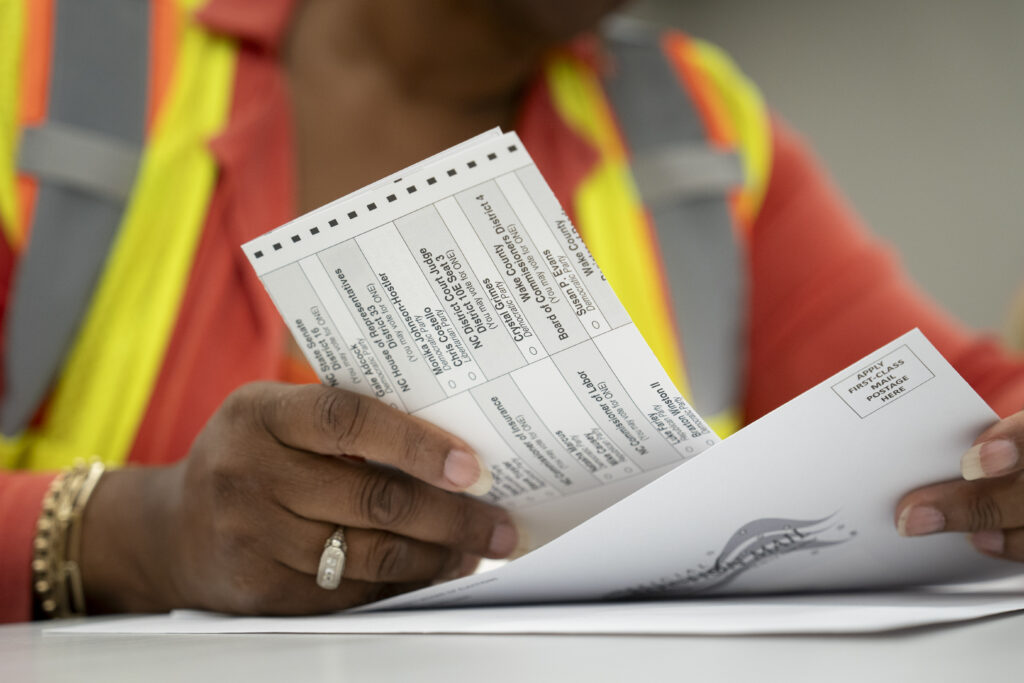
North Carolina’s last-minute restrictions on absentee ballots will lead to “arbitrary disenfranchisement,” pro-voter groups* argue in a lawsuit filed Tuesday.
The tighter rules around envelope errors and voting assistance “will inevitably disenfranchise scores of North Carolina voters,” the North Carolina Alliance for Retired Americans, North Carolina Asian Americans Together, Down Home North Carolina and two individual voters argue in the lawsuit.
Absentee voting has already begun in North Carolina with 81,389 mail ballots requested and 7,247 already returned, according to data from the University of Florida’s Election Lab.
Get updates straight to your inbox — for free
Join 350,000 readers who rely on our daily and weekly newsletters for the latest in voting, elections and democracy.
On the same day ballots were to be sent out, the North Carolina State Board of Elections voted along party lines to pass two new absentee ballot memos, skirting the typical legislative review needed to pass such rules and ignoring significant public dissent.
The first enacted stricter requirements for envelope errors. If an absentee ballot’s outer envelope is properly sealed, but the inner envelope is mistakenly unsealed, the vote will not count. In doing so, pro-voting groups argue the Board instituted a signature verification requirement by requiring that election officials check a voter’s signature on an inner envelope against existing voter signatures.
The Board also limited who can help voters submit ballots, allowing only a “voter’s near relative or legal guardian” to assist with voting.
The pro-voting groups argue those changes, particularly the signature verification requirement, will lead to varied enforcement across counties, will cause potential disenfranchisement and violate the Voting Rights Act and the Constitution.
“The state-sanctioned free-for-all will inevitably subject ballots to varying scrutiny between and within counties — resulting in unequal treatment of voters and arbitrary disenfranchisement,” plaintiffs wrote.
*The Elias Law Group (ELG) represents plaintiffs North Carolina Alliance for Retired Americans, North Carolina Asian Americans Together, Down Home North Carolina, Vaeme Afokpa and Raquel Nelson in this case. ELG Firm Chair Marc Elias is the founder of Democracy Docket.