Leading elections expert says Trump’s mail voting restrictions will create ‘massive chaos and confusion’
 Prefer us on Google
to see more of our voting rights news coverage when you search.
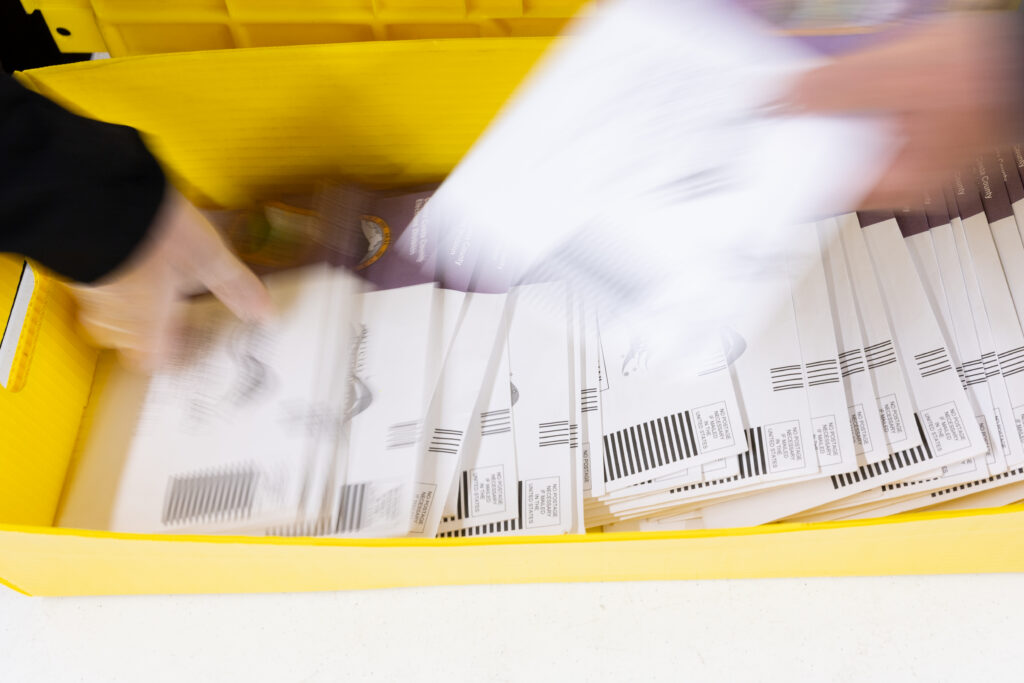
President Donald Trump and the U.S. Postal Service risk unleashing “massive chaos and confusion” by implementing expansive mail voting restrictions weeks before the upcoming midterms, a widely respected elections expert said in a new court filing.
Tammy Patrick, a senior official at the National Association of Election Officials who has over 20 years of experience in administering elections, said that neither states nor USPS itself can feasibly comply with the mail voting requirements that the Trump administration is pursuing.
The dynamic threatens to jeopardize mail voting procedures and leave hundreds of thousands of voters unable to cast a mail ballot through no fault of their own, she said in a court declaration in support of a pro-voting lawsuit seeking to block USPS’s new restrictions before November.
“I foresee disastrous consequences for the 2026 election if election offices cannot comply with these requirements,” Patrick, an expert on election mail, warned. “It is my expert opinion that election officials, their service providers, and USPS do not have sufficient time or resources to implement the Rule for the 2026 General election.”
Get updates straight to your inbox — for free
Join 350,000 readers who rely on our daily and weekly newsletters for the latest in voting, elections and democracy.
Patrick’s declaration came just days after the Supreme Court’s conservative-appointed majority lifted a lower court order against Trump’s March 2026 executive order seeking to restrict mail ballots, a form of voting he has falsely claimed is fraudulent.
After the Court lifted the order, USPS adopted new regulations — based on Trump’s order — requiring states to alter the envelopes they use to send ballots to voters, assign unique identifying barcodes to those envelopes and give the federal government a list of people who intend to vote by mail.
If states do not comply with those requirements, USPS would in turn refuse to deliver ballots to voters in those states.
Democrats, over a dozen states and several pro-voting groups are now challenging USPS’s new rule.
In those lawsuits, the Department of Justice and USPS have claimed that the agency isn’t attempting to control election procedures through the new regulations. Instead, they have asserted the changes are meant to standardize election mail and ensure that only eligible voters cast mail ballots.
Patrick, however, said the new rule represents a “dramatic shift” in the Postal Service’s role in elections, transforming it from a neutral carrier of the country’s election mail into an elections administrator.
“The Rule is unprecedented and upends the longstanding division of responsibility between election officials and USPS, in which election offices determine who is eligible to receive a mail ballot for the USPS to deliver,” Patrick said.
In a separate court filing, Patrick also analyzed a bombshell whistleblower report on USPS’s efforts to implement the new rule and build an online portal to collect states’ absentee voter lists and check their mail voting envelopes.
In it, the anonymous federal official claimed the Postal Service’s new system remains “astonishingly untested” and will likely result in innumerable bureaucratic mistakes and thousands of mail ballots undelivered.
The whistleblower was especially alarmed by USPS’s complex plan to verify mail ballots before they are sent out to voters. If just one error arises during the verification process, thousands of ballots could be sent back to state election officials and ultimately could go undelivered, the official said.
Patrick noted that USPS did not detail several aspects of the crucial verification step in the rule it adopted last week. She said the omission was “consistent with my conclusion that USPS has not provided election officials with sufficient information to implement the Rule.”
In addition to being “incredibly time-consuming and impos[ing] demands that many election offices cannot meet,” Patrick said that process would “create additional points at which ballot mail could be delayed or rejected before entering the mailstream, despite being compliant with all relevant State election laws.”
“The Report corroborates my opinion that election offices cannot reasonably be expected to satisfy these new requirements in time for the 2026 general election without the proper technical specifications, clear instructions, tested systems, and adequate training of staff,” she added.
Patrick’s declarations were entered in support of a lawsuit against USPS’s new rule by a coalition of voting-rights organizations led by the League of Women Voters of Massachusetts.
Last week, the federal judge overseeing that case and a separate suit filed by 24 Democratic-led states and Washington, D.C., issued a temporary 14-day restraining order barring USPS from forcing all states to change their mail voting procedures and submit their absentee voter lists to the federal government.
The pro-voting groups and states are currently seeking a preliminary court order against the rule, and a federal judge will hear their arguments and the DOJ’s defense of the rule in a pivotal hearing in Boston Thursday.