Deputy attorney general endorses sending ICE agents to voting sites
 Prefer us on Google
to see more of our voting rights news coverage when you search.
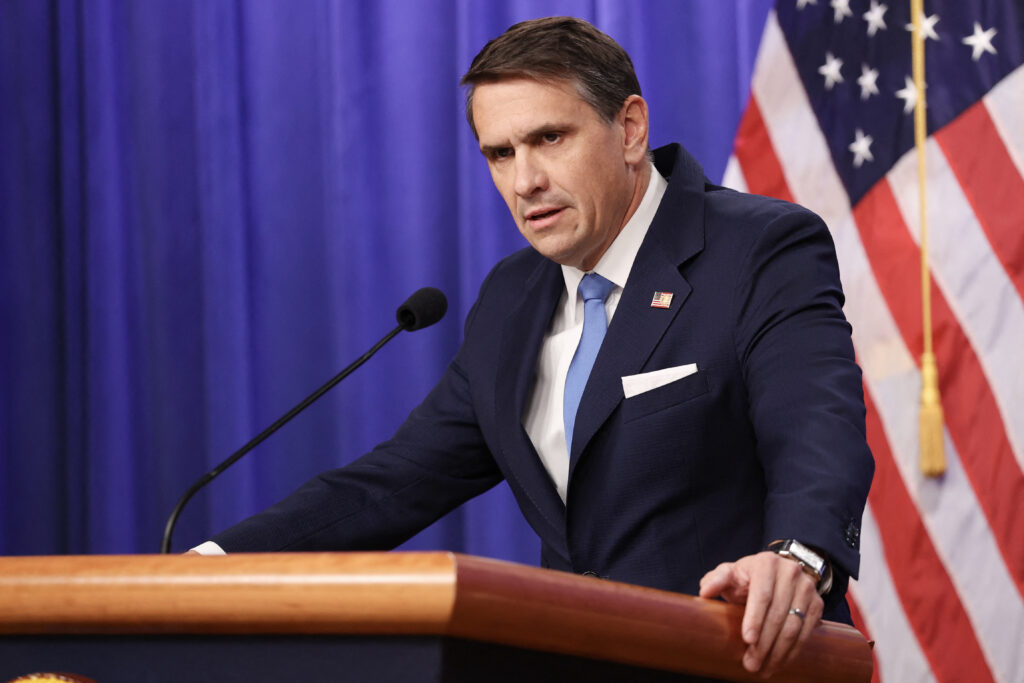
During a norm-shattering appearance at a conservative political conference Thursday, Deputy Attorney General Todd Blanche said he couldn’t understand why anyone would disagree with a president deploying federal agents to the polls.
Speaking at the Conservative Political Action Conference (CPAC), Blanche was echoing recent calls from far-right activists for President Donald Trump to deploy Immigration and Customs Enforcement (ICE) agents to voting sites during the 2026 midterms — a tactic clearly meant to intimidate voters and poll workers and influence election outcomes.
Get updates straight to your inbox — for free
Join 350,000 readers who rely on our daily and weekly newsletters for the latest in voting, elections and democracy.
Blanche, the second-highest-ranking official in the Department of Justice (DOJ), downplayed concerns over ICE agents patrolling voting sites, even though federal law bars the deployment of federal troops or armed federal law enforcement to any polling place unless “such force be necessary to repel armed enemies of the United States.”
“Why is there objection to sending ICE officers to polling places?” Blanche, one of Trump’s former personal attorneys, said during a stage interview. “Illegals can’t vote. It doesn’t make any sense.”
With his comments, Blanche is now the most prominent Trump official to voice support for federal immigration officers patrolling polls.
The White House and leaders of the Department of Homeland Security (DHS), which oversees ICE, have repeatedly said there are no plans to send federal immigration officers to the polls. However, they have never definitively ruled out the tactic.
When CPAC chair Matt Schlapp baselessly claimed that noncitizen voting is widespread in the U.S., Blanche agreed with him — even though numerous studies and voter roll audits have shown that vanishingly few noncitizens attempt to register, and fewer still try to vote.
“Well, amen. That’s right,” Blanche said before praising the DOJ Civil Rights Division’s crusade to obtain states’ unredacted voter rolls. The DOJ has sued 29 states and D.C. as part of the effort, which is based on false claims of widespread illegal voting.
“We are fighting a judiciary, and we are fighting in blue states that don’t want this and that say, ‘No,’” Blanche said.
“And you can ask yourself why, but I think the answer is obvious,” he added, insinuating that states have only opposed the DOJ because they seek to promote noncitizen voting.
Both Republican- and Democratic-led states have opposed the DOJ’s efforts over privacy concerns and because the Constitution does not give the executive branch authority to administer elections.
Blanche’s appearance at CPAC’s annual conference broke with decades of internal DOJ policy.
In the past, department officials — especially top political appointees — were prohibited from attending partisan political events, even in their personal capacities. However, Attorney General Pam Bondi, another one of Trump’s former attorneys, rescinded many of those restrictions earlier this year.