‘Bulls**t’: Nevada election chief blasts Trump’s noncitizen voter roll claims after DHS walks them back
 Prefer us on Google
to see more of our voting rights news coverage when you search.
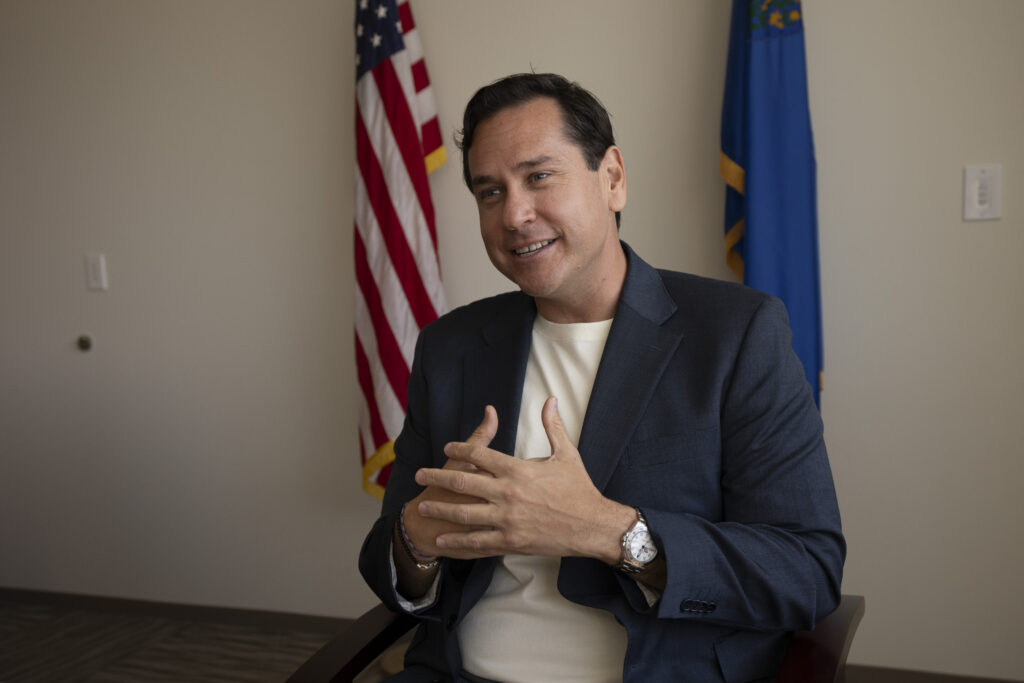
Nevada’s top election official called the Trump administration’s effort to police state voter rolls “bulls**t” after the Department of Homeland Security (DHS) walked back claims recently amplified by President Donald Trump that thousands of noncitizens were illegally registered to vote in the battleground state.
In a private Aug. 13 virtual conference with Nevada officials, DHS officials disclosed that they had identified only 185 “potential” noncitizens in Nevada — far from the nearly 16,000 the department initially alleged to have found through an analysis of the state’s public voter file earlier this year, according to recordings obtained by Democracy Docket.
The disclosure undermines assertions of widespread election fraud and illegal voting that Trump and Homeland Security Secretary Markwayne Mullin made last month while calling for new voting restrictions and increased executive branch involvement in state election and voting procedures.
In a letter to Nevada officials, Mullin had alleged that a DHS analysis of the state’s public voter registration list “revealed that there may be as many as 15,903 non-citizens registered” in the state.
Nevada Secretary of State Cisco Aguilar (D) said in an interview with Democracy Docket Friday that the discrepancy between Mullin’s public statement and the department’s disclosures last week was more evidence that the ultimate goal of DHS’s review is to disenfranchise eligible voters.
Get updates straight to your inbox — for free
Join 350,000 readers who rely on our daily and weekly newsletters for the latest in voting, elections and democracy.
“The fact that they are so flippant about a fundamental constitutional right is unsettling,” Aguilar said. “They are not sophisticated in their efforts to determine who is eligible to vote and who’s not, and that’s dangerous.”
“If they are going to accuse individuals in a certain state that they do not understand of being a noncitizen, when they are potentially a citizen — that is dangerous,” he continued.
“This whole exercise has been bulls**t,” Aguilar added. “Their whole desire to create confusion, create chaos, create lack of confidence in the electoral process is all bulls**t.”
During the call, federal officials said that the nearly 16,000 figure Mullin referenced in the letter to Nevada was only “the ceiling” of how many noncitizens could be registered in the state. The department’s review of the state’s voter file is not yet complete and it is still considering 14,000 names for further review, they explained.
In addition to Nevada, Mullin sent letters containing similar allegations to California, New Jersey and Pennsylvania — all states led by Democrats. In total, the administration claimed to identify 278,000 noncitizens on state rolls between the four states.
Though the department’s review was incomplete, Trump and Mullin presented its preliminary findings as a fact during public addresses in July, all the while calling for a complete overhaul of U.S. elections.
“Finally, to reveal just how vulnerable our elections continue to be, we are releasing the results of a stunning investigation by the Department of Homeland Security,” Trump said in a primetime speech on July 16. “According to the DHS review, state voter rolls and public records, they identified approximately 278,000 noncitizens who are registered to vote in federal elections.”
Based on that finding and several other claims he leveled in the address, the president said his Republican allies must pass the SAVE America Act, an anti-voting bill he strongly backs. If enacted, it would disenfranchise millions of Americans by requiring proof of citizenship to register to vote, imposing strict voter ID requirements for federal elections and restricting mail voting.
In his own address a day after Trump’s, Mullin asserted that, “Out of just four blue states, we found 250,000 noncitizens registered to vote.”
Mullin also asserted that the department’s findings should prompt election officials across the country to comply with a slate of election demands from the Trump administration — and pointedly threatened those who don’t obey with criminal charges.
“We will make sure that we make those states a priority to look at who voted in their states and will hold them, the election officials, accountable,” Mullin said.
Citing Mullin’s threat, Nevada officials asked the federal officials during the meeting whether DHS had opened any investigation into any of them.
Heather Honey, a conspiracy theorist involved in efforts to cast doubt on the 2020 election results who now holds an elections-related senior position at DHS, said they had not because the department “would not have the statutory authority to charge an election official.”
“We don’t do enforcement of those particular laws,” Honey said, adding that she would report back to Mullin that Nevada officials were cooperating “in good faith” with the department.
Asked about Mullin’s threat Friday, Aguilar said, “I’m not scared of these f***ers.”
After Mullin sent the letter to Nevada, state officials repeatedly asked DHS to substantiate its claim by sending Aguilar’s office data to verify whether a voter flagged by the department was a citizen, according to email exchanges obtained by Democracy Docket.
DHS finally provided a small batch of data the day after the virtual meeting — nearly a full month after Trump and Mullin’s public claims.
The information, however, was unusable to the state because there was no way to identify a voter flagged by DHS. The dataset contained no names, addresses, phone numbers or other information usually included in a state’s public voter registration list.
Instead, the dataset contained only four columns: one titled “Voter Case Number,” another titled “Voter Case State,” a column on whether the person associated with a case number is a citizen, and a final column on whether that case number was “confirmed” or “pending review.”
“It’s gross negligence to even think that we’d only take that dataset and truly apply it to our analysis of our voter rolls,” Aguilar said, adding that DHS refused to provide any additional information in response to repeated requests.
The meeting also revealed how DHS believes the administration can continue pursuing voter purges even after the federal 90-day “quiet period” has begun. The National Voter Registration Act bars states from conducting systematic programs to remove voters from the rolls within 90 days of a federal election when it may be too late to correct an improper removal.
DHS officials told Nevada that the federal government has “kind of already completed the systematic part” by running the state’s public voter file against federal immigration records. Nevada, they said, could then review the resulting names and begin the process of removing voters it determines ineligible one-by-one.
“And because of that, the 90-day quiet period does not apply,” a DHS official said. “This is not a systematic process. This is an individualized process.”
This tracks almost exactly with a legal position the Trump Department of Justice (DOJ) has separately advanced as part of its nationwide voter roll crusade. The DOJ has tried to argue the “quiet period” doesn’t prevent mass purges if the federal government does the systematic review beforehand, then gives states a list of voters to remove one at a time.
The Nevada meeting shows that theory is moving from courtroom argument to practice — with DHS conducting the mass-data matching itself, then handing names to state officials for person-by-person review while insisting the resulting process is no longer “systematic” and therefore falls outside the 90-day protection.