Jackson blasts Supreme Court decision reviving Trump voter-purge database
 Prefer us on Google
to see more of our voting rights news coverage when you search.
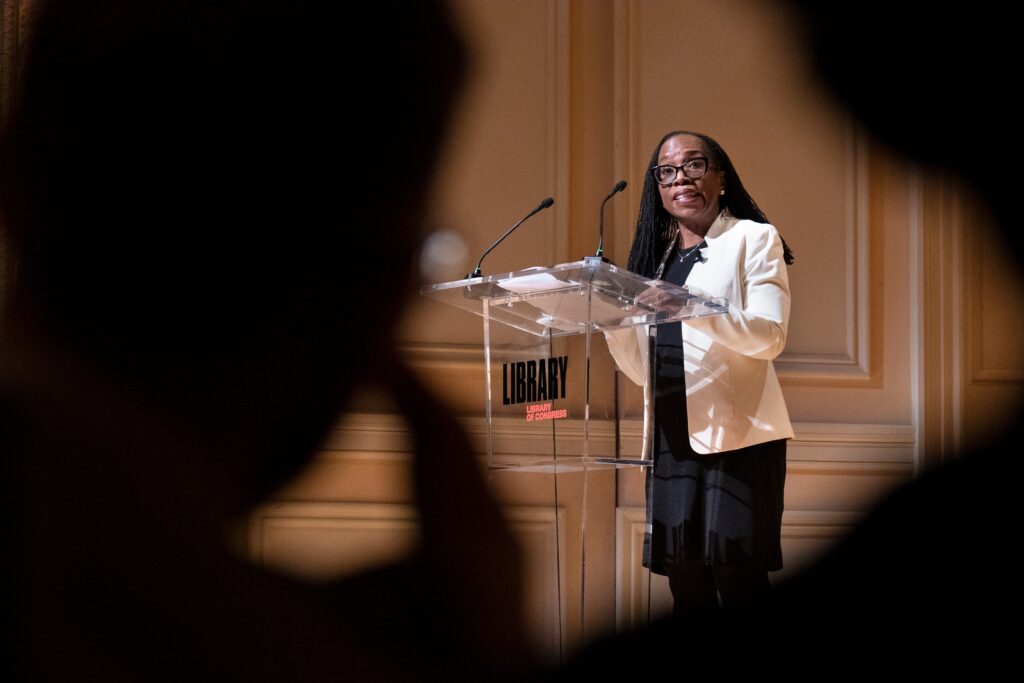
The U.S. Supreme Court’s three liberal justices argued the Court’s conservative majority ignored real harms to voters by reviving the Trump administration’s flawed centralized citizenship database Friday.
Justice Ketanji Brown Jackson, who wrote the dissent, said the Court was wrong to allow President Donald Trump to overhaul the U.S. Department of Homeland Security’s (DHS) Systematic Alien Verification for Entitlement (SAVE) system to initiate voter registration purges.
“The harm caused by burdening or disenfranchising even a few lawful voters outweighs the nonexistent harm that the government experiences when it is prevented from taking an action that it likely lacks the authority to take,” Jackson wrote in the dissent.
Instead, she said, the court should have left intact a lower-court order that blocked the system while litigation proceeds.
Get updates straight to your inbox — for free
Join 350,000 readers who rely on our daily and weekly newsletters for the latest in voting, elections and democracy.
In March 2025, Trump directed federal agencies to create a centralized online tool for state and local officials to verify voters’ citizenship and immigration status. Trump has long stoked baseless fears that thousands of noncitizens are illegally voting in U.S. elections.
A district judge found in June that the database “trampled on the privacy rights of American citizens in a manner that threatens the sacred right to vote.”
But in the unsigned emergency order, the Supreme Court’s six conservative justices said the lower-court order would impede “the federal government’s efforts to assist state and local agencies in the proper administration of the midterm elections.”
Jackson, meanwhile, said that the court’s Friday ruling “focuses only on the harms the Government will purportedly suffer absent a stay, disregarding the harms that the modified SAVE system has caused, and will likely continue to cause, to lawful voters.”
She accused the majority of misreading both Supreme Court precedent and U.S. statutes by allowing DHS and the White House to unilaterally expand the executive branch’s authority. As a result, she said, the court ignores that states could cancel some naturalized citizens’ voter registrations, or force others to provide proof of citizenship, potentially disenfranchising legitimate voters.
“The majority only looks at one side of the scale — the judicial equivalent of expecting a seesaw with weight applied on only one side to work properly,” Jackson wrote.