Trump DOJ loses bid for New Jersey voter rolls, now 0 for 18
President Donald Trump’s Department of Justice (DOJ) suffered its 18th defeat, with no wins, in its nationwide voter data crusade Wednesday, when a federal judge dismissed the department’s lawsuit* seeking New Jersey’s unredacted voter rolls.
The ruling is perhaps the most telling yet about the weakness of DOJ’s case for state voter rolls: It came nine days after the department tried to bolster its case by citing New Jersey’s recent admission that a software glitch led to thousands of noncitizens being mistakenly added to the rolls.
U.S. District Judge Zahid Quraishi wrote that the error had “no bearing” on whether DOJ had a right to the voter rolls.
Assistant Attorney General Harmeet Dhillon responded to the ruling by escalating her attack on New Jersey Gov. Mikie Sherrill (D), accusing her of protecting “illegitimate voters” and suggesting DOJ would continue pursing the state’s data despite the dismissal.
“All you are protecting here is illegitimate voters who cancelled out the votes of your own state’s citizens, in violation of federal law,” Dhillon wrote on social media. “Stay tuned. This isn’t over.”
Get updates straight to your inbox — for free
Join 350,000 readers who rely on our daily and weekly newsletters for the latest in voting, elections and democracy.
In his ruling, Quraishi granted New Jersey’s motion to dismiss and denied DOJ’s motion to compel the records, ruling that the Civil Rights Act of 1960 does not give the federal government access to the state’s live voter registration database.
The dismissal with prejudice prevents DOJ from refiling the same claim in the district court, though the department can appeal, as it has almost every other loss.
New Jersey had already provided DOJ with its publicly available voter list. The department nevertheless sued for the private information, including voters’ driver license and Social Security numbers. (It settled for public information from other states, Democracy Docket has reported.)
DOJ argued that Title III of the Civil Rights Act gives the attorney general broad authority to obtain election records. But Quraishi, an appointee of President Joe Biden, held that the law applies to documents that “come into” election officials’ possession — not a continually changing database created and maintained by the state.
“The plain text of Title III applies only to records ‘which come into’ election officers’ ‘possession’ and thus does not extend to New Jersey’s computerized VRL—a document the State itself created,” Quraishi wrote.
The judge also found that DOJ’s interpretation would be in direct conflict with federal election laws. Title III prohibits the alteration of records it covers, while the Help America Vote Act and National Voter Registration Act require states to update their computerized voter lists continually.
“Simply stated, this creates a conflict,” Quraishi wrote, calling DOJ’s claim to the database “untenable.”
The court’s opinion emphasized that the Constitution primarily entrusts election administration to the states, while federal laws give the executive branch only “specific, narrow roles” in regulating elections. It also identified the case as one of “over two dozen” lawsuits DOJ recently filed seeking voter-registration data from states and localities.
“The Framers of the Constitution chose to embrace balance in crafting the Elections Clause,” Quraishi added. “The diffusion of power between state and federal government was intended to preserve and restore to the people their equal and sacred rights of election [against] the influence of ambitious or popular characters, or in times of popular commotion, and when faction and party spirit run high … Notably, the Executive Branch did not feature at all.”
The ruling arrived one day after Sherrill formally rejected a new DOJ request for personal information about roughly 6,600 people mistakenly registered through a Motor Vehicle Commission software failure.
Sherrill said that demand had “no legal basis.” Dhillon responded that DOJ would obtain the information “through all legal means.”
Principal Deputy Assistant Attorney General Jesus Osete also responded to Sherrill’s refusal on social media with two words: “Challenge accepted.”
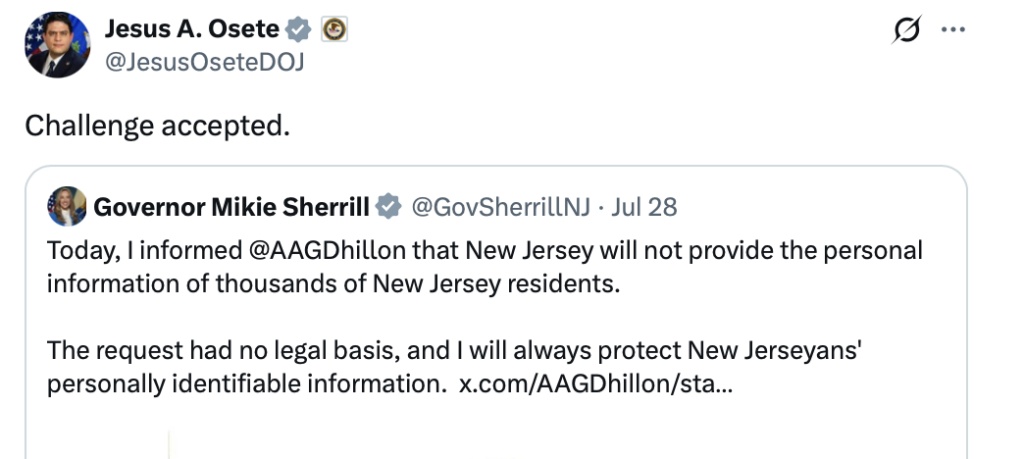
By the next day, a federal judge had answered that challenge by throwing out DOJ’s case.
DOJ attempted to use the newly disclosed registration error to bolster its existing lawsuit. But Quraishi said the development had “no bearing” on whether the department was legally entitled to New Jersey’s voter database.
The New Jersey ruling drops DOJ’s district court record in its voter roll campaign to 0-18, extending a losing streak in which judges across the country have repeatedly rejected DOJ’s claims of sweeping authority over states’ voter data.
*The Elias Law Group (ELG) represents the defendant-intervenors in this case. ELG firm chair Marc Elias is the founder of Democracy Docket.