As Michigan starts early voting, election deniers attack the process
 Prefer us on Google
to see more of our voting rights news coverage when you search.
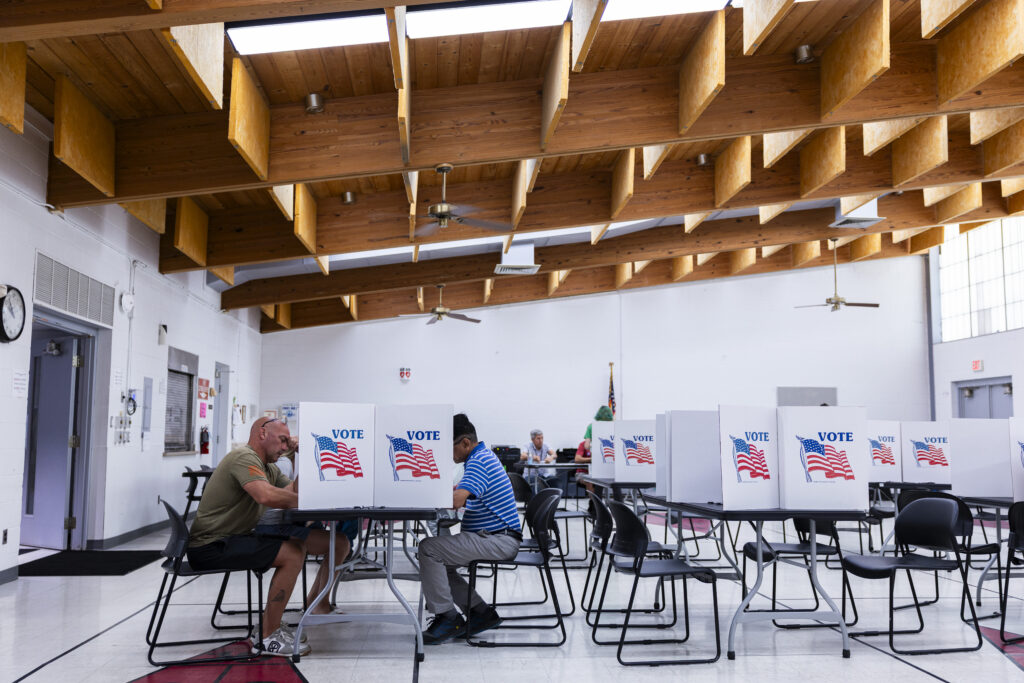
As Michigan voters head to the polls for the start of early voting, the biggest threat to the midterm elections in the Great Lake State lies in the information space: Conspiracy theorists and election deniers are working overtime to sow distrust in Michigan’s voting process.
That’s nothing new in the Trump era. But with their extreme disinformation about Michigan elections and Secretary of State Jocelyn Benson (D) — who is also the Democratic candidate for governor — the anti-voting activists appear to be setting the stage for a potential challenge to the certification of election results that don’t favor Republicans.
And it’s taking its toll on the state’s election officials.
Earlier this month, Courtland Township Clerk Sue Hartman (R) announced she would resign from her post after the election because, she said, fighting back against election lies became too hard to deal with.
“It’s frustrating, when you have to constantly walk around and tell people, ‘No, no one is cheating,’” Hartman told a local outlet.
Conspiracy theorists have already inundated Michigan’s primaries with false claims about fraudulent voter registrations, Democrats scheming to steal votes, and supposedly widespread Election Day irregularities. The disinformation has particularly targeted Michigan cities and municipalities that are majority-Black and Democratic strongholds.
The wave of falsehoods comes during a pivotal U.S. Senate race pitting progressive Abdul El-Sayed (D) against Trump-backed former U.S. congressman and election denier Mike Rogers (R). It’s poised to be one of the most important contests in the midterms and could determine who controls the chamber.
Because of that, Benson’s office is working overtime to ensure disinformation doesn’t run rampant and impact voting.
One of the latest conspiracy theories stems from a lawsuit filed in August by Bridgewater Township clerk Michelle McQueer (R).
McQueer sued Benson over a state rule that requires all Michigan election officials to delete electronic voter pollbook records within seven days after the vote is certified. The township clerk argued that the state rule conflicted with a federal law that requires election officials to hold on to all voting records in a federal election for at least 22 months after vote has been certified.
Get updates straight to your inbox — for free
Join 350,000 readers who rely on our daily and weekly newsletters for the latest in voting, elections and democracy.
In August, a Michigan court of claims judge granted McQueer’s request to pause the state rule for the primary election held in August.
That sparked a frenzy among the state’s election deniers.
“A judge just put in writing, over his own signature, that the State’s confidence it has no legal worries is reckless,” the anti-voting group Michigan Fair Elections Institute wrote about the order.
Soon, the Republican National Committee (RNC) and the Michigan GOP had intervened in the lawsuit, and then the U.S. Department of Justice (DOJ) made the rare move of filing a statement of interest in the case. That further stoked the embers of conspiracists.
But the same judge later denied McQueer’s request to block the state rule for the general election.
“Should this matter remain pending following the general election, the Court will revisit this matter,” Michigan Court of Claims Judge Michael Riordan wrote earlier this month.
Michigan’s pollbook records rule may stand for now, but the DOJ’s interest in the case looms ominously over the election. The department could use the rule as a way to challenge Michigan’s election results if they aren’t to Trump’s liking — a strategy similar to the one it has deployed in Alaska, where it recently filed a lawsuit to preemptively challenge the results of the state’s senate race, because one of the four candidates on the ballot has the same name as the Republican incumbent.
Amid the fallout from McQueer’s lawsuit, anti-voting activists are now directing their ire and disinformation at Benson.
“If you are an election official or poll worker who has been directed by the MI Bureau of Elections or MI SoS Jocelyn Benson to maintain ineligible voters on Michigan’s voter rolls or destroy records in violation of federal law, please forward evidence [to the DOJ],” former Michigan lawmaker and anti-voting activist Patrick Colbeck wrote on X.
Benson is no stranger to these kinds of attacks. For years, Michigan election deniers and far-right lawmakers have cooked up conspiracy theories about her. The GOP-majority Michigan House of Representatives tried to impeach Benson last year over some of her election policies — including the directive for election officials to delete pollbook data.
Conspiracy theorists have also claimed that Benson has kept ineligible and dead voters on the state’s voter roll.
“I took a deceased voter off the rolls in my township, and guess what? That voter was put back on. That was done by the secretary of state’s office,” Rep. Rachelle Smit (R), the chair of the House’s Election Integrity Committee, said at a hearing in March.
McQueer’s lawsuit isn’t the only one that is stoking conspiracy theories about the Michigan vote.
Earlier this month, the RNC and the Michigan GOP sued Lansing election officials, alleging they had violated state law for not appointing enough Republican poll workers for Election Day.
Poll workers are an essential part of the elections process, but election administrators often struggle to find enough people to take on the job — and finding equal numbers of poll workers from each party can be difficult in areas where voters of one party outnumber the other.
Finding and training qualified poll workers is also an arduous task for election officials, who have to be extra diligent to look out for political operatives attempting to infiltrate the role to unlawfully disrupt the ballot counting and contest election results.
Nonetheless, right-wingers have used the lawsuit to falsely claim Lansing’s election officials are setting the groundwork to rig the vote in the Democratic stronghold.
“Election officials looking to CHEAT,” one popular MAGA content creator wrote on social media. “Lansing, Michigan appointed 140 Democrat poll workers. And 71 Republicans. State law says it’s supposed to be as close to even as possible. Republicans sent qualified people. The city wouldn’t even show them the records. Now the RNC is suing. Good. Watch every precinct.”
The assertion that Democrats will need to cheat to win Lansing is a bit of a stretch — the city is the capital of Michigan and a Democratic stronghold that hasn’t voted for a Republican president since 2000.
For more information on how to vote early in person in Michigan, see the Michigan Department of State’s website.