‘Too big to rig’: Democrats’ midterm landslide divides election deniers
 Prefer us on Google
to see more of our voting rights news coverage when you search.
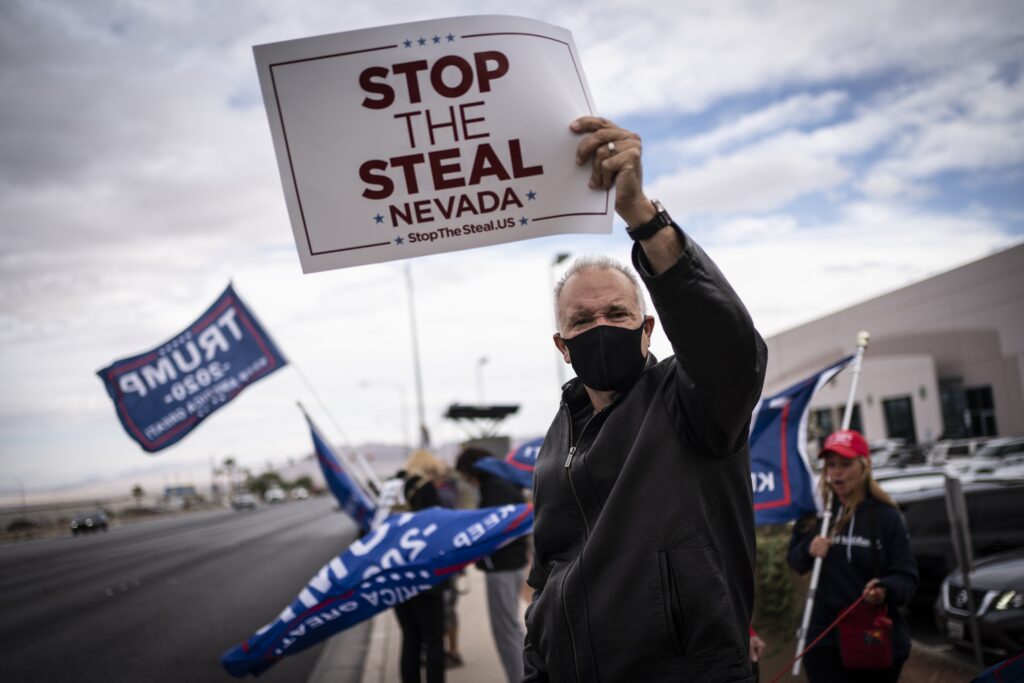
The cacophony of anti-voting conspiracy theories reached a fever pitch in the days before the midterm elections: Voting machines made with foreign parts were supposedly compromised. Noncitizens had purportedly registered illegally to vote in huge numbers. And Democrats would allegedly use mail voting to commit election fraud.
But a week after Election Day, the election deniers, anti-voting activists and MAGA faithful who spent months pushing these and other false claims about voting are divided over how to understand the Democrats’ historic midterm landslide.
Some have — gasp! — even concluded the election results might be legitimate. And some are placing the blame for the loss on President Donald Trump.
That’s not to say election denial is dead. Leading anti-voting activists are still plotting to make it harder for Americans to vote. And Trump himself returned to the poisoned well this week, asking his Truth Social followers whether anyone really believes that the results were “honest.”
“How could the Polls be so wrong???” the president asked. “Some early voting ‘dumps’ were so large that it was impossible to win, no matter how many people went to vote. It’s all about the machines, which are far more important than the voter!”
But those election deniers who acknowledge the GOP defeat face another question: What’s next for their anti-voting activism?
Get updates straight to your inbox — for free
Join 350,000 readers who rely on our daily and weekly newsletters for the latest in voting, elections and democracy.
‘Digest the failure directly’
The most striking admission that Republicans legitimately lost the midterms came from Ali Alexander, a far-right conspiracy theorist who was one of the key architects of the 2020 Stop the Steal movement.
“STOP THE STEAL SAYS MIDTERM WIPEOUT WAS LEGITIMATE; WILL NOT PROTEST,” Alexander announced in a statement on the Telegram messenger app just two days after the election.
Other key figures who pushed Trump’s Big Lie after the 2020 election took similar stances. In an open letter to Trump, disgraced former National Security Adviser General Michael Flynn spelled out what the president must do after the resounding midterm loss.
At the top of the list: Accept the defeat.
“Stop shifting blame or masking the reality of what happened; digest the failure directly so you can use it as fuel to move out smartly into the future,” Flynn wrote.
Seth Keshel, an anti-voting activist who previously asserted that he briefed key White House staff on his research, has been pushing back against claims of a stolen midterm election on social media.
Keshel rose to prominence among MAGA followers over the past few years for his election forecasting. Ahead of the 2024 race, he accurately predicted Trump would win key swing states and return to the White House. This time, he had predicted that Democrats would narrowly win a House majority in the midterms, while the GOP would hold on to the U.S. Senate with a one-seat majority.
But when the results proved far different, Keshel — who has long pushed false claims of large-scale voter fraud — put the conspiracy theories that were flooding his feed to bed.
“This is not the same as 2020, when there were booming piles of net new Trump votes everywhere you looked,” Keshel wrote on X last week, addressing the tight Mississippi U.S. Senate race that no one expected to be close. “This is not voting and crossing over, and the margin in one deep red county.”
Other MAGA commentators like former Fox News host Megyn Kelly and Jennica Pounds — a data analyst with Trump’s Department of Defense who is known online as DataRepublican — have made comments suggesting the midterm results were legitimate.
“Like, we’re going to do that again? We don’t trust the vote?” Kelly said on her radio show Monday.
Then, using a phrase popularized by Trump, she suggested the results were “too big to rig.”
Another notable figure to publicly accept the midterm results is the anti-voting lawyer and Trump ally Cleta Mitchell.
“I’m a very big believer in the Declaration of Independence where it says that governments derive their just powers from the consent of the governed,” she told former White House press secretary Sean Spicer last week. “And I think that the governed withdrew their consent for a number of things.”
Mitchell’s comments are especially notable given both her close ties to Trump and her role in building the election denial movement into a vast ecosystem through the Election Integrity Network (EIN), the organization she started in the aftermath of the 2020 vote.
‘Why Is No One Talking About a Stolen Election?’
Despite that, there’s still a strong contingent of conspiracy theorists who insist the midterms were stolen. Like Trump, they do not believe Democrats could possibly have won up and down the ballot, all across the country.
Kari Lake, a Trump appointee who pushed the stolen election playbook to contest her own failed 2022 bid for Arizona governor, has been churning out a steady stream of conspiracy theories since Election Day.
In response to data showing that every county in Iowa shifted blue this election, Lake said that the “math isn’t mathing here.”
“Let’s audit this election to make sure the results are honest before we hand over the Hawkeye state and America to Communists,” she wrote. “Do not certify until you VERIFY the vote.”
MyPillow CEO Mike Lindell — a towering figure in the election denial community who lost the GOP primary for Minnesota governor earlier this year — has also been on a kick spreading new conspiracy theories about the GOP’s midterm flop.
“My cybersecurity expert found that Texas Attorney General Ken Paxton [who lost his bid for the U.S. Senate in Texas] received 292,000 FEWER VOTES than the average Republican statewide candidate, with lower-profile races drawing more votes,” he said on social media Tuesday. “That’s not improbable. It’s IMPOSSIBLE! We’re similar [sic] patterns in other states. These numbers demand answers!”
(In fact, Paxton was widely viewed as a deeply flawed candidate who was dragged down by repeated corruption allegations and personal scandals.)
The day after the midterms, far-right commentator Joe Hoft wrote an article titled “Why Is No One Talking About a Stolen Election? Were the 2026 Midterms Legit?” that repeated the familiar claims of rigged voting machines.
“We are told that the results of the 2026 elections are legitimate despite reports of machines adding ballots to the counts,” Hoft wrote.
Other conservative figures, like podcaster Joe Oltmann, have parroted Hoft’s voting machine conspiracy theories. Oltmann claimed on social media that he and other election deniers have prepared a report for Trump that proves the midterm results weren’t legitimate.
“We’ve spent this time making sure what’s in it isn’t theory and isn’t academic,” Oltmann wrote. “It has to hold up. What I can tell you is this: I don’t believe these systems can be hardened, because I don’t believe they were ever built to be secure.”
Where to now?
Despite the midterms dividing election deniers, it’s clear that their mission to suppress voting in America by pushing for draconian voting restrictions won’t stop.
In a lengthy X post, Mitchell, the prominent anti-voting lawyer, outlined where her movement is headed as Democrats prepare to take control of Congress and many state legislatures.
“It is only when you have a very close election that people start examining the process and whether there were dead people voting, whether there are votes cast illegally from [P.O. boxes] or vacant lots… whether the tabulators jammed so that ballots were scanned more than once… whether the printers at the vote centers were working… whether voters had to be sent to a different location… how many people showed up to vote and were told they had ‘already voted…’” she wrote.
Earlier this year, Mitchell’s group, EIN, laid out its policy goals for the near future. It’s a laundry list of what you’d expect from the nation’s biggest coalition of state and local anti-voting groups: strict voter ID laws in as many states as possible, rolling back mail voting, cutting down the early voting period, mass voter challenges, empowering election officials to deny and delay certification and making it harder for people to register to vote.
These proposals will be critical to EIN’s fight to prevent Democrats from maintaining power in future elections.
“Their goal is to model every state’s election laws after California’s,” Mitchell wrote. “Americans concerned about election integrity need to be ready for that fight in every statehouse, every legislative committee and every county election office.”