Mississippi Secretary of State crashes out over Experian voter data after election fiasco
 Prefer us on Google
to see more of our voting rights news coverage when you search.

Mississippi Secretary of State Michael Watson (R), in a now-deleted social media post, threatened to sue the credit reporting giant Experian over data the state used to mark thousands of voters as inactive, roiling its close Senate race.
The threat came after the company said its data wasn’t intended to be used for validating voter records.
The remarkable dispute between Mississippi’s top election official and one of the nation’s largest credit reporting companies is casting a spotlight on the risks of using commercial data for voting purposes. It’s also raising questions about whether Watson’s office used the data with appropriate safeguards.
Meanwhile, a right-wing former federal election official who has promoted the use of commercial data for purging voter rolls is scrambling to defend the practice after the Mississippi fiasco.
Get updates straight to your inbox — for free
Join 350,000 readers who rely on our daily and weekly newsletters for the latest in voting, elections and democracy.
Democrat Scott Colom on Wednesday was declared the winner of Mississippi’s Senate race, defeating Sen. Cindy Hyde-Smith (R).
But more than 230,000 Mississippi voters were classified as inactive ahead of the November election, though Watson has said that figure represents inactive registrations accumulated over several years.
The state’s use of commercial address data from Experian came under particular scrutiny after eligible voters were mistakenly marked inactive.
Under Mississippi law, county election commissioners mark voters inactive when sending confirmation notices about a potential address change. In some cases, those notices were sent to incorrect addresses supplied by Experian, leaving voters unaware that their registration status had changed.
Although their votes ultimately were counted without additional steps, the large number of affidavits created confusion and uncertainty during ballot counting for the tight race.
Experian has tried to distance itself from the problems in Mississippi.
“The solution provided at that time consisted of supplemental address information and was not designed or intended to validate voter records,” spokesperson Scott Anderson told The Atlantic last week.
Anderson added that election officials were responsible for decisions about voter registration policies and updates to voter records.
Watson’s office disputed Experian’s characterization of the agreement in a statement to Democracy Docket.
“Mississippi was never told the data was only supplemental or that it was not intended for this use,” Elizabeth Jonson, Watson’s communications director, said.
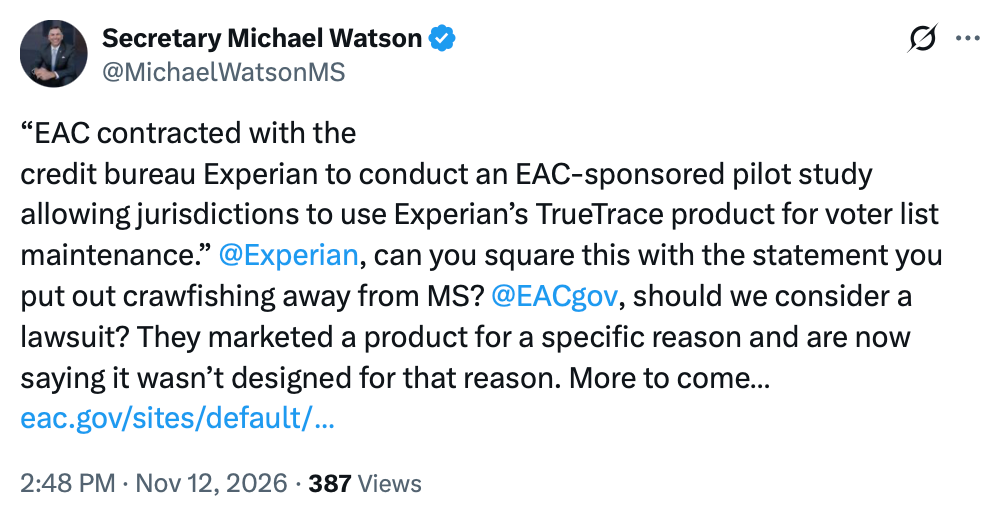
In his now-deleted post published Thursday, Watson accused Experian of “crawfishing away from Mississippi.”
Watson also noted that the U.S. Election Assistance Commission (EAC) — an independent federal agency that helps states run elections — had worked with Experian on a federally sponsored pilot program that tested the company’s product for voter roll maintenance.
“Should we consider a lawsuit?” Watson asked the federal agency. “They marketed a product for a specific reason and are now saying it wasn’t designed for that reason. More to come…”
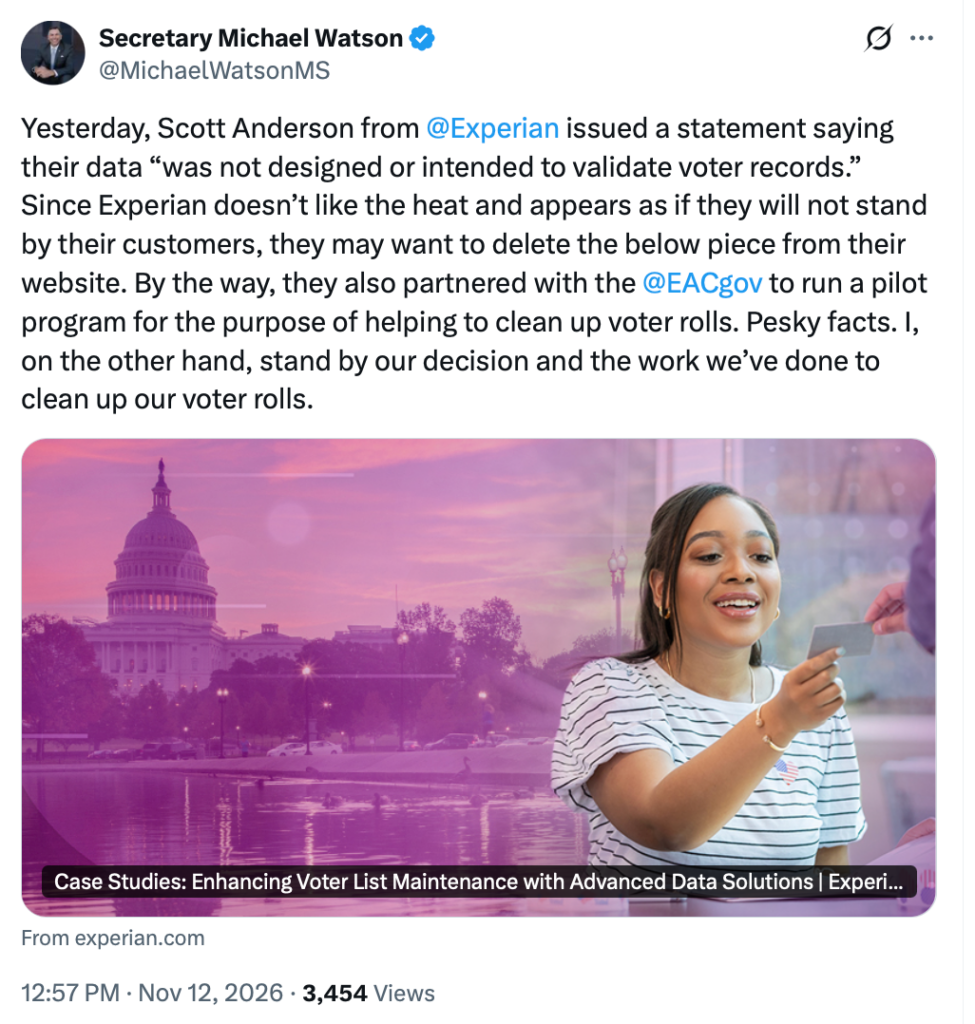
In a different post published Thursday, which remains online, Watson pointed to a 2024 article on Experian’s website that promoted commercial data as a tool for improving voter registration records.
“Since Experian doesn’t like the heat and appears as if they will not stand by their customers, they may want to delete the below piece from their website,” Watson wrote.
Mississippi has since switched to another commercial data provider, IDI.
In a Wednesday briefing, Watson said IDI compares address information from all three major credit reporting agencies and assigns scores to the reliability of that information.
He insisted the change wasn’t prompted by problems with Experian, but by the availability of what his office considered a better product.
Watson’s office did not say whether Mississippi is actively preparing legal action against Experian in its Friday response to questions from Democracy Docket.
After Democracy Docket’s inquiry was sent Thursday, his post threatening a lawsuit was deleted.
It’s the second time that a post by Watson has been deleted in the post-election period. On Tuesday, a short-lived post under his name incorrectly told voters how to cure their mail ballots. In fact, the state now has no process for curing mail ballots, after a recent rule change made by Watson.
Watson’s office signed a $50,000 contract with Experian in December 2024 to supplement address-change information traditionally obtained from the U.S. Postal Service. The contract identified voter roll maintenance as the purpose of the agreement.
“The stated purpose of Mississippi’s agreement was to build off of that pilot, which was for list maintenance,” Jonson told Democracy Docket, referring to the EAC’s federally sponsored project with Experian.
In July 2025, the office announced the partnership, saying it would bring a “new level of reliable data” to Mississippi’s voter roll maintenance process.
But the contract, obtained by the local outlet Mississippi Today, included disclaimers that Experian couldn’t guarantee the accuracy or reliability of its information.
Experian has since sought to draw a distinction between providing supplemental address information and determining the accuracy of voter registrations.
The Experian article Watson cited, titled “Case Studies: Enhancing Voter List Maintenance with Advanced Data Solutions,” features a product called Best Contact, rather than TrueTrace, the product Mississippi purchased.
But another document Watson pointed to establishes that TrueTrace was specifically tested for voter roll maintenance — through a partnership with the EAC.
The partnership involved a pilot study that allowed election jurisdictions to use TrueTrace for voter list maintenance.
It included Mississippi and the state’s Lafayette County and examined more than 11 million voter addresses across 11 jurisdictions.
An EAC study of the program, published in August 2025, found that commercial data could help election officials identify voters who may have moved.
But the same federal study Watson cited also raised concerns about the quality and timeliness of the data supplied by credit reporting companies.
“It is crucial to assess whether this data can reliably identify new or updated addresses for voters,” the report said.
The EAC called for additional research to determine which information was more accurate — the addresses already on voter rolls or the new addresses supplied by a credit bureau.
The agency also recommended that election officials establish clear criteria for verifying voters’ addresses, identify potential sources of errors and use commercial information to supplement, rather than replace, existing data sources.
Experian had not responded as of publication to questions from Democracy Docket about how it reconciles its earlier marketing and participation in the EAC pilot with its recent statements, what it understood Mississippi would do with its data, and whether it believes the state used its product improperly.
Amid the fallout, a former EAC official, now at the right-wing Heritage Foundation, which advocates for more restrictive voting policies, has sought to defend the use of commercial credit data.
In an op-ed Wednesday, Don Palmer, who served on the commission when it conducted and published its TrueTrace study, argued that Mississippi was right to supplement traditional voter roll maintenance information with commercial data.
Palmer described affidavit voting as a safeguard that allows eligible voters to cast ballots while officials verify their eligibility. He cited a preliminary affidavit ballot acceptance rate of about 78% as evidence that the process was working.
Palmer also wrote that commercial data should be treated as “a lead for investigation rather than a conclusion” — a distinction similar to the one Experian is now drawing about its own product.
Reports that some information went unverified, Palmer argued, demonstrated the need for stronger safeguards rather than abandoning commercial data altogether.
At Heritage, Palmer has sought to stoke fears about noncitizen voting, despite studies that show it doesn’t occur at significant rates.
Watson promoted Palmer’s op-ed Thursday, defending Mississippi’s election and declaring that he stood by his office’s voter roll maintenance efforts.
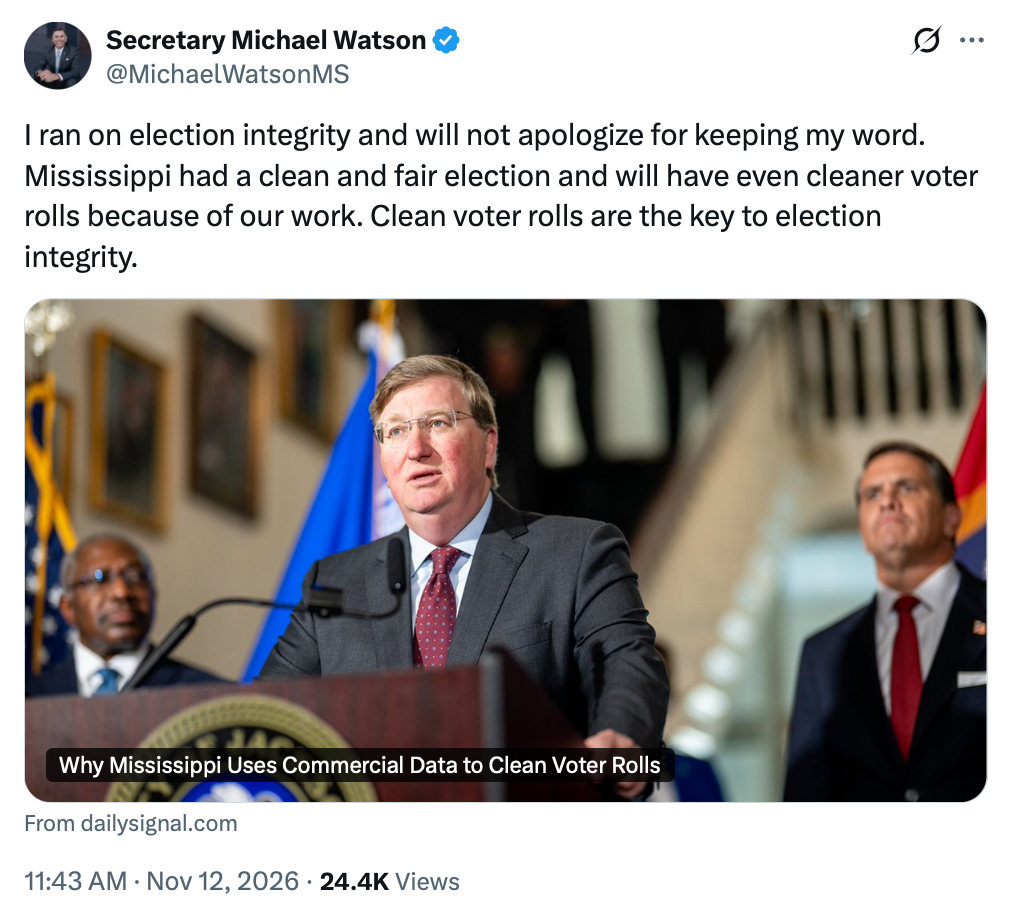
“I ran on election integrity and will not apologize for keeping my word,” Watson wrote.
Other states have taken a different approach to using commercial address information. In West Virginia, for example, election officials seek confirmation from voters before changing their registration status.
In Mississippi, an eligible voter can be moved to inactive status before receiving the very notice that would allow them to correct erroneous information.
Earlier this week, Watson shifted responsibility for problems involving the data on county election commissioners, saying local officials were responsible for verifying the information before changing voter registrations.
“I cannot make an election commissioner do his or her job,” Watson said Monday.
But Rankin County Election Commissioner Tonya Rivers told Democracy Docket that the state supplied inaccurate information and that local officials weren’t initially informed that Experian data had been incorporated into their address-change records.
Rivers described speaking with voters whose suggested new addresses were in states they had never visited.
“And they’re upset. And now they don’t trust us,” Rivers said. “That’s not a great situation to be in. It’s a terrible situation.”