How Democrats fought off Trump’s redistricting scheme
 Prefer us on Google
to see more of our voting rights news coverage when you search.
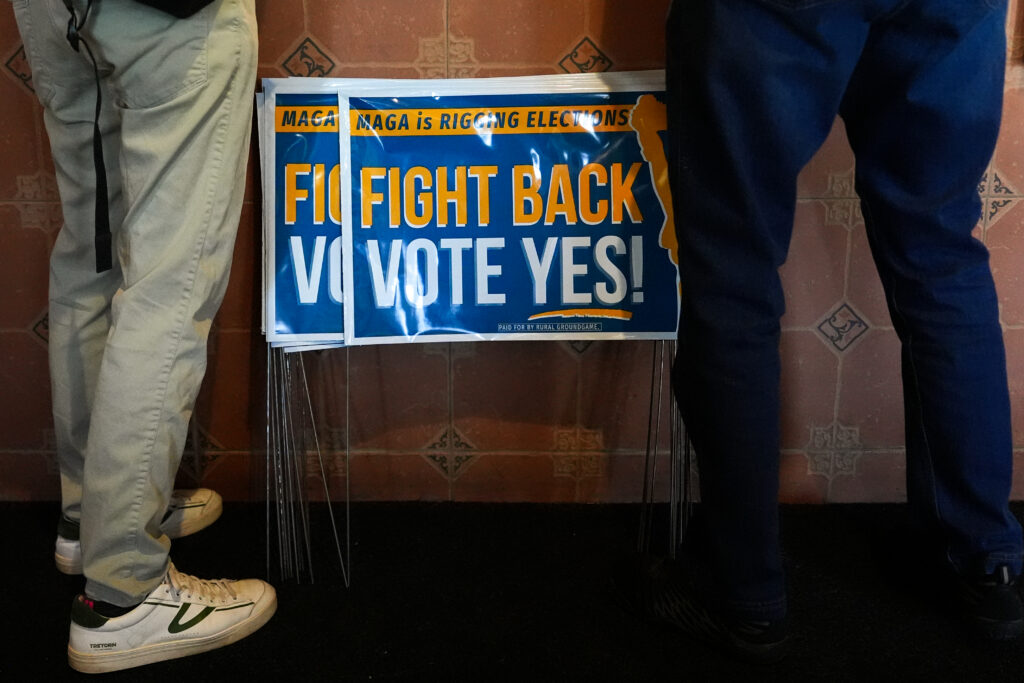
If Democrats’ remarkable victory in the Virginia referendum election tells us anything, it’s this: President Donald Trump’s unprecedented effort to use mid-decade redistricting to maintain control of Congress in the 2026 midterms has not gone according to plan.
Republican-controlled states have delivered some potential gains, but Democrats have caught Trump off guard with their willingness to fight back by redrawing maps in blue states to wipe out the GOP’s possible gains.
And while Republicans in Texas, Missouri and North Carolina have forced new congressional maps into law without going to the voters for approval, Democrats in California and Virginia have leveled the playing field by making their case to voters.
“Our response has been forceful, temporary, as a direct reaction to what MAGA extremists have done, and at all times, approved by the voters,” House Minority Leader Hakeem Jeffries (D) told reporters Wednesday. “That’s the big difference between how we’ve approached this effort and Republicans, who are going into state legislatures in the dead of night, passing maps and then being afraid to present those maps to the people in those states.”
But the fight isn’t over yet.
Get updates straight to your inbox — for free
Join 350,000 readers who rely on our daily and weekly newsletters for the latest in voting, elections and democracy.
In three states, the maps remain in limbo: Virginia, Florida and Missouri. Democrats’ Virginia plan still must be upheld by the court.
Republicans are also set to begin a Florida redistricting special session next week that could further alter the national redistricting math. Missouri’s disputed gerrymander is still being litigated. And, of course, the final score won’t be settled until November, when voters go to the polls in newly redrawn districts across the country.
Separately, if the Supreme Court rules, as expected, to badly weaken the Voting Rights Act in Callais v. Louisiana, it will likely spur more GOP-controlled states to draw new maps, wiping out Democratic districts where non-white voters form majorities — though that likely wouldn’t happen in time for the midterms.
But Tuesday’s win in Virginia was an astonishing blow to Trump’s efforts to gerrymander, one that signaled just how far his redistricting scheme has strayed off course. Trump has one more GOP play to make — Florida — but Jeffries warned that wouldn’t go according to plan, either.
“Our message to Florida Republicans is: F around and find out,” Jeffries said Wednesday, arguing that a new map would only backfire on the GOP by spreading their supporters thinner and making more districts vulnerable to being picked up by Democrats. “The Republicans are dummymandering their way into the minority before a single vote is cast, because they started this war and we’re going to finish it.”
Trump v. America
From the start, redistricting proved to be more challenging than Trump may have anticipated.
Texas Republicans quickly bent the knee and began a special session to deliver five more seats in Congress, but Democrats in the Texas House fled the state to block a vote on the measure. Some went to Illinois. Others headed to California, where they met with Gov. Gavin Newsom (D) and made the case for a national response.
Texas Republicans issued arrest warrants to compel Democrats’ attendance, filed still-pending lawsuits attempting to declare their seats vacant and even asked the FBI to intervene. Democrats eventually returned to Texas and Republicans passed their map. But by then, Newsom was already calling for California to redraw its congressional map in response.
The battle spread quickly as the White House spent months pressuring GOP-controlled states across the country to enter the fray. In many cases, they were unsuccessful. In Nebraska, New Hampshire and Kansas, GOP lawmakers turned down Trump’s demand. South Carolina stayed out of the fight. But Trump’s plan failed most spectacularly in Indiana, where a majority of Republican lawmakers voted down a proposed gerrymander despite facing an avalanche of threats and harassment from Trump and his allies.
The White House did, however, get two more Republican-led states to bite: North Carolina and Missouri. In both states, lawmakers rushed hasty redraws into law at the expense of minority voters.
By the end of 2025, the U.S. Supreme Court had allowed Texas to use its new map, despite a Trump-appointed lower court judge ruling it was likely an illegal racial gerrymander. Republicans had picked up one seat each in North Carolina and Missouri.
But, by then, California voters had already delivered a stunning blow against Trump. In November, they overwhelmingly approved the Democrats’ plan to redistrict.
In Missouri, voters turned in more than 300,000 signatures to put the GOP gerrymander to a statewide referendum vote. In Utah, a judge struck down a GOP gerrymander, opening the door for Democrats to pick up one more seat in Congress.
And Virginia Democrats launched a surprising, ambitious attack of their own, asking voters to let them sidestep the state’s bipartisan redistricting process and enact a temporary new map that could allow them to pick up four more seats in Congress.
Not all Democratic-led states jumped at the chance to redistrict. Maryland’s Senate leader, a Democrat, blocked the state from joining the fight, insisting that redistricting could backfire if the inevitable litigation resulted in a less favorable court-ordered map. New Jersey passed. Illinois didn’t take up redistricting, either.
But Republicans were already warning that Trump was gambling with the maps.
“If you go a little bit further, you could get surprised in an election cycle and not go your way,” Sen. Thom Tillis (R-NC) cautioned in October. “Just be careful what you wish for.”
After Democrats’ victory in Virginia, it looks like he may be right.
The 11th hour
Despite Democrats’ successes, much uncertainty remains. The new Virginia map is embroiled in litigation. Florida is still tentatively moving forward with Gov. Ron DeSantis’ push to redistrict in a special session next week, despite reluctance from his own party, warnings from Jeffries and, not least of all, the state constitution’s ban on partisan gerrymanders. And despite Missouri voters gathering enough signatures to hold a referendum on the gerrymander, the GOP still appears poised to slip its new map through.
Jeffries blasted Republicans Wednesday for accusing Democrats of unfair redistricting in Virginia even as they themselves have fought tooth and nail to stop voters from having the final say on the Missouri map, dragging referendum supporters through prolonged legal battles rather than simply acknowledging their right under the state constitution to hold a veto vote on state legislation.
“So we don’t want to hear any pearl clutching from these people on the other side of the aisle,” Jeffries said. “We take our case to the voters. They don’t. And if they’re on the right side of this fight, why are they pushing back in Missouri? Just allow the map to go forward – the current map to go forward – and then the voters can decide in Missouri pursuant to the Missouri Constitution as to whether it should be enacted.”
“And Republicans are fighting us right now,” Jeffries continued. “Because they’re afraid of their own voters. But we’re going to keep the pressure on them at all times.”
While some Republicans are complaining about the Virginia redistricting election, others now seem to be distancing themselves from the fight.
Asked on Wednesday if the redistricting battle was worth it, Rep. Richard Hudson (R-N.C.), chair of the National Republican Congressional Committee, reportedly answered: “Not for me to decide that. Wasn’t my decision.”
Rep. Don Bacon (R-Neb.), whose own state stayed out of the fray, told CNN that Democrats’ gains could have been prevented.
“You got to always think, what are they going to do in response? And I think this was foreseeable,” Bacon said.
Ari Fleischer, the former White House press secretary to President George W. Bush (R), neatly summed up the state of play in a social media post Tuesday night after the Virginia election was called.
“I should also point out that the GOP will now lose net seats across the country. If you’re going to pick a fight, at least win it. The other side will always fight back,” Fleischer said. “All this was foreseeable and avoidable. We should not have started this fight.”