California Voters Overwhelmingly Approve New Map, Countering Trump’s Gerrymander Push
 Prefer us on Google
to see more of our voting rights news coverage when you search.
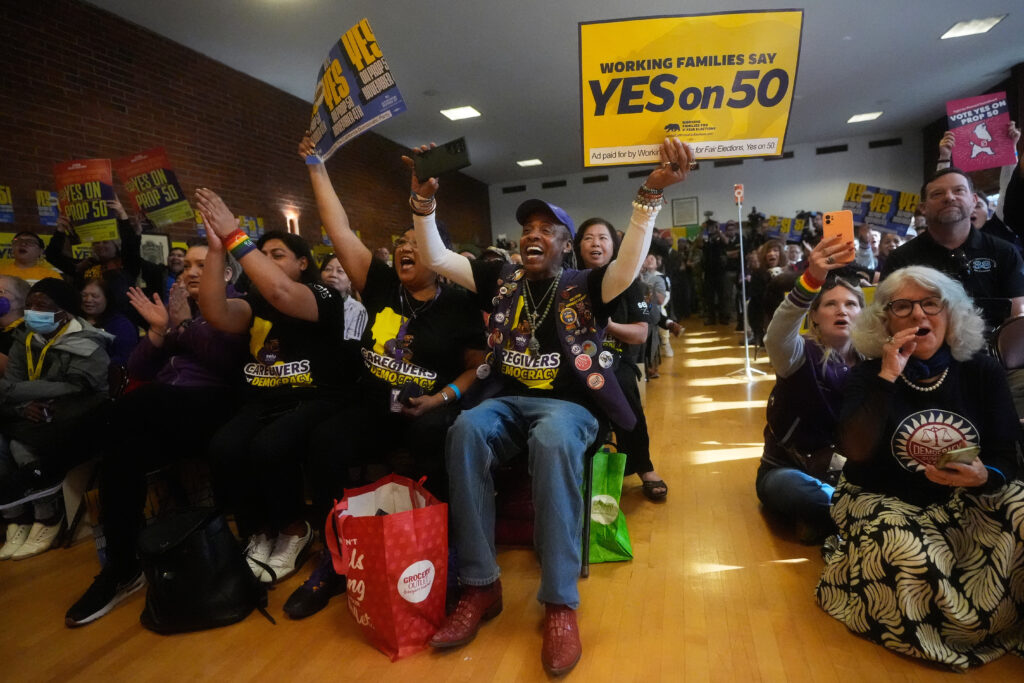
President Donald Trump’s plan to rig the 2026 election by gerrymandering congressional districts hit a massive roadblock Tuesday: California voters.
Golden Staters overwhelmingly approved a plan to redraw the California congressional map in response to Trump’s efforts, the AP projected. The decisive result clears the way for Democrats to pick up as many as five seats and counter some of Trump’s potential gains in GOP-controlled states.
Get updates straight to your inbox — for free
Join over 350,000 readers who rely on our daily and weekly newsletters for the latest in voting, elections and democracy.
In Texas, Missouri and North Carolina, GOP lawmakers have passed congressional maps this year at Trump’s insistence, creating more Republican districts at the expense of minority communities – without getting approval from voters. In California, Democratic legislators decided to respond with their own redraw, but under state law, they were required to ask voters to weigh in first.
On Tuesday, California voters answered with a resounding yes.
Unsurprisingly, Trump was quick to cast doubt on the outcome, threatening on Election Day to investigate the state’s mail ballots before polls had even closed.
In a post on his social media platform Truth Social, Trump claimed without evidence, “The Unconstitutional Redistricting Vote in California is a GIANT SCAM in that the entire process, in particular the Voting itself, is RIGGED. All ‘Mail-In’ Ballots, where the Republicans in that State are ‘Shut Out,’ is under very serious legal and criminal review. STAY TUNED!”
White House press secretary Karoline Leavitt doubled down on Trump’s empty claim Tuesday, saying “there’s fraud” in California’s elections.
Asked to provide evidence, Leavitt instead said, “It’s just a fact.”
Proposition 50 supporters raised more than twice as much as opponents, raking in $129 million in contributions and straining the capacity of the state’s campaign finance website.
Republicans have filed around half a dozen legal challenges aiming to stop Proposition 50, none of which have been successful so far. The California Supreme Court rejected multiple challenges from Republicans hoping to block the state’s “Election Rigging Response Act” legislation. Federal courts in Texas also dismissed two GOP lawsuits against the California plan.
Steve Hilton, a Republican candidate for California governor, also challenged the ballot measure in federal court. Just hours before the measure was approved by voters, the challenge was dismissed.
The Trump administration pushed back on Proposition 50, as well. The U.S. Department of Justice announced it would send election monitors to polling sites in California, a move some critics described as election interference. California, in turn, said it would dispatch its own observers to watch over federal monitors.
California lawmakers took up redistricting at the urging of Gov. Gavin Newsom (D), a possible 2028 presidential candidate. Newsom was quick to call for a response to Texas’ redistricting over the summer.
“We’re doing this in reaction to a president of the United States who called the sitting governor of the state of Texas and said, ‘Find me five seats,’” Newsom said in August while announcing the Proposition 50 special election.
North Carolina Republicans went on to speed through a redistricting effort of their own in October, passing a map designed to flip one Democratic seat and declaring that Proposition 50 had “backfired.” North Carolina Democrats, meanwhile, noted that Proposition 50 would give California voters the final say on their map, while North Carolinians would not be consulted on whether to do a redraw.
California was the first Democratic-led state to enter the redistricting fray, but it likely won’t be the last.
Virginia lawmakers passed a proposed constitutional amendment last week that would allow the state to make changes to its map until 2030 “in response to actions taken by another state.” Lawmakers would need to pass the measure again next year before sending it to voters for approval. Democrats could gain as many as four seats if the Virginia redraw moves forward.