ICE killed a man in Houston and residents want answers. But Trump’s gerrymander may take away their voice in Congress
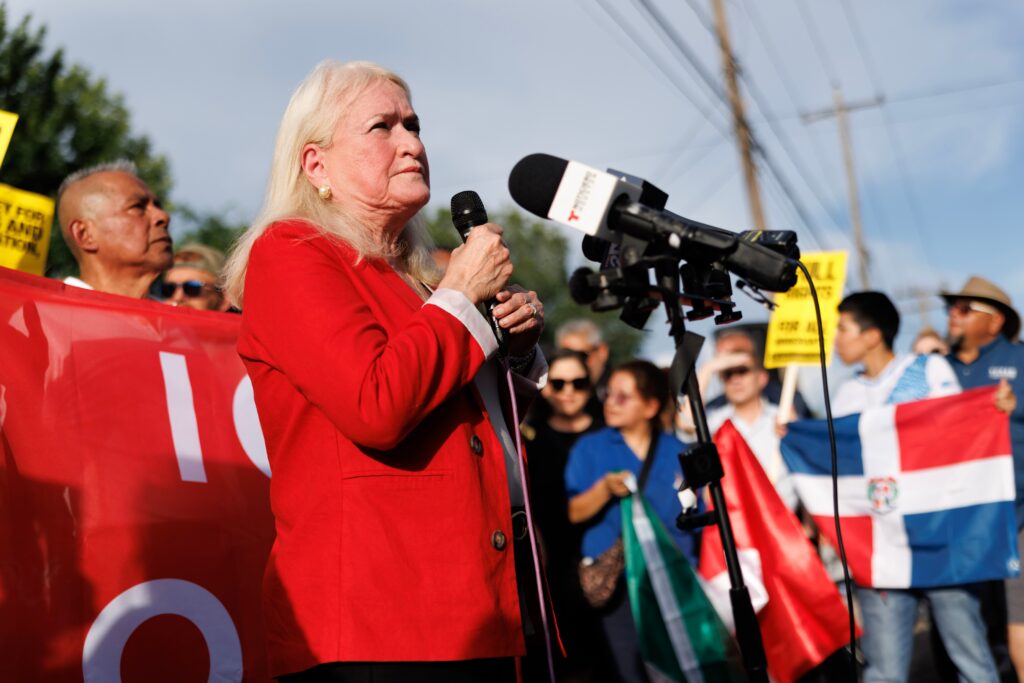
When Immigration and Customs Enforcement (ICE) officers fatally shot Lorenzo Salgado Araujo, a Mexican immigrant, in Houston earlier this month, Rep. Sylvia Garcia (D) sprang into action.
Garcia immediately questioned the immigration agency’s account of the incident and demanded an independent investigation. She rushed to gather firsthand accounts of the shooting, meeting with witnesses who were in federal custody at an immigration detention facility. When security officers initially insisted she could not enter, Garcia was undeterred.
“The victim’s family, my constituents, and the entire community deserve a complete and transparent accounting of what happened,” Garcia said in a statement.
In demanding accountability, Garcia is fulfilling an essential component of her job as a member of Congress: representing the people of the heavily Latino East End — including the Magnolia Park neighborhood where the shooting took place — and ensuring that her constituents’ voices are heard in the halls of power.
Despite Garcia’s efforts, East End residents face an uphill battle to get answers from the Trump administration and hold ICE accountable. But starting next year, their odds are likely to be even steeper.
That’s because, thanks to President Donald Trump’s nationwide push for pro-GOP partisan redistricting, many are set to lose their voice in Congress.
When Texas redrew its congressional map last year under pressure from Trump, lawmakers split the East End in two, putting parts of it, including the Magnolia Park area, into a new Republican-leaning 9th District. After the November elections, it will likely have a GOP congresswoman who has said almost nothing about Salgado Araujo’s killing.
The episode is perhaps the starkest recent example of how Trump’s gerrymanders aren’t just boosting the GOP’s chances of retaining control of Congress. They also damage democracy on an even more fundamental level — by undermining the ability of voters, especially minority voters, to elect leaders who will truly represent their interests and respond to their concerns — even in matters of life and death.
Shifting borders, shifting reality
East End voters redrawn into the new District 9 will have two options on the ballot in November: Democrat Leticia Gutierrez and Republican Alex Mealer.
Gutierrez is an immigrant and public health advocate who has lived in the district for most of her life. Mealer is an Army veteran who filed a 2023 lawsuit challenging the results of a local election she lost. (Even Mealer’s own lawyer said she didn’t support Mealer’s claims of fraud.) And Mealer’s opponent in the GOP primary blasted her for not living in the district.
Since Salgado Araujo’s killing, Mealer has said little about the case.
Get updates straight to your inbox — for free
Join 350,000 readers who rely on our daily and weekly newsletters for the latest in voting, elections and democracy.
Her only statement was in a social media post on the day of the shooting, when she shared information from the Department of Homeland Security (DHS) that amplified ICE’s version of events.
“Today is yet another reminder of the dangers law enforcement face everyday as they protect our safety,” Mealer wrote. “I have full confidence in law enforcement’s ability to conduct a thorough investigation and ensure justice is served.”
In response, Gutierrez posted a video criticizing Mealer’s response and drawing a direct line between the redistricting scheme and Mealer’s stance on the shooting. Her conclusion: “They redrew this district to silence the East End.”
‘Pawns’ in the redistricting fight
Though debates over redistricting often focus on who controls Congress, Houstonians will now face the wider consequences voting advocates warned of last year.
Gerrymander opponents repeatedly sounded the alarm that Republicans redrew Texas’ congressional map at the expense of minority voters — and particularly of Latino Texans. They account for much of the state’s population growth over the past decade, yet stand to lose representation under the new map.
In a court filing challenging the gerrymander, advocates pointed out that all eight of the districts most impacted by the changes had majority-minority populations.
Richard Murray, a political scientist at the University of Houston who has analyzed Texas political trends for decades, testified in federal court that the new map makes profound and unnecessary changes to longstanding Houston congressional districts that have been electing minority representatives for decades. It amounts to “evidence of intentional discrimination,” he said. (A federal court found likely intentional discrimination and blocked the map, but the U.S. Supreme Court ultimately reversed the ruling.)
State Sen. Royce West (D), who also testified against the map, told the court that there’s a predictable outcome when Texas Republicans redraw a map for political gain: “It’s always the minority communities that end up being the pawns.”
And the shift will be extreme.
In 2024, District 29 — which included the East End — voted for Kamala Harris by 20 points. Under the new map, a large portion of the neighborhood is now part of a newly formed district, District 9, that stretches out into rural Liberty County, and that Mealer is favored to win.
Garcia told reporters Tuesday that she’s heard from community members who are worried about the changes.
“I know that many of the constituents that I have in the current 29th Congressional District are saddened,” she said. “They’re concerned because they’re just not sure that they’re going to be able to compete, particularly with northern parts of the district that go all the way to Liberty County, whether they’ll be able to compete with it for the time and attention of a new member.”
New representation
For her part, Garcia isn’t going anywhere: She is running for re-election in the new District 29.
But after November, many of her former constituents in the East End will no longer have her voice advocating for them. And fighting ICE’s impunity requires playing the long game.
Minneapolis officials have been struggling for more than six months to hold ICE accountable for the deaths of Renee Good and Alex Pretti, making slow progress in the face of long odds.
In Houston, the Harris County District Attorney’s office has begun an independent investigation into the ICE shooting, but it’s clear that it will be a struggle.
Two weeks after the incident, DHS officials still have not even disclosed the names of the ICE officers involved. Aaron Reitz, the new U.S. attorney for southern Texas, is a far-right backer of Trump’s mass deportation agenda. He has called for the federal government to deport “as many [immigrants] as possible” and threatened to denaturalize political opponents.
Mealer did not respond to detailed questions from Democracy Docket asking her whether she would continue efforts to hold ICE accountable for Salgado Araujo’s shooting death, whether she lives in the district and whether she believes the immigration agency’s aggressive tactics violated policy.
However, Gutierrez, her Democratic opponent, did respond.
“If elected, I will continue Congresswoman Sylvia Garcia’s fight to demand answers, accountability, and justice for the family of Lorenzo Salgado Araujo,” Gutierrez said in a statement. “No family should have to bury a loved one without knowing the truth, and no federal agency should ever be above accountability.”
Salgado Araujo’s killing “raises deeply troubling questions that demand an independent investigation,” Gutierrez continued.
“To every resident of District 9, especially those living in mixed-status households, I want you to hear this: you deserve to live with dignity, not fear. I want our neighbors to know they are not alone,” Gutierrez added. “And to everyone who is eligible to vote this November: your voice matters. Change only happens when ordinary people stand together and demand it.”