Callais ruling may come too late to boost Trump in midterms
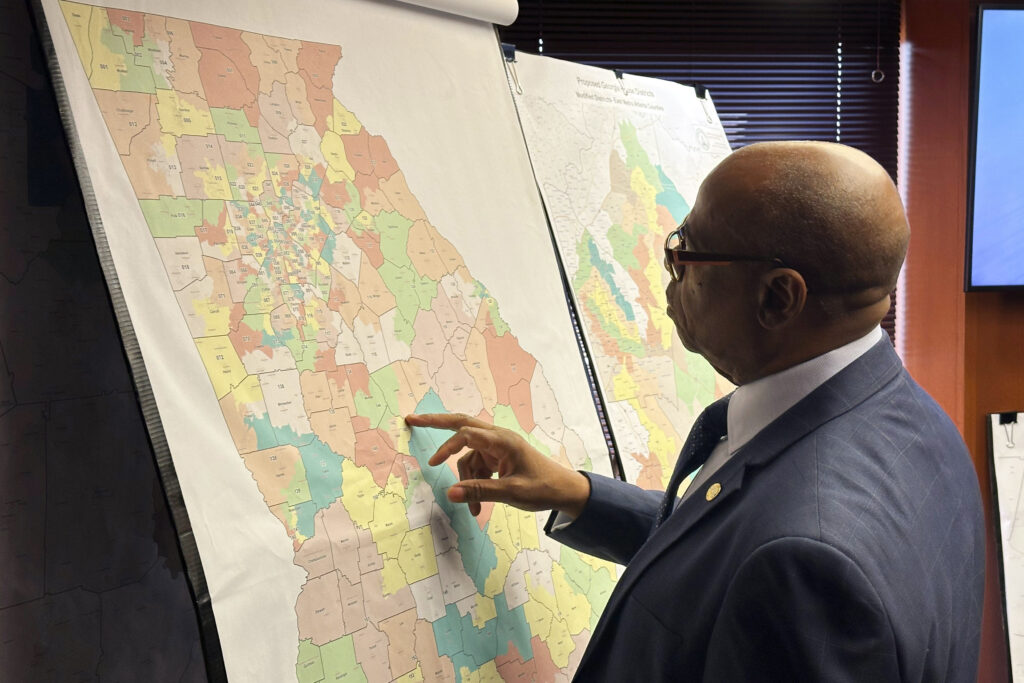
Most legal observers expect the U.S. Supreme Court will kneecap the ability of the Voting Rights Act (VRA) to block discriminatory election laws like racial gerrymanders when it issues its opinion sometime in the coming months.
But the most pressing question with Louisiana v. Callais might not be how the court will rule, but when.
Until now, Democrats have fought the redistricting wars kicked off last summer by President Doinald Trump, amid cratering approval numbers, more or less to a draw. All the time, though, they’ve feared that a ruling in Callais weakening the VRA could allow for yet more redraws, potentially giving the GOP a huge additional batch of seats in mostly southern states.
But with every passing day, experts say, it’ll get harder for more Republican-led states to heed Trump’s call.
Get updates straight to your inbox — for free
Join 350,000 readers who rely on our daily and weekly newsletters for the latest in voting, elections and democracy.
“If the Supreme Court delays a Callais decision until early summer, it might be at that point impossible to change district lines for the 2026 elections,” said Jeffrey Wice, a law professor at New York Law School. “But I would never say ‘never,’ because of the unpredictability of what Donald Trump might tell a state to do.”
Some voting rights experts worried Callais might be one of the first cases the Supreme Court handed down when its term began last week.
But not all.
“I was actually surprised to hear that Callais might have come out last Friday,” said Luis Fuentes-Rowher, a law professor at Indiana University Bloomington. “This is a blockbuster in every sense of the term, the kind of opinion that always comes out late in the term. For the Court to then release early would be a terrible look.”
Court watchers now mostly agree that Callais will come out toward the end of the term, whether because of the enormity and complexity of the case or due to some strategic foot dragging by the disappointed dissenting justices. The Supreme Court doesn’t say in advance when it’ll release specific rulings on cases they’ve heard, often unveiling the biggest decisions in a rush before their summer recess that can last into late June (and, occasionally, even July).
Trump has repeatedly fretted publicly about the oversight actions Democrats might take should they reclaim the House, including impeachment, while floating the idea of cancelling the election. In addition to his redistricting pleas, the president has called on states to end mail-in voting, impose strict voter identification laws, and take other actions to suppress turnout.
So if Callais goes the way democracy advocates fear, Trump will likely implore more Republican-led states to launch last-minute gerrymanders. Since he originally urged Texas to redistrict last summer, his approval ratings have only fallen as Americans have soured on the administration’s brutal immigration enforcement tactics, military adventurism abroad, and persistently high prices led by spiking health care and energy costs.
But at a certain point, it’ll be too late for them to do so, even if they want to, said Tammy Patrick, chief program officer at the National Association of Election Officials. And the deadline is sooner than some may think.
“The finish line is not the general election,” said Patrick. “It’s actually the primary election.”
Once voters cast primary ballots, the lines will be set for that election. And under the Uniformed and Overseas Citizens Absentee Voting Act (UOCAVA), primary ballots must be mailed out to overseas and military voters 45 days before an election. So election officials will need to have all their lines redrawn, ballots prepared, and machines prepped a month and a half before the primary election.
Implementing a redistricting is much more than just replacing the old electoral map with a new one, said Patrick. In many states, some electoral and district lines must be coterminous. “That doesn’t mean that they’re just redrawing the congressional lines or just the district lines, it also means that they may have to take into consideration municipalities, school districts, fire districts, board of supervisorial districts, all these other types of districts,” said Patrick. “That can mean dozens of districts or hundreds of districts.”
Making matters worse, most state and local election officials don’t have access to modern mapping technology, said Patrick. While lawmakers and independent redistricting commissions use GIS software to draw maps in shape files, Patrick estimates about a quarter of state and local election offices have that technology. “So, they are literally taking those maps and getting out colored pencils and redrawing lines manually and then physically moving every single voter into a new district,” Patrick said.
After that, for each new precinct, local election officials need to consider a series of questions. “How many poll workers need to be hired? How many voting booths need to be delivered? How many ballots need to be printed, and in what ballot style?” Patrick said.
Ballots need to be customized for each precinct, which means officials often need to print thousands of different ballots and then make sure they all are delivered to the correct polling places and absentee voters. When Patrick worked as the federal compliance officer in Maricopa County, Arizona, she said the office would need to print between 8,000 and 10,000 different ballots for the county’s 2 million registered voters.
Normally, states aim to have everything squared away a month or more before candidates start collecting signatures to get on the primary ballots.
Rushing the process means there would be little-to-no time to double check the work, uncover mistakes and fix them before the election. That would be a recipe for Election Day chaos, with voters perhaps receiving incorrect ballots or being sent to the wrong polling locations, all of which “lends fuel to the fire of voter fraud and mismanagement by the states and local governments,” Wice said.
An analysis by Fair Fight Action and Black Voters Matter identified 14 states where the elimination of Section 2 could lead Republican lawmakers to redraw 19 congressional districts into safe GOP seats. Of those, Texas, North Carolina, and Missouri have already redistricted this year, and one — Indiana — has already decided against redistricting this year.
Out of the rest, six are currently scheduled to hold primaries before June: Louisiana (May 16), Mississippi (March 10), Alabama (May 19), Kentucky (May 19), Ohio (May 5), and Georgia (May 19).
South Carolina’s primary is scheduled for June 9, while another four states have primaries in August (Tennessee, Missouri, Florida, and Kansas). Taking into consideration UOCAVA’s 45-day rule, a Callais ruling in June would give those states only a few days to perform all the redistricting work that normally takes months.
Now, any of those states could decide to push back their primary dates. Louisiana already did so last year, shifting the 2026 primary back a month, in a move Democrats decried as a naked attempt to buy mapmakers more time to redraw districts ahead of the midterms once the Court rules in Callais.
While Florida has already scheduled to take up redistricting in April, it’s unclear how many of the others might, even if the court guts Callais tomorrow. Ohio redrew its congressional maps last fall, giving Republicans better odds in two districts, as part of their normal redistricting process.
Candidate filing deadlines have also already closed in some of the states, like North Carolina and Mississippi, but those could theoretically be reopened and extended by lawmakers.
If a state did move to delay filing deadlines or primary dates, any federal candidate already running in those races would have standing to challenge, thanks to the Supreme Court’s recent decision in Bost v. Illinois State Board of Elections.
Still, Wice cautioned that he wouldn’t put anything past the GOP.
“Anything could happen anytime,” he said “We have to expect the unexpected, and that it’s really hard to predict what might happen.”