Virginians said ‘YES’ to redistricting. Will the courts now say ‘NO’?
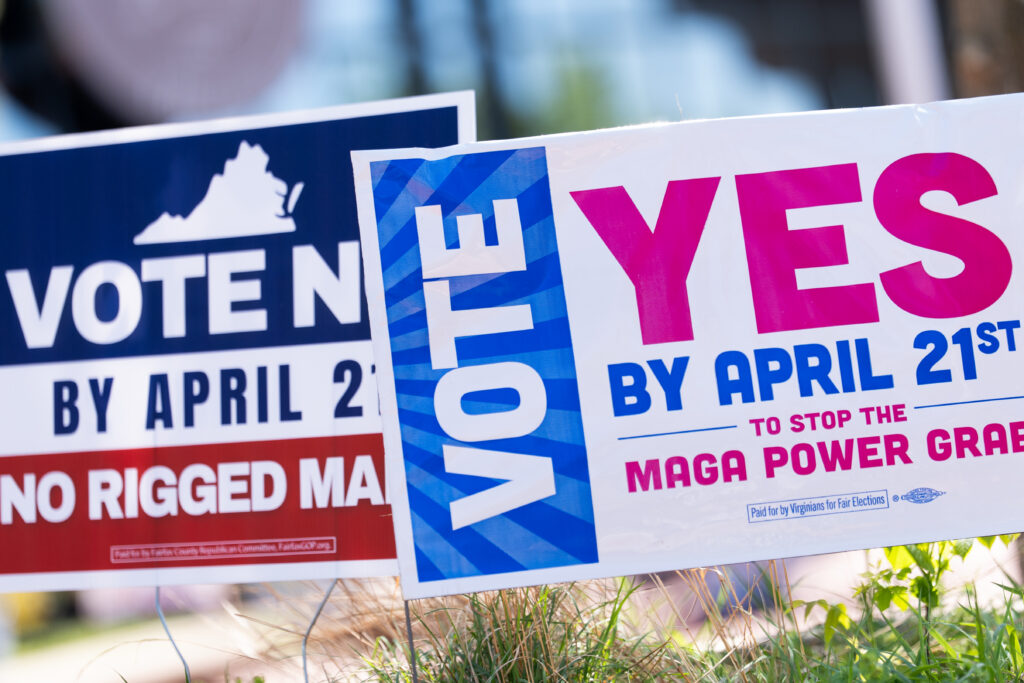
Virginia adopted an amendment to the Commonwealth’s constitution Tuesday night allowing the state legislature to redraw the congressional map and swing up to four House of Representatives seats to Democrats — if the courts don’t step in to block the plan after the voters have spoken.
Republicans launched multiple legal challenges to the referendum that remain pending in state courts. In a pair of cases, the Supreme Court of Virginia decided to allow the referendum to go forward while the legal challenges were pending, while litigation in a third has only recently begun.
No matter what happens next in these lawsuits, the results are sure to be appealed, and the fate of Virginia’s redistricting won’t be settled until the Virginia Supreme Court issues a final decision. But blocking the amendment after voters blessed it would send political shockwaves across the Commonwealth as courts are often reluctant to usurp the will of the voters.
The Associated Press called the special election at 8:49 p.m., less than two hours after polls closed. With 97% of the vote counted, “yes” votes led by roughly 3 percentage points.
Minutes later, Terry Kilgore, the Virginia House of Delegates GOP Leader, issued a statement saying the fight was far from done. “[T]he ballot box was never the final word here. Serious legal questions remain about both the wording of this referendum and the process used to put it before voters,” he said. “Those questions have not been resolved, and they now move where they belong: to the courts.”
Get updates straight to your inbox — for free
Join 350,000 readers who rely on our daily and weekly newsletters for the latest in voting, elections and democracy.
Republican state lawmakers first sued to block Virginia’s redistricting in October.* As polls showed Democrats cruising to a massive victory in November’s state legislature elections, Virginia Speaker of the House Don Scott expanded a special legislative session to launch the constitutional amendment referendum process. In McDougle et. al. v. Nardo et. al., Republicans argued that only the Virginia governor — then Republican Glenn Youngkin — could call or expand a special session, asking the court to block the amendment.
After a district court granted the injunction request, defendants appealed. The Court of Appeals asked Virginia’s Supreme Court to weigh in, and in February they stayed the injunction, allowing the referendum to move forward. The Virginia Supreme Court has yet to say whether it will schedule oral arguments in the case, which will be fully briefed come Thursday when the Democrats defending the referendum file a reply brief.
The Republican National Committee (RNC) led another legal challenge in a different district court in February that argued the redistricting amendment did not properly follow the necessary procedures for constitutional amendments. A trial court in Republican National Committee v. Koski granted a temporary restraining order to block preparations for the referendum vote, just a day after the complaint was filed. But shortly thereafter, the Virginia Supreme Court paused the restraining order and remanded the case back to the trial court for a final judgment.
If that judge again rules in favor of the RNC, Democrats will surely appeal the decision.
Finally, the RNC filed another legal challenge in March, along with the Republican Party of Virginia and some Virginia voters.* In that lawsuit, Republican National Committee v. Virginia State Board of Elections, the GOP plaintiffs focused their challenge on the newly drawn congressional districts, arguing that they “completely destroy” the districts drawn in 2021 and that the new map isn’t “compact” as required by Virginia’s constitution. The trial court there heard oral arguments on the Republicans motion for a preliminary injunction on Monday, but has yet to rule.
No matter how the judge there decides, the order will undoubtedly be appealed.
Trump now appears to be losing the redistricting war he launched last year when he called on GOP-controlled states to redraw their congressional maps in a bid to retain control of Congress in 2026.
While Republicans in Texas, Missouri and North Carolina passed new maps at Trump’s behest, they have been matched by new maps favoring Democrats in California and Virginia. As things stand right now, the new Republican maps give them an edge flipping seven districts, while the new Democratic maps will help them turnover 10 GOP-held districts, giving Democrats a 3 seat lead in the gerrymandering campaign.
But Florida lawmakers will convene a special legislative session next week that could add between two and five safe seats to the GOP’s tally.
Adeline Tolle contributed to this report.
*Intervenor-defendants in these cases are represented by the Elias Law Group (ELG). ELG Chair Marc Elias is the founder of Democracy Docket.