GOP states join DOJ in asking Supreme Court to let Trump block some mail ballots
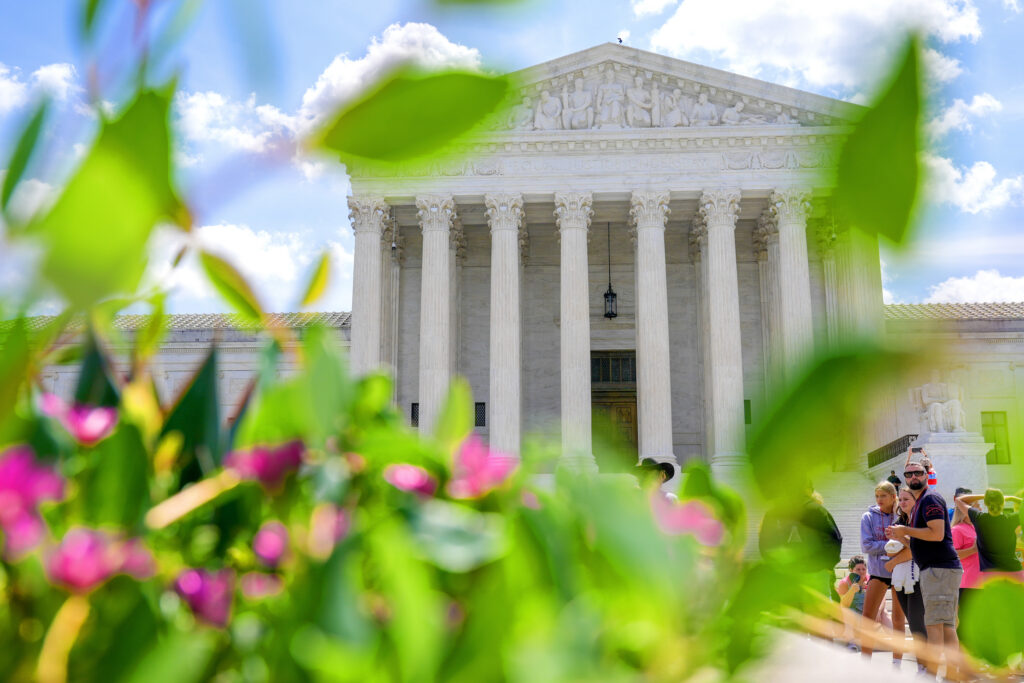
A dozen Republican states led by Missouri asked the U.S. Supreme Court to let President Donald Trump’s sweeping executive order attacking mail voting go into effect before the midterm elections in November.
Alabama, Florida, Indiana, Kansas, Louisiana, Montana, Nebraska, Oklahoma, South Carolina, South Dakota, and Texas joined Missouri in filing an emergency appeal Wednesday.
On Saturday, a three-judge panel for the 1st Circuit Court of Appeals upheld a lower court order blocking the U.S. Postal Service (USPS) from implementing Trump’s March decree on vote-by-mail. The Department of Justice (DOJ) filed its own stay application with the Court on Monday.
Justice Ketanji Brown Jackson has directed the 23 Democratic states who are challenging Trump’s order to file their rejoinder brief by 4 p.m. Aug. 3. As circuit justice for the 1st Circuit, Jackson can grant or deny the application, or she can refer it to the full Supreme Court to decide.
Trump’s order directs the Department of Homeland Security and the Social Security Administration to compile citizenship lists for states, which then would send their lists of eligible voters who requested mail-in or absentee ballots to USPS. It then directs the Postal Service not to deliver ballots from voters not on the lists.
USPS proposed a rule in June to enact Trump’s edict, and Postmaster General David Steiner later told U.S. senators that mail carriers would not deliver mail ballots in states that refused to send voter lists to USPS.
Like the DOJ, the GOP-led states argued in their filing Wednesday that the injunction was “premature” because no federal agency had fully implemented a rule stemming from Trump’s order yet.
“[T]he District Court enjoined the EO based on rampant speculation about potential future federal policies that continue to evolve before they are finalized and put into effect,” the states argued.
Get updates straight to your inbox — for free
Join 350,000 readers who rely on our daily and weekly newsletters for the latest in voting, elections and democracy.
The states essentially contend that it’s too soon to block a very likely illegal order — the U.S. Constitution clearly empowers states to administer elections with Congressional supervision, leaving no role for the president — because we don’t yet, less than 100 days before the midterms, have any idea how the administration might attempt to implement it.
“The District Court speculated that these lists will be inaccurate and potentially cause States to remove eligible voters from the registration rolls,” the red states wrote. “But at the time Respondents sued, important details about the policy were not set. That is true even now; for example, the parties still do not know which databases federal agencies will use, whether those databases will be inaccurate, and whether and how each individual State would use the lists.”
In two separate lawsuits challenging the executive order, the U.S. Court of Appeals for the District of Columbia allowed the Trump administration to continue working on the order. In both, the court agreed that the challenges were premature because the administration had not yet done enough to put the order into practice for judges to assess its legality.
However, in its opinion Tuesday, the D.C. Circuit Court made clear that, for procedural reasons, it didn’t consider recent steps taken by USPS and DHS in furtherance of the order. And it suggested that an injunction might now be timely given what has transpired since the lower court denied a preliminary injunction in May.
“The action the Order contemplates would involve the President, whom the Constitution vests with no express authority over the conduct of elections, undertaking a substantial and unfunded overhaul of election procedures—including the implementation of a nationwide reform to Postal Service mail-handling processes—on the threshold of the November election,” the D.C. circuit panel wrote. “Put differently, the Order ‘may not prove feasible to implement in any manner whatsoever,’ at least before the 2026 election to which Plaintiffs tie their claims of irreparable harm.”