Trump intimately involved in DOJ’s seashell case against James Comey, new filing alleges
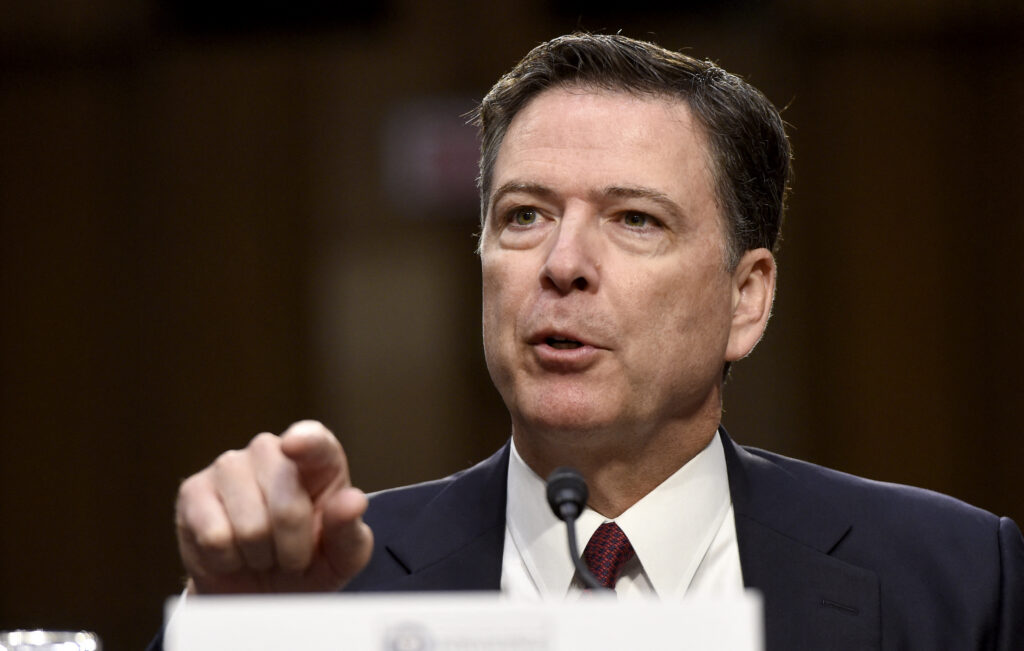
President Donald Trump demanded details from the Secret Service’s interview with former FBI Director James Comey over a social media post featuring seashells that the Department of Justice (DOJ) alleged was a threat to kill the president, according to a new court filing.
The new detail is the clearest indicator yet of Trump’s intimate involvement in the prosecution of his political enemies and another example of the president personally directing law enforcement agencies to take specific actions in sensitive investigations.
The disclosure was included in Comey’s new request to throw out the felony charges against him over the May 2025 post, which featured a photo of seashells on a North Carolina beach arranged to spell “86 47,” a common anti-Trump slogan.
Get updates straight to your inbox — for free
Join 350,000 readers who rely on our daily and weekly newsletters for the latest in voting, elections and democracy.
In his filing Tuesday evening, Comey argued that Trump’s request for the interview details — among other evidence — indicated close coordination between the Secret Service, the DOJ, the FBI and the White House throughout the seashell case.
That coordination, Comey argued, proved that the case amounted to a vindictive and selective prosecution in violation of the First Amendment and due process and equal protection principles. He asked U.S. District Judge Louise Wood Flanagan, a George W. Bush appointee overseeing the case, to throw out the charges.
The new allegations were based on public statements from Trump officials, as well as internal government documents that the Trump administration turned over to Comey’s lawyers.
“Ample objective evidence—much of which comes directly from government officials’ own public statements and admissions—establishes that the President’s animus toward Mr. Comey led to this vindictive and selective prosecution,” his latest motion to dismiss reads.
Earlier this year, the DOJ accused Comey of calling for Trump’s assassination through the post and charged him with one count of making threats against the president and another of transmitting those threats through interstate communications. If convicted, he could face up to 10 years in prison and a maximum criminal fine of $250,000.
Trump officials and many of the president’s allies claimed that, through the post, the former FBI chief was calling for the president’s assassination. Comey said he came across the shells while walking along the beach and assumed the message was a political call to oppose Trump, who is the 47th president. He said he didn’t realize that some associate “86” with political violence, which he denounced.
Even though Comey removed the post, the Secret Service had him physically and digitally trailed and also questioned him on May 15, the same day he made the post.
Around the same time as that interview, “the Secret Service was closely coordinating with the DOJ and the President himself,” Comey said in his new filing.
“The Secret Service sent frequent updates to Air Force One, in response to direct requests from President Trump who wished for an update in advance of speaking to the press,” Comey alleged.
A day after the Secret Service questioned Comey, Trump claimed in a Fox News interview that the former FBI chief was “a dirty cop” who “meant assassination” through the post.
The president also asserted he was “not going to get involved” in the Secret Service’s investigation even though he had already demanded intimate details from its interview with Comey.
Comey also said that a Secret Service agent acknowledged that the “number three” person at the DOJ ordered that the former FBI chief be electronically surveilled without a warrant, even though the agent “made clear that it was ‘legally’ a ‘bad idea’ because there was no belief of ‘imminent danger to life.’”
FBI documents filed alongside the motion to dismiss indicate that federal investigators were desperate to prove that Comey must have known that “86” was a term for committing violence.
Investigators unsuccessfully searched decades-old organized crime cases Comey worked on early in his career as a federal prosecutor and tried to scour Comey and his wife’s social media accounts for references.
They also sought input from Salvatore “Sammy the Bull” Gravano, a notorious former mobster who previously confessed to his involvement in 19 murders.
While Gravano told investigators that he believed all law enforcement agents know that “86” is mob slang for killing someone, Comey’s lawyers noted that the former gangster did not indicate that he personally understood the seashells post to be a violent threat.
Comey has maintained that “86” can mean to eject, dismiss or remove someone or something.
In addition to his new motion to dismiss, the former FBI chief also asked Judge Flanagan to probe the grand jury proceedings that led to the charges in the seashell case. Comey argued increased scrutiny was necessary because grand jury proceedings in the DOJ’s previous criminal case against him in Virginia last year were “highly irregular.”
Earlier this week, Comey asked Flanagan to drop the charges because his anti-Trump post couldn’t constitute a serious expression of intent to commit harm, also known as a “true threat,” against the president.
Comey is set to be arraigned on the charges in a federal court in New Bern, North Carolina, on Sept. 30. He is expected to plead not guilty. If the charges survive until he issues a plea, he will face a jury trial starting Oct. 21.