Appeals court backs Trump bid to block some mail ballots, for now, as Supreme Court mulls issue
 Prefer us on Google
to see more of our voting rights news coverage when you search.
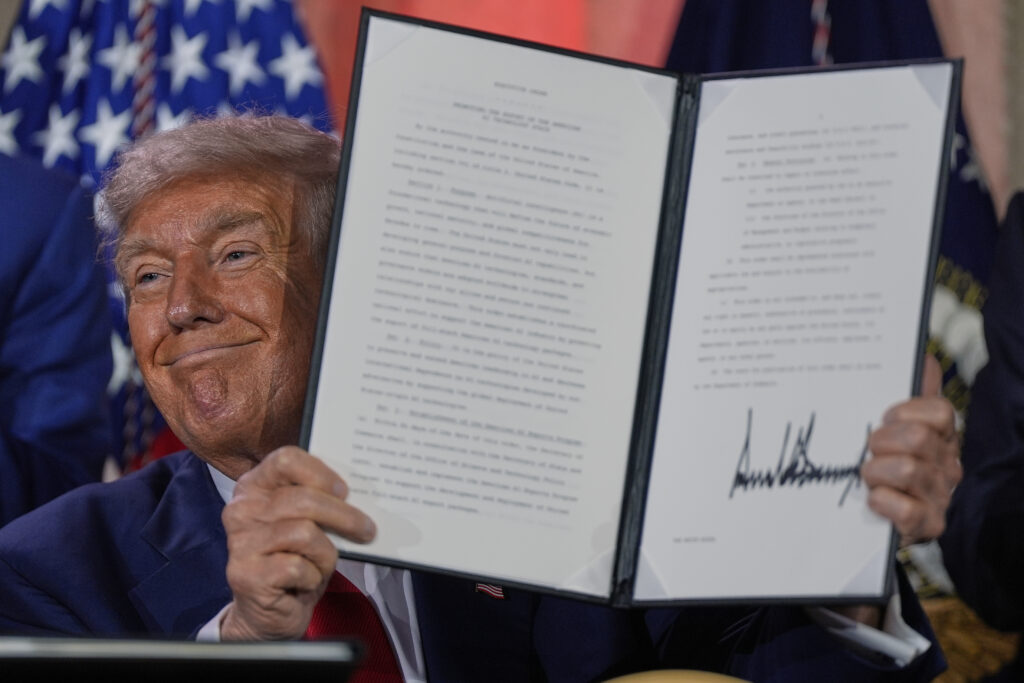
A federal appeals court is letting the Trump administration continue implementing President Donald Trump’s anti-mail voting executive order. The ruling Tuesday comes a day after the administration asked the U.S. Supreme Court to lift a block on implementing the order in 23 Democratic-led states and Washington, D.C. upheld in a separate case.
Together, the twin developments over the last 24 hours suggest that with midterm voting set to begin in under two months, a resolution to the high-stakes voting question — in which large numbers of voters are at risk of having their mail ballots go uncounted — may soon be approaching.
The United States Court of Appeals for the District of Columbia affirmed a lower court’s decision, holding that a lawsuit challenging the constitutionality of Trump’s March 2026 edict was premature because the administration hasn’t executed it yet.
“[W]hile Plaintiffs have identified a number of serious questions concerning the lawfulness of proposed actions if implemented on the threshold of the upcoming federal election, this case likely is unripe for review in its present posture,” the judges wrote. “If the defendant agencies take steps to implement the Executive Order in a manner that violates federal law or the Constitution, Plaintiffs can promptly seek relief, which the district court and this court can decide in as expeditious a manner as circumstances require.”
But in a potential positive sign for voters, the court also noted that, for procedural reasons, it had not considered the steps USPS had taken over the last few weeks to implement the order.
“Since appealing, Plaintiffs have informed this court of subsequent factual developments bearing on the ripeness of their claims,” the judges wrote. “We do not consider those developments because they are not part of the record before the district court or before us on appeal.”
That could offer reason to believe that, once the court considers those more recent steps, it could decide that the challenge is no longer premature.
Get updates straight to your inbox — for free
Join 350,000 readers who rely on our daily and weekly newsletters for the latest in voting, elections and democracy.
After Trump signed the executive order in March, which ordered the U.S. Postal Service (USPS) to send mail ballots in new barcoded envelopes only to voters on citizenship lists compiled by the Department of Homeland Security (DHS) and the Social Security Administration, Democratic groups led by the Democratic Senatorial Campaign Committee quickly sued.* But U.S. District Judge Carl Nichols denied the preliminary injunction in May, saying it would be premature to issue it when the federal agencies hadn’t begun implementation yet.
The D.C. circuit court’s opinion comes just days after the U.S. Court of Appeals for the First Circuit ruled against the Trump administration Saturday, affirming the preliminary injunction a federal court in Massachusetts issued blocking the executive order’s implementation in 23 states and Washington, D.C. There, the circuit court panel rejected the government’s appeal 2-1, with one – Judge Joshua D. Dunlap, a Trump appointee – dissenting to part of the ruling.
Almost immediately after, the Department of Justice (DOJ) asked the Supreme Court to allow the sweeping attack on mail voting to go into effect before the upcoming midterm elections, filing an emergency appeal Monday.
That request marks the first time that the Trump DOJ has asked the Supreme Court to weigh in on one of Trump’s anti-voting executive orders.
In both the D.C. and Massachusetts cases, the Trump administration argued that it was too soon for courts to weigh in because USPS, which has proposed a rule in furtherance of the executive order, has not yet finalized those new regulations. The circuit courts’ apparent split on that question makes a Supreme Court intervention more likely.
The D.C. Circuit’s decision seemed to treat the legalistic caveats in Trump’s order with a credulity other courts have rejected.
“[T]he Executive Order, which is not self-executing, directs the agencies to act only to ‘the extent feasible and consistent with applicable law, including but not limited to the Privacy Act of 1974,’ and so requires compliance with the very legal limitations about which Plaintiffs are concerned,” the D.C. panel wrote.
That contrasts sharply with what the First Circuit said over the weekend in holding that the states’ challenge was timely. “[A]s the Supreme Court held just last year, a litigant at ‘substantial risk [of] harm’ from a government policy need not ‘wait and see’ how exactly it will be implemented to bring suit,” the majority wrote.
However, the D.C. Circuit Court later suggested that the executive order’s savings clause might fall short of safeguarding the order once a challenge is ripe. “The action the Order contemplates would involve the President, whom the Constitution vests with no express authority over the conduct of elections, undertaking a substantial and unfunded overhaul of election procedures—including the implementation of a nationwide reform to Postal Service mail-handling processes—on the threshold of the November election,” the judges wrote. “Put differently, the Order ‘may not prove feasible to implement in any manner whatsoever,’ at least before the 2026 election to which Plaintiffs tie their claims of irreparable harm.”
Last week, voting rights groups in a separate lawsuit challenging the executive order renewed their own entreaty for a preliminary injunction. That came after a different D.C. Circuit panel in yet another lawsuit against Trump’s edict suspended a lower court’s nationwide injunction while the government’s appeals there — again, on the question of ripeness — are considered.
USPS has said in letters to Congress and regulatory filings that it would not finalize its proposed rule until the court injunctions are lifted. A spokesperson for USPS declined to clarify whether the rule might be finalized against the 27 states not subject to the Massachusetts court’s injunction, citing the ongoing litigation.
*The Democratic plaintiffs in this case are represented by Elias Law Group (ELG). ELG firm chair, Marc Elias, is the founder of Democracy Docket.
*Maya Bodinson and Adeline Tolle contributed to this report.