Trump admin begs Supreme Court to quickly unblock anti-mail voting executive order
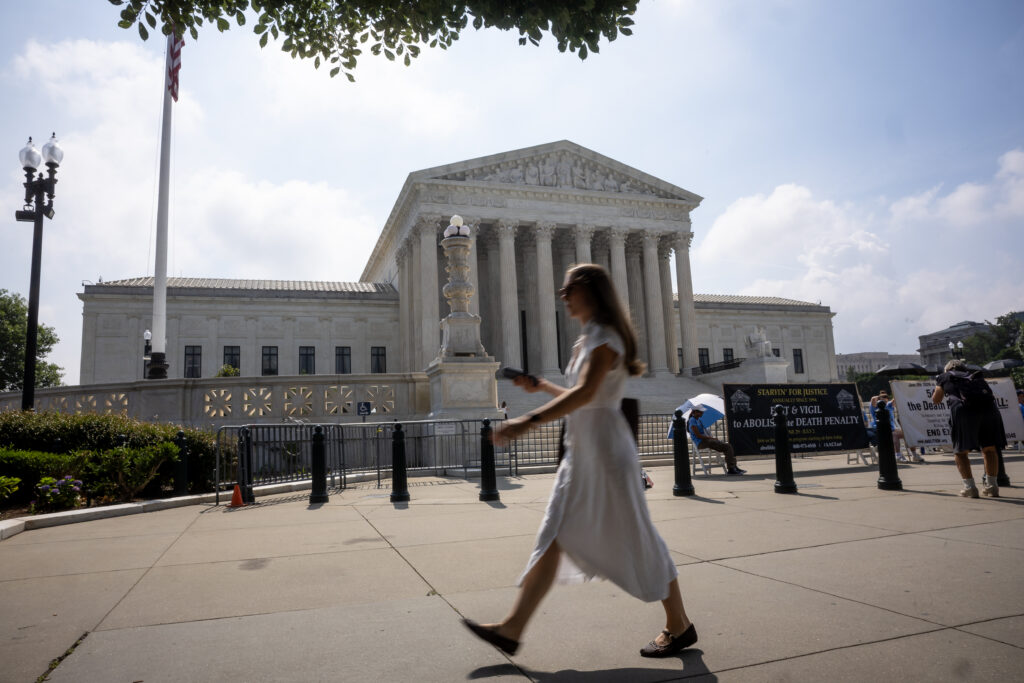
The Trump administration has asked the U.S. Supreme Court to hurry up and let it implement sweeping restrictions on mail voting that President Donald Trump is attempting to impose by executive order.
In a supplemental brief Wednesday, the Department of Justice urged the Court to overturn two separate orders issued by U.S. District Court Judge Indira Talwani that prevent the administration from implementing the order nationwide.
“The district court’s new order confirms the urgent need for this Court to grant the stay of the permanent injunction and to explain its rationale for doing so,” Solicitor General D. John Sauer wrote.
The DOJ’s request emphasizes the Trump administration’s desire to impose the mail voting restrictions for the November midterms.
The administration originally asked the Supreme Court to stay a permanent injunction that prevents the order from taking effect in 23 states and the District of Columbia after a three-judge panel for the 1st Circuit Court of Appeals upheld Talwani’s order in June. Now it also wants the justices to overturn a separate order Talwani issued Monday in response to a lawsuit from the League of Women Voters of Massachusetts that halted the order’s implementation nationwide.
Trump’s executive order directs the Department of Homeland Security and the Social Security Administration to compile citizenship lists for states, which would then send their lists of eligible voters who requested mail-in or absentee ballots to the U.S. Postal Service (USPS). It then directs the USPS not to deliver ballots from voters who aren’t on the lists.
Get updates straight to your inbox — for free
Join 350,000 readers who rely on our daily and weekly newsletters for the latest in voting, elections and democracy.
USPS proposed a rule in June to enact Trump’s edict, and Postmaster General David Steiner later told U.S. senators that mail carriers would not deliver mail ballots in states that refused to send voter lists to USPS.
In hectoring the court to act faster, the administration appears to be ignoring the terms of Trump’s decree. The order, and the subsequent Postal Service proposed rulemaking, asks states to notify USPS that they will use mail-in ballots “no fewer than 90 days prior to a Federal election.” That 90-day deadline passed last week.
“In all events, it is critical that the Court act promptly on the pending stay,” Sauer wrote. “Otherwise, the district court’s erroneous orders will effectively run out the clock on the government’s ability to implement Section 3 of the Executive Order for the federal elections in November, thereby causing irreparable harm to the federal government, the public, and election integrity.”
Voting experts have warned that the order, even if quickly implemented, would confuse mail voters and wreak havoc on ballot counts. Around 48 million votes were mailed in 2024, and 35 million in 2022.
The supplemental brief, like the federal government’s other filings in these cases, ignores the U.S. Constitution’s Elections Clause, which provides that states and Congress, not the president, have the authority to regulate federal elections. Instead, the brief focuses on the procedural argument that it’s simply too soon for courts to rule on the order’s legality.
“Courts cannot enjoin implementation of an Executive Order that merely instructs agencies to pursue a proposed policy in a manner that is consistent with law, while leaving open material issues for them to resolve, unless and until those agencies actually take concrete actions that injure the plaintiffs,” Sauer wrote.
In two separate lawsuits filed in Washington, D.C., federal appellate judges have agreed with the administration’s argument that the executive order’s implementation wasn’t far enough along for the courts to assess its legality because the Postal Service has not yet issued a final rule to implement the order. However, in one of those rulings, the U.S. Court of Appeals for the D.C. Circuit suggested the decree was constitutionally dubious, noting that — once the order is developed enough to make a legal challenge “ripe” — it could be quickly enjoined.
Facing so many ongoing legal challenges, the administration’s supplemental brief asks the Supreme Court to write its stay decision to explicitly cover them all.
“[T]o avoid any risk of yet another instance where multiple emergency applications are needed due to contrived doubts about the scope of this Court’s stay orders it would be prudent for this Court to make clear that the Article III problem warranting a stay is based on the uncertainty concerning the government’s future actions, not anything specific to the individual plaintiffs—in fact, the government’s briefing in this Court did not even make any such plaintiff-specific arguments,” it states.
The Supreme Court received briefs in the emergency stay application early last week but has yet to issue an order.