Alito, Thomas stand by Trump mail voting rule the rest of Supreme Court rejected
 Prefer us on Google
to see more of our voting rights news coverage when you search.
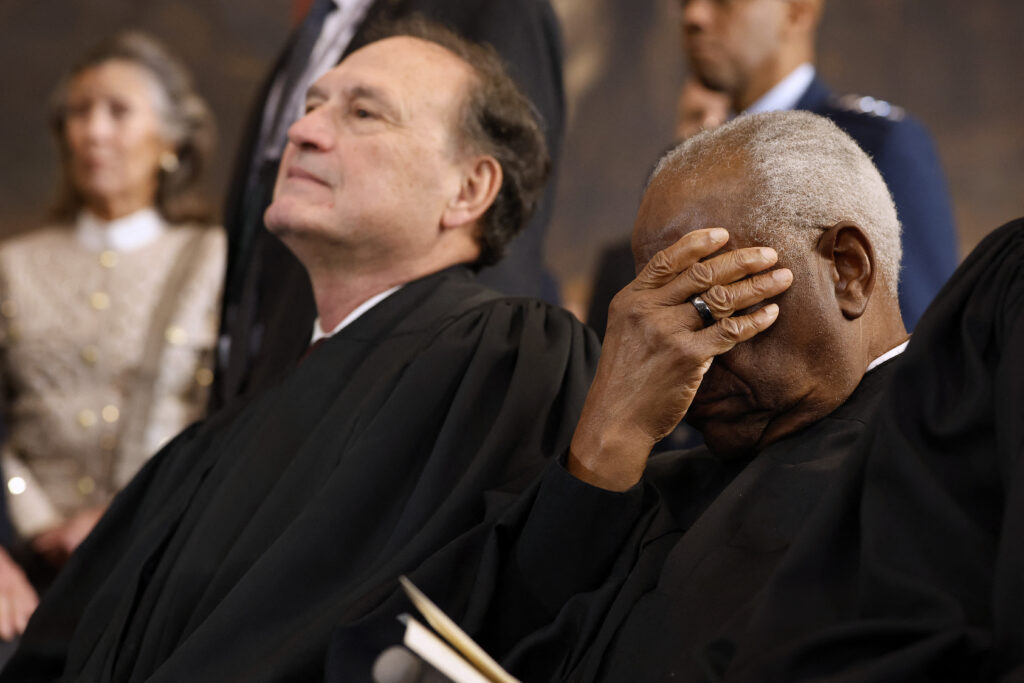
U.S. Supreme Court Justice Samuel Alito mounted a failing defense of President Donald Trump’s effort to restrict mail voting after the majority of the Court refused to let the restrictions take effect before the midterms.
In a dissent joined by Justice Clarence Thomas, Alito offered the high court’s only defense of Trump’s attempt to clamp down on mail voting just weeks before the midterms.
Alito argued, essentially, that, as the government had claimed, the U.S. Postal Service (USPS) rule implementing the order was simply a mailing requirement similar to others that it might create, not a sweeping attempt to regulate mail voting.
None of Trump’s three appointees agreed to intervene and lift a lower court order barring the rule from taking effect before the election. Justices Neil Gorsuch and Amy Coney Barrett joined the majority opinion. Separately, Justice Brett Kavanaugh wrote a short concurring opinion saying it’s too close to the election to implement the rule before voting begins, but leaving the door open to implement it in the future.
Get updates straight to your inbox — for free
Join 350,000 readers who rely on our daily and weekly newsletters for the latest in voting, elections and democracy.
Despite the court’s near consensus, Alito argued that the Postal Service’s rule is well within the authority given to it by Congress to regulate the mail system. To dispute that, the challengers had to argue that the rule was “ultra vires” or completely beyond the scope of the power granted to the Postal Service, which Alito rejected.
“It is also not clear that the Postal Service created a new class of nonmailable matter, let alone that it is specifically prohibited from doing so,” Alito wrote.
The Postal Service’s rule established new envelope requirements for mail ballots, which states would need to submit for review prior to the election. It also required states to submit to the federal government a list of authorized mail voters.
“The rule’s requirements appear more similar to other threshold requirements for mailing—such as the basic requirement to list the recipient’s address on one side of the package or stamping requirements—that do not render noncompliant mail ‘nonmailable material,’” Alito wrote.
Alito’s argument comes after a federal district court judge in the District of Columbia issued a second injunction Sunday blocking the rule in a separate case brought by Democratic organizations, finding that the rule is likely ultra vires and exceeds “any conception of the outer bounds” of the Postal Service’s statutory authority.*
However, Alito argued that the states and voting organizations challenging the rule failed to adequately show that the voting restrictions are so unreasonably beyond the Postal Service’s powers.
“I express no view on whether the Government would be likely to succeed on de novo review of the Postal Service’s powers. But for now, the Government has satisfied its burden of making a strong showing that the plaintiff States’ ultra vires claim is not likely to succeed,” Alito wrote.
Sen. Andy Kim (D-N.J.) said on social media that it is “scary” the Supreme Court’s decision wasn’t unanimous. “Two justices, Alito and Thomas, completely willing to shred our Constitution,” he wrote.
Kavanaugh, a Trump appointee, was more measured, writing that there is “at least a fair prospect that the final rule falls within the Postal Service’s statutory authority.” However, he joined the majority in refusing to reinstate the rule because he believes it left too little time for local election officials to prepare. That stance leaves open the prospect of reviving the measure for future votes.
Trump, who frequently votes by mail himself, has tried to claim his voting order is about securing the nation’s elections from fraud. However, his administration failed to produce any evidence of mail-voting fraud to justify the restrictions.
However, Alito argued in his dissent that the government has a vested interest in securing the election system and that halting the mail voting rule would harm the federal government more than the states who, under the Constitution, administer elections. Alito said that the various court orders halting the mail voting rule prevented the Postal Service from completing the regulation and implementing it with adequate time before the midterms.
“In April, the plaintiff States sued to challenge the President’s internal directive to subordinates mandating a rulemaking. For months, this litigation cast a cloud over the Government’s ability to issue a final rule,” Alito wrote. “The District Court entered several injunctions months later prohibiting the Government from undertaking that rulemaking.”
Alito also blamed the Supreme Court’s Democrats for exacerbating that delay.
“Indeed, this Court spent from late July to the end of August drafting nearly 40 pages of opinions, including two dissents, despite the Government’s public notice that it would not publish a final rule while subject to the injunctions … and its representation that it had a strong interest in issuing its rule in early to mid-August to allow time to implement it,” he wrote.
The Supreme Court in August ruled that prior efforts to halt the mail voting rule were premature. Justice Ketanji Brown Jackson slammed the Republican majority in a fiery dissent that accused the high court of injecting “chaos and uncertainty” into the 2026 midterm elections.
*The Elias Law Group (ELG) represents Democratic plaintiffs in a separate challenge to the order. ELG Firm Chair Marc Elias is the founder of Democracy Docket.