Holly Jolly Gerrymander: Here’s How Trump Attempted to Rig Elections in 2025
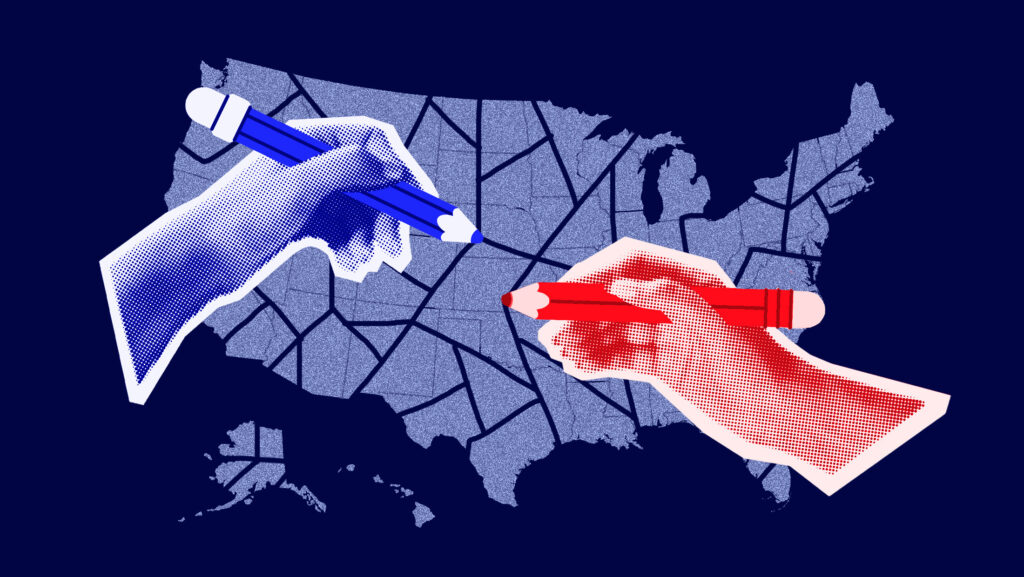
Much like replacing a smoke detector or coming down with the flu, it’s best if we only have to deal with redistricting once per decade.
And yet, here we are, mid-decade, wading through nonstop redistricting news because 77 million people voted for a convicted felon who will happily demolish democracy like it’s the East Wing of the White House if it helps him hold on to power in the 2026 midterm elections.
We’re living in a fragile moment for America’s political maps. Seven months into President Donald Trump’s redistricting arms race, several states have rushed to rewrite their congressional maps ahead of next year’s midterm election – a situation the U.S. Supreme Court enabled in 2019 with its Rucho v. Common Cause decision, which gutted federal courts’ power to stop partisan gerrymandering. And the high court is poised to hand down yet another landmark ruling in the new year that could have profound consequences for redistricting by dramatically weakening the Voting Rights Act’s protections against racial gerrymandering.
With that in mind, here’s a look at what transpired during the redistricting chaos of 2025.
Get updates straight to your inbox — for free
Join 350,000 readers who rely on our daily and weekly newsletters for the latest in voting, elections and democracy.
Texas
It all started in the Lone Star State, where Republican lawmakers scrambled to bend the knee to Trump when he demanded more GOP-friendly congressional seats.
In August, Trump said the Republican Party was “entitled to five more seats” in Texas. State House Democrats put up a good fight – many of them even fled to Illinois to block Republicans from holding a vote on the map. And Texas Republicans responded by threatening Democrats with arrest, urging law enforcement to “hunt” them down and filing lawsuits to remove them from office.
Democrats eventually returned and the map passed. After voting advocates and minority voters challenged* it in court, a panel of federal judges ruled to block the map, agreeing it was likely a racial gerrymander. But the U.S. Supreme Court then intervened, clearing the way for Texas to use its new map in 2026.
California
California quickly responded, with Democratic lawmakers racing to pass a map that countered the GOP gains in Texas. Unlike in Texas, California had to get voter approval for the plan. In November, California voters overwhelmingly passed the ballot measure, greenlighting a map that could see Democrats pick up five seats. Republicans swiftly challenged it in court, claiming it was a racial gerrymander illegally drawn “to favor Hispanic voters.” A panel of federal judges heard the case* earlier this month, but has not yet issued a ruling.
Missouri
Missouri Republicans rushed a gerrymander through the legislature in September, setting off a staggering amount of litigation, which continues to this day. Opponents have filed lawsuits* claiming the state’s constitution bans mid-decade gerrymanders.
But their best chance of stopping the effort may be through another route: The Missouri constitution gives voters the power to veto acts of the legislature in a referendum, so opponents of the gerrymander got to work organizing. Within 90 days, they had turned in a petition signed by more than 300,000 Missourians who wanted to put the map to a statewide vote.
Republicans have fought the referendum at every turn, and they could succeed in blocking it from appearing on the ballot. What’s at stake in Missouri is more than the one congressional seat the new map would likely hand to Republicans. Voters’ right to hold a referendum and check the power of the legislature is also in jeopardy.
North Carolina
North Carolina Republicans passed their gerrymander in October that could deliver one more congressional seat to the GOP at the expense of Black voters. Democrats described the map as “blatant discrimination” and challenged* it in court. A panel of federal judges in November ruled that the state can use its new gerrymander in 2026.
For a state with an even partisan split, North Carolina’s congressional delegation now reflects a politically distorted reality. It elected a 7-7 congressional delegation as recently as 2022. But after the new GOP-majority North Carolina Supreme Court legalized partisan gerrymandering in 2023, the delegation is now 10-4 Republican. Under the new map, it could be 11-3 in 2026.
Ohio
Ohio Republicans adopted a new map in October that gives the GOP better odds in two districts currently held by Democrats. Ohio voters have fought for years to establish a fair redistricting process, but the map ultimately was drawn up by a GOP-majority redistricting commission. Notably, the state didn’t take up redistricting this year at Trump’s request. Rather, Ohio’s convoluted redistricting rules required the state to redraw its map this year.
Utah
Utah’s 2025 redistricting battle showcased just how far the GOP is willing to go – and how relentlessly they’ll fight – to stop voters from holding fair elections.
In November, a Utah judge struck down the GOP-controlled legislature’s congressional map, finding that it violated a voter-approved state constitutional amendment banning partisan gerrymandering. As a result, Democrats could potentially pick up one of the state’s four congressional seats, which are currently all held by Republicans.
But Republicans are now moving on to even more extreme measures – rejecting the court-ordered congressional map and extending the filing deadline for candidates running for those seats. That’s a signal that they will appeal the November ruling to the Utah Supreme Court, and possibly the U.S. Supreme Court.
They’re also taking steps to repeal the voter-approved amendment banning partisan gerrymandering. And they passed a bill giving the Utah Supreme Court exclusive jurisdiction over future redistricting cases.
Indiana
This year, Hoosiers did what so many Republicans before them seemingly could not: They said no to Trump.
After facing months of threats, harassment and intimidation from the Trump administration and its backers, a majority of Indiana Senate Republicans voted down redistricting, refusing to go along with a plan that could have allowed the GOP to pick up two more congressional seats.
Next year
The new year will bring new battles over congressional maps.
Virginia Democrats are set to move forward with redistricting in 2026, but they will need voter approval to do so. Democrats currently hold 6 of the state’s 11 congressional seats, but some Democrats are pushing for a 10-1 map.
Maryland Gov. Wes Moore (D) and other top state Democrats, have advocated for redistricting, and launched a commission to explore the idea. But standing in their way is Maryland Senate President Bill Ferguson (D), who has adamantly opposed the idea. It’s unclear which side will prevail.
The Wisconsin Supreme Court declined to take a redistricting case over the summer, but two more lawsuits are moving forward that challenge the existing congressional map as a partisan gerrymander favoring Republicans. If the court ultimately orders a map that accurately reflects the state’s even partisan split, Democrats could pick up two additional seats in Congress.
Meanwhile, Florida Republicans plan to launch a mid-decade redraw. They already hold a 20–8 advantage in their congressional delegation, and the new map could deliver several more GOP seats. One possible problem for them: Florida voters passed a ban on partisan and racial gerrymandering in 2010 — though the state’s GOP-controlled Supreme Court greenlit a Republican gerrymander earlier this year.
As we head into 2026, stay tuned to Democracy Docket for the latest news in the national redistricting arms race.
*The Elias Law Group (ELG) represents parties in the case. ELG Firm Chair Marc Elias is the founder of Democracy Docket.