North Carolina Passes Trump Gerrymander Targeting Black Voters, With Legal Challenge Likely
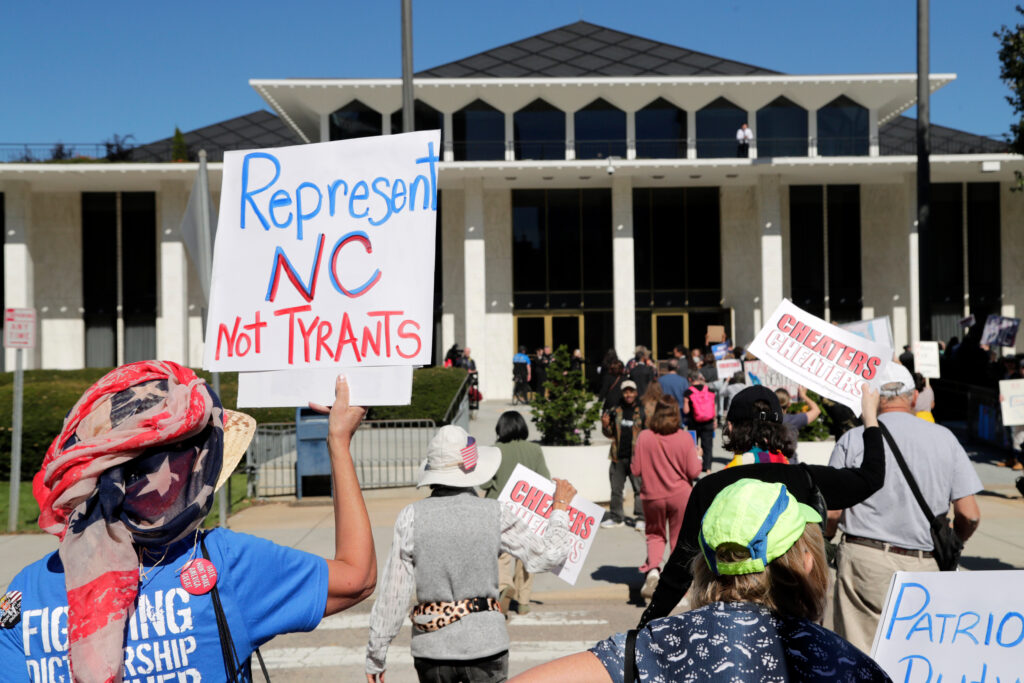
North Carolina on Wednesday became the latest state to enact a gerrymandered congressional map at the request of President Donald Trump – a redraw designed to create an additional Republican seat in Congress, at the expense of Black voters.
Ignoring ongoing and impassioned protests by voters in the chamber, the North Carolina House voted 66-48 to pass the map. With the Senate having approved the measure Tuesday and no role for the governor in the state’s redistricting process, it became law.
Both chambers advanced the map after providing minimal opportunity for public input and making no changes to the plan based on the feedback they received.
North Carolina is the third state to redraw district lines this year at Trump’s demand, following Texas and Missouri. Utah also passed a new gerrymander this month – a redraw stemming in part from ongoing redistricting litigation. Ohio has a gerrymander in the works, as well. Trump is also pressuring Republican lawmakers to create more GOP congressional seats in Kansas, Indiana, Florida and other states.
Get updates straight to your inbox — for free
Join over 350,000 readers who rely on our daily and weekly newsletters for the latest in voting, elections and democracy.
The North Carolina redraw leaves 12 of 14 districts untouched, specifically targeting a group of Black residents who are moved out of the 1st Congressional District and into the 3rd – including the district’s congressional representative, Rep. Don Davis, a Black Democrat. The 1st district will now have a 55-45 GOP lean.
Shortly before the final vote, House Democratic Leader Robert T. Reives II implored Republican House members to break with their party and vote against a map he said was drawn only to benefit Trump.
“We are the last line of defense for this state,” Reives said. “We are the last line of defense for the people who got us here.”
The map represents a stark new reality for a state that’s evenly split between Republicans and Democrats. North Carolina elected a 7-7 congressional delegation as recently as 2022. But after the new GOP-majority North Carolina Supreme Court legalized partisan gerrymandering in 2023, the delegation is now 10-4 Republican. Under the new map, it could be 11-3 in 2026.
For a third day in a row, North Carolina residents were escorted out of the proceedings after chanting against the map.
House Speaker Destin Hall (R) chided demonstrators: “The sergeant-at-arms will clear the gallery of the folks who have self-selected for themselves to be removed, who believe their voices are more important than everyone else’s.”
State Rep. Brenden H. Jones (R) on Wednesday repeated the GOP talking points used throughout the state’s astonishingly brief, three-day redistricting process: the map was drawn without using racial data, and the gerrymander was a necessary response to California’s decision to redraw maps if voters approve Proposition 50 in November.
“Proposition 50 has backfired,” Jones told lawmakers. “North Carolina will not be lectured, will not be bullied, will not be sued into submission.”
North Carolina Republicans have ignored that California’s redraw came in response to a Texas gerrymander.
Democrats have argued the North Carolina GOP didn’t need racial data in order to draw a discriminatory map. They’ve also noted that California voters will decide whether to enact the proposed congressional map, while North Carolina voters won’t have that opportunity.
State Sen. Ralph Hise (R), who said he drew the gerrymander himself, argued the objective was to draw another seat for Trump.
“The motivation behind this redraw is simple and singular. Draw a new map that will bring an additional Republican seat to the North Carolina congressional delegation,” Hise said during the Senate committee hearing Monday. “Republicans hold a razor-thin margin in the United States House of Representatives and if Democrats flip four seats in the upcoming midterm elections, they will take control of the House and torpedo President Trump’s agenda.”
U.S. Sen. Thom Tillis (R) warned his fellow Republicans the gerrymander could backfire on them.
“Be careful what you wish for,” Tillis told a reporter. Tillis announced in June he won’t seek re-election after Trump attacked him for opposing his sweeping budget bill.
Former Rep. Eva Clayton, a Democrat who represented the 1st Congressional District from 1992 to 2003, slammed the North Carolina GOP Tuesday for dismantling a district with a historical record of Black representation, and for moving Davis out of the district he represents.
“If you cannot understand that as being blatant discrimination, then you don’t know what discrimination is,” Clayton told reporters.
“Hopefully the courts will intercede,” Clayton added, hinting at a legal challenge to come.