Federal Court Greenlights North Carolina’s Trump-Ordered Gerrymander
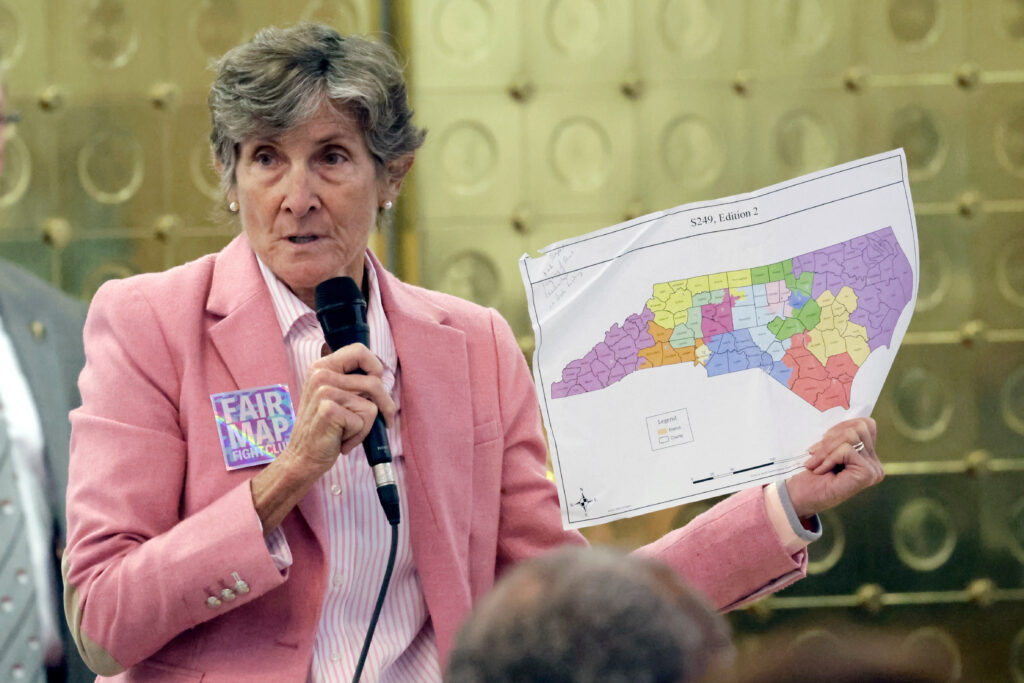
A federal court ruled Wednesday that North Carolina’s new congressional gerrymander — pushed by President Donald Trump to give Republicans another U.S. House seat — can be used for the 2026 elections. Voting rights groups have warned the map further weakens Black voting power for partisan gain.
The three-judge federal panel rejected emergency requests from civil rights groups and cleared the way for the mid-decade gerrymander even as it acknowledged the seriousness of the risk to Black voting representation.
Get updates straight to your inbox — for free
Join 350,000 readers who rely on our daily and weekly newsletters for the latest in voting, elections and democracy.
“Plaintiffs allege constitutional violations that, if proven, cannot be fully redressed after the upcoming elections,” the judges wrote.“‘Discriminatory voting procedures in particular are the kind of serious violation of the Constitution for which courts have granted immediate relief’ because ‘once the election occurs, there can be no do-over and no redress.’”
Despite that warning, the panel denied all requests to block the map for 2026.
“A preliminary injunction is unwarranted because Plaintiffs at this point in the litigation have not made a clear showing that they are likely to succeed on the merits of any claim advanced in their motions,” the court added. “The NAACP Plaintiffs’ motion for a preliminary injunction and Williams Plaintiffs’ motion for a preliminary injunction are DENIED.”
The court’s ruling leans heavily on a U.S. Supreme Court decision — also from North Carolina — that bars federal courts from reviewing partisan gerrymandering, leaving Black voters with virtually no federal remedy against extreme, politically engineered maps.
“Claims of excessive partisanship in redistricting present political questions not suitable for resolution in federal courts,” the judges wrote.“‘Partisan gerrymandering claims present political questions beyond the reach of the federal courts.’”
The challenged map rewrites two districts in eastern North Carolina, shifting tens of thousands of Black voters into configurations that dilute their influence.
Experts for the plaintiffs warned that Black-preferred candidates would struggle to compete under the new design and the court acknowledged the consequences plainly.
“Based on the election data studied, the 2025 plan makes it less likely that black-preferred candidates will win in CD 1, while making it more likely that black-preferred candidates will win in CD 3,” the judges wrote. “The likelihood of success for black-preferred candidates in either district is slim.”
The ruling leaves North Carolina’s new map in place for next year’s elections and strengthens Republican efforts to expand the party’s House majority nationwide.
Although the case continues to trials and appeals, this decision means that North Carolina voters — especially Black voters long anchored in the state’s historic Black Belt — will head into 2026 under districts engineered to diminish their electoral influence.