Trump’s Threats to Indiana Funding Are Illegal ‘Coercion on Steroids’
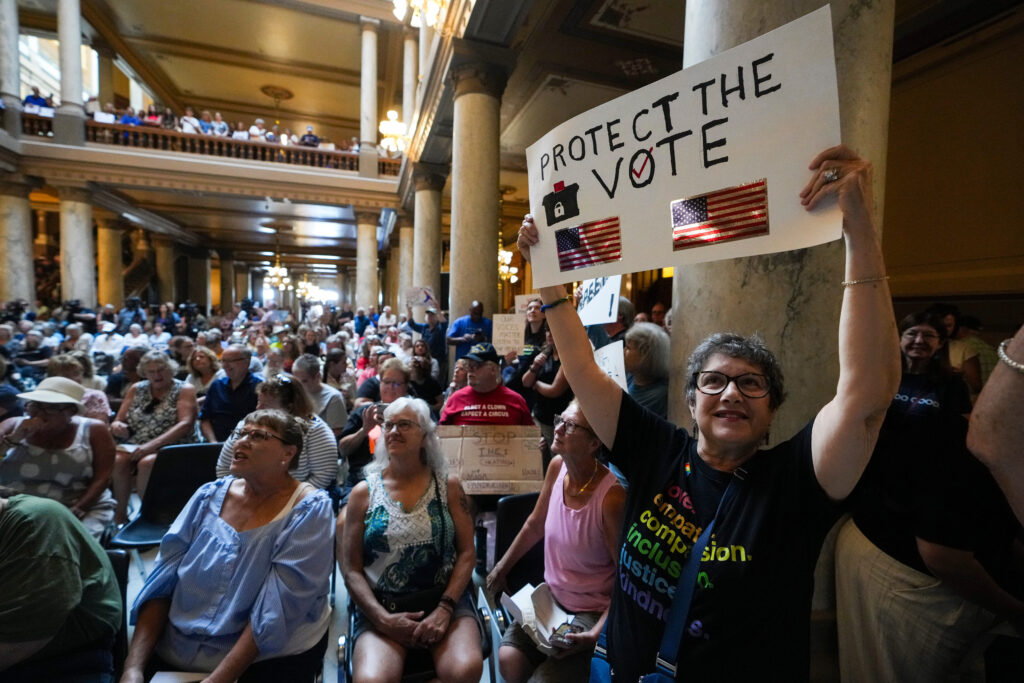
The Indiana Senate resoundingly rejected President Donald Trump’s demands to redraw the state’s congressional districts this week, with a majority of Republican senators voting against the plan despite weeks of threats, harassment and bullying from the president and his supporters.
More details about those threats came to light shortly before the vote Thursday when Heritage Action, an arm of the powerful conservative Heritage Foundation think tank, posted a warning for Indiana lawmakers on social media.
“President Trump has made it clear to Indiana leaders: if the Indiana Senate fails to pass the map, all federal funding will be stripped from the state,” the organization wrote. “Roads will not be paved. Guard bases will close. Major projects will stop. These are the stakes and every NO vote will be to blame.”
Hours later, Indiana Lt. Gov. Micah Beckwith (R) appeared to confirm what Heritage Action said, replying to IndyStar columnist Jacob Stewart in a tweet he later deleted: “The Trump admin was VERY clear about this. They told many lawmakers, cabinet members and the Gov and I that this would happen. The Indiana Senate made it clear to the Trump Admin today that they do not want to be partners with the WH. The WH made it clear to them that they’d oblige.”
The reaction came swiftly from both sides of the aisle. Many concluded the president’s intended actions violate the U.S. Constitution.
Get updates straight to your inbox — for free
Join 350,000 readers who rely on our daily and weekly newsletters for the latest in voting, elections and democracy.
Among the prominent people condemning the Heritage Action post was Tim Chapman, a former Heritage Foundation leader who now serves as a senior advisor at Advancing American Freedom, an advocacy organization founded by former Vice President Mike Pence.
“There is nothing conservative about backing threats to a state’s federal funding because it declines to push a President’s own political agenda – that is unconstitutional and coercive to states,” Chapman wrote.
Meryl Justin Chertoff, adjunct professor of law at Georgetown Law, said that if Trump did, in fact, threaten to withhold all federal funding from Indiana, it would violate the law.
“It would not be okay for Congress to do it,” Chertoff said. “But even if this was okay for Congress to do, it also violates who’s supposed to be doing the spending. So there are two separate problems: One is Congress couldn’t do it. And the second is the President certainly can’t do it because it’s not even one of his powers.”
Congress has the power to set conditions on funding to states in some instances when there is a clear correlation between the purpose of the condition and the purpose of the spending, Chertoff said. And the federal government has some leeway on spending when it comes to discretionary grants.
But Indiana losing all federal funding because of a redistricting vote would fall outside of that authority.
“What adds an additional layer of complication to this is the president is taking what is thought of as being congressional power, and is saying that he is entitled to exercise it as the executive, which is a fundamental misconception of the separation of powers,” Chertoff said.
While the federal government has some power to induce states to follow a policy agenda, there are limits on how the president can pressure them, said Professor Luis Fuentes-Rohwer, a leading election law scholar with the Maurer School of Law at Indiana University Bloomington.
“Coercion is clearly unconstitutional,” Fuentes-Rohwer said. “This is coercion on steroids.”
Ultimately, if Trump did threaten all of Indiana’s federal funding, it signals that the structures of American democracy are in serious danger, he said.
“It’s so beyond the pale, beyond any bounds of what we hope the Constitution means,” Fuentes-Rohwer said.