Florida Supreme Court Greenlights DeSantis’ Congressional Map that Eliminates Black Representation
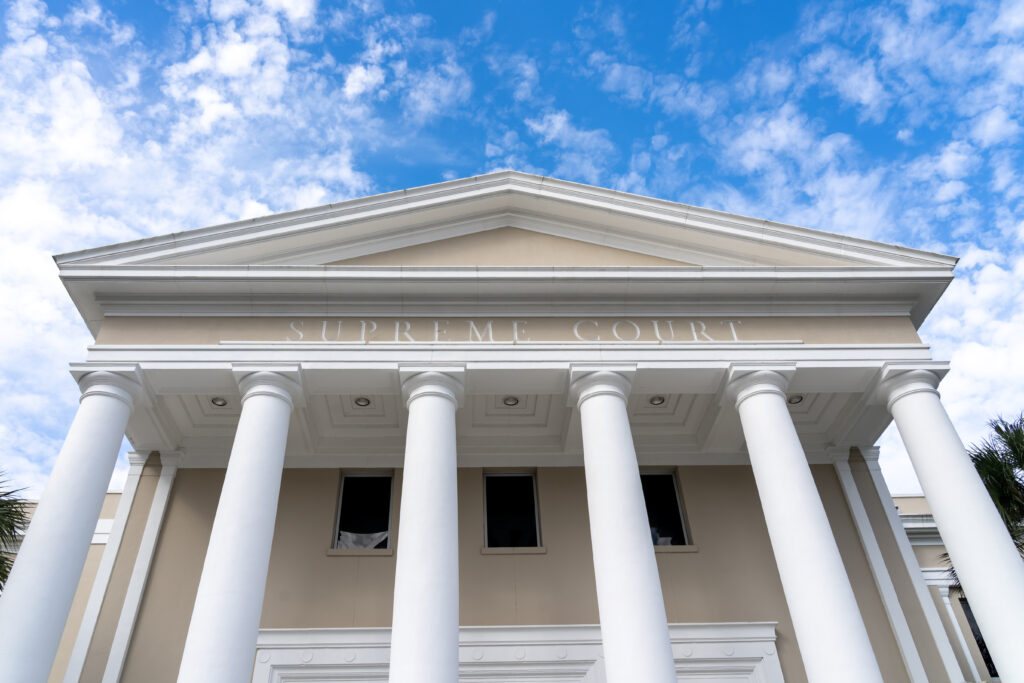
The Florida Supreme Court upheld a congressional map drafted by Gov. Ron DeSantis (R) — even as it acknowledged that the map weakens Black electoral power in the state.
The right-leaning court ruled Thursday by 5-1 that restoring a traditionally Black-represented district would violate the U.S. Constitution’s Equal Protection Clause, as it would amount to racial gerrymandering.
The 5th Congressional District, held by Black representatives for nearly 30 years, was dismantled at DeSantis’ request in 2022. His new map scattered Black voters across four separate districts, reducing their ability to choose a candidate that best represents them in North Florida.
Plaintiffs, led by Black Voters Matter Capacity Building Institute, argued DeSantis’ map was a flagrant assault on Black representation and a direct defiance of voters’ will. In 2010, Florida voters passed the Fair Districts Amendment (FDA) with 63% support, banning maps that reduce the ability of minority voters to elect their candidates of choice.
A trial court struck down DeSantis’ map in 2023, finding it violated the FDA. But Florida’s highest court now held that federal constitutional requirements take precedence over the state’s effort to ensure fair maps.
The FDA includes a ‘non-diminishment’ clause, which states: “Districts shall not be drawn to deny racial or language minorities the equal opportunity to participate in the political process and elect representatives of their choice.”
The U.S. Supreme Court has ruled that while race can be considered in redistricting, it usually cannot be the dominant reason a district is drawn.
“The Legislature’s obligation to comply with the Equal Protection Clause is superior to its obligation to comply with the Non-Diminishment Clause,” the court held. “Compliance with the Non-Diminishment Clause is not a compelling governmental interest under the test established in the Supreme Court’s Equal Protection Clause jurisprudence.”
In a sharp dissent, Justice Jorge Labarga criticized the majority for siding with a map that “not just diminished,” but “eliminated” Black voters’ ability to elect their candidate of choice. Labarga argued the case should have been sent back to the trial court to fully examine whether a fairer map could have been drawn that complied with both state and federal law.
“Today’s decision is highly consequential,” Labarga wrote. “Given the significance of this decision, the proper course is to remand this case for a trial.”
The majority refused, arguing “there is no justification for prolonging uncertainty over the validity of the Enacted Plan.”
Plaintiffs may still file a motion for rehearing, but unless it is granted DeSantis’ map will remain in place for the 2026 election and beyond.
“This was always the constitutionally correct map,” DeSantis said in a statement following the ruling. “Both the federal courts and the FL Supreme Court have upheld it.”