In California Redistricting Challenge, GOP Alleges Illegal Racial Gerrymander
 Prefer us on Google
to see more of our voting rights news coverage when you search.
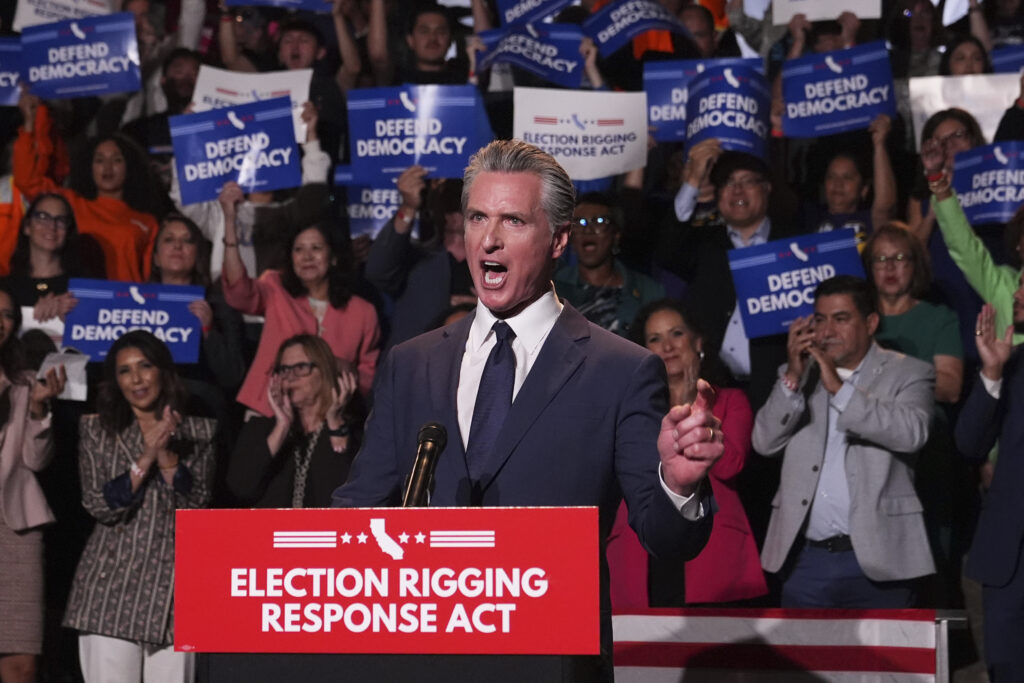
Republicans and the U.S. Department of Justice (DOJ) argued in federal court this week that California’s new redistricting plan constitutes an illegal racial gerrymander — and not a legal partisan one, like Democrats claim.
During the three-day hearing, Republicans deployed many of the same arguments they had faced amid legal wrangling over Texas’ GOP gerrymander — namely, that the new congressional maps favored certain racial groups over others.
This summer, President Donald Trump sparked a national redistricting arms race when he convinced Texas lawmakers to redraw the state’s congressional map to give the GOP an edge in the 2026 midterm elections.
In November, California voters responded by overwhelmingly approving Proposition 50, a ballot initiative greenlighting Democratic lawmakers’ plan to offset the GOP’s potential gains in Texas by drawing the same number of new Democrat-leaning seats in California.
The GOP sued immediately after Prop 50 passed, claiming that “race and Latino demographics” were “intentionally and directly” used as criteria in drawing the new map. Their argument rests heavily on public comments made by Paul Mitchell, head of the firm Redistricting Partners, who was hired by the Democratic Congressional Campaign Committee (DCCC) to draft the map.
Republicans are asking the court to block the map, claiming it was drawn “to favor Hispanic voters” in violation of the Fourteenth and Fifteenth Amendments.
Get updates straight to your inbox — for free
Join 350,000 readers who rely on our daily and weekly newsletters for the latest in voting, elections and democracy.
In its complaint, the GOP argued that Mitchell said his work on the Legislature’s plan was guided by racial considerations and that the “number one thing that [he] first started thinking about” was “drawing a replacement Latino majority/minority district in the middle of Los Angeles.”
The lawsuit was filed by the Dhillon Law Group, a firm founded by Harmeet Dhillon, who now leads the DOJ’s civil rights division. In August, the firm made two attempts to block the California redistricting effort. The California Supreme Court denied both petitions.
In the latest challenge, the DCCC intervened* to assist with defending the map. The DOJ also intervened, seeking to block it. Dhillon recused herself.
The case was heard by a panel of three federal judges: Josephine L. Staton, appointed by former President Barack Obama; Kenneth K. Lee, appointed by President Donald Trump; and Wesley L. Hsu, appointed by former President Joe Biden.
A group of U.S. Supreme Court justices recently signaled their position on the California map in a Dec. 4 ruling that allowed Texas to use its new gerrymander.
Justice Samuel Alito, joined by Justice Clarence Thomas and Justice Neil Gorsuch, wrote that it was “indisputable” that “the impetus for the adoption of the Texas map (like the map subsequently adopted in California) was partisan advantage pure and simple.”
Unlike in the Texas redistricting legal battle, which featured two days of testimony from GOP mapmaker Adam Kincaid, Democratic mapmaker Mitchell did not testify at the California hearing, despite being called as a witness by the GOP.
Mitchell reportedly was not required to testify because he was served in Sacramento, outside of a 100-mile radius of the court hearing in Los Angeles.
Mitchell sat for a deposition Dec. 10. The DOJ filed a motion Sunday blasting Mitchell’s legal counsel for repeatedly blocking questions during the deposition, claiming his counsel “asserted legislative privilege approximately 122 times.”
During Kincaid’s testimony in Texas, attorneys defending the gerrymander also repeatedly blocked questions, claiming the answers were privileged information. They also sought to present him as a lay witness rather than an expert witness, a legal maneuver designed to allow him to give the court his version of the story without turning over detailed information about how he made the map.
*The Democratic Congressional Campaign Committee is represented in the lawsuit by the Elias Law Group (ELG). ELG Chair Marc Elias is the founder of Democracy Docket.