Wisconsin Supreme Court hears challenges to pro-GOP congressional gerrymander
 Prefer us on Google
to see more of our voting rights news coverage when you search.
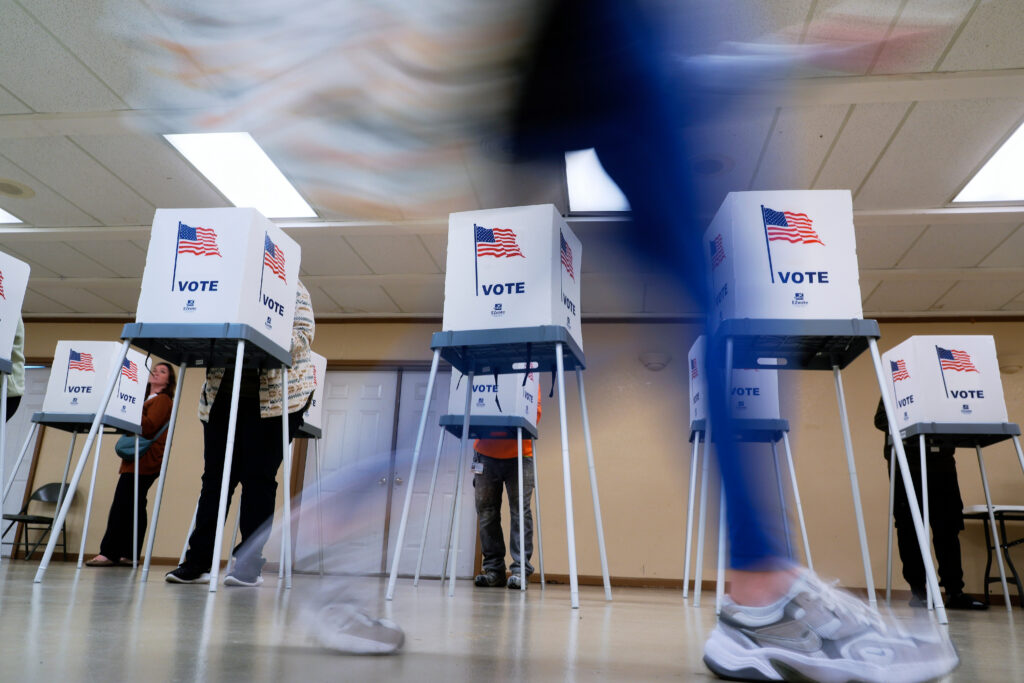
The Wisconsin Supreme Court heard oral arguments Wednesday in two cases challenging the state’s congressional map as a gerrymander that advantages Republicans. If the court were to rule for the plaintiffs, the state could have more Democratic-friendly districts for the 2028 elections.
Wisconsin voters have a nearly even partisan split — President Donald Trump won the state in 2024 by less than one percentage point — but Republicans hold six out of eight congressional districts. Plaintiffs* in the lawsuits are asking the state Supreme Court to take action to put a new map in place.
The state’s current congressional map was adopted by the Wisconsin Supreme Court in 2021 when it was controlled by a conservative majority. Following recent elections, the court now has a 5-2 liberal majority.
Get updates straight to your inbox — for free
Join 350,000 readers who rely on our daily and weekly newsletters for the latest in voting, elections and democracy.
The cases heard Wednesday offered different legal arguments against the map. In the first case, a group of Wisconsin voters challenged the congressional map as a partisan gerrymander that discriminates against Democrats. In the second, the organization Wisconsin Business Leaders for Democracy argued the map is an anti-competitive gerrymander.
The voters in the first case argue that the court made a “grave error” by choosing to make “the least change possible” to maps adopted by the Wisconsin Legislature, which resulted in maps that “proved to be some of the most biased in the country.” They went on to ask the court to rule in their favor based on their separation of powers claim.
“It should hold that Wisconsin’s congressional map was selected based on a criterion that required this Court to abandon its role as a neutral and independent institution, in violation of the Wisconsin Constitution’s separation of powers, and so must be replaced with a new map selected in accordance with traditional redistricting criteria,” they argued.
They also asked the court to block the state from using the current map, as well as reverse a lower court’s dismissal of their claims that the Wisconsin Constitution prohibits partisan gerrymandering.
The justices extensively questioned attorneys during Wednesday’s oral arguments, some of them hinting at how they might rule on the matter.
Justice Brian Hagedorn seemed to reject plaintiffs’ arguments, suggesting that they had no legal basis for their complaint that the map was unfair.
Meanwhile, Justice Chris Taylor appeared skeptical of the state’s argument that the case was just a political fight over whether voters have a right to Republican or Democratic districts. Taylor said the case was actually a matter of protecting voters from constitutional harm.
“So if a class of voters, if their vote is being diluted or infringed upon, that seems to me to violate these principles of the people being sovereign — because we have then elevated the power of politicians above individuals’ right to choose their government,” Taylor said.
And Chief Justice Jill J. Karofsky pushed back against the state’s argument that there is no way for a court to determine whether a map is too partisan.
“It feels like what you’re asking us to do is just stick our head in the sand,” Karofsky said.
The two lawsuits are part of a longer effort to redraw the state’s congressional districts. Last year, the Wisconsin Supreme Court declined to hear a lawsuit seeking a new map before the 2026 election.
*Some of the plaintiffs are represented by the Elias Law Group (ELG). ELG Firm Chair Marc Elias is the founder of Democracy Docket.