Could a new court ruling undermine Trump’s favorite voter suppression bill?
 Prefer us on Google
to see more of our voting rights news coverage when you search.
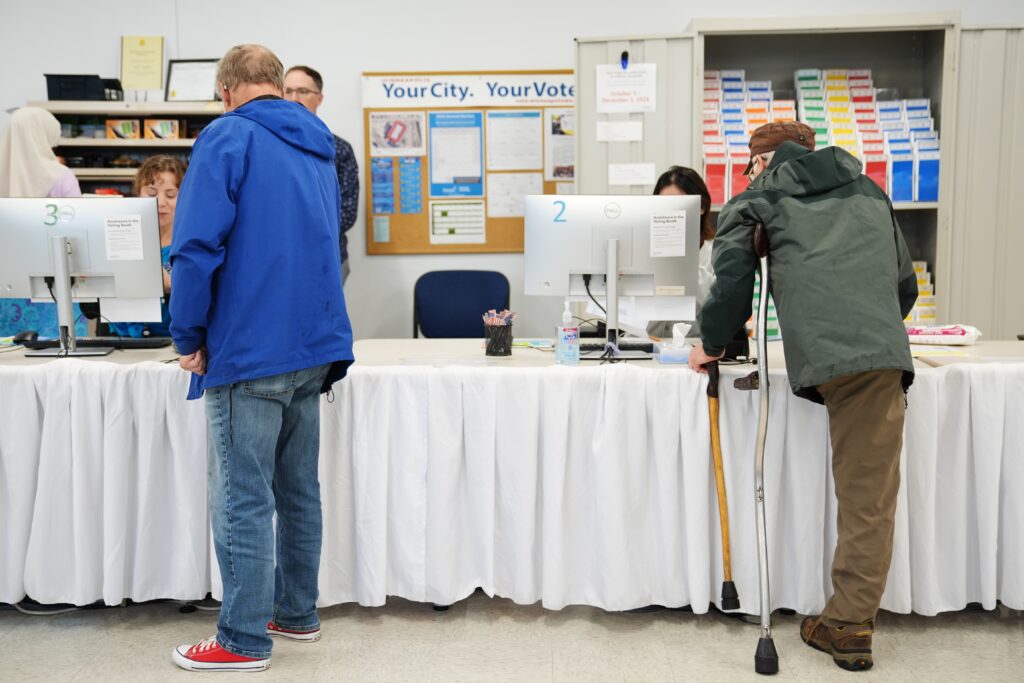
An unusual ruling in Florida last week — in a case that is part of the Trump administration’s bid to spread fear about noncitizen voting — could raise questions about the constitutionality of the sweeping voter suppression measure being pushed by the president.
U.S. District Judge David S. Leibowitz last Thursday dismissed a criminal case against a Jamaican national for illegally voting as a noncitizen, finding that the 1996 federal law she was prosecuted under is unconstitutional because only states — not the federal government — can decide who is qualified to vote.
“Congress has no power to say who can vote or who cannot vote in federal elections — that foundational power is reserved for the States, and limits Congress,” he wrote.
Leibowitz’s ruling, which the administration has said it will appeal, does not invalidate the federal noncitizen voting ban, and there is little evidence of an organized push to challenge the law.
Still, the decision could have implications in similar cases being aggressively pursued by the administration. And it illustrates how courts might treat federal laws requiring voters to provide documentary proof of citizenship (DPOC) to register to vote — a longstanding goal for President Donald Trump.
Trump spent much of the past year demanding passage of the SAVE America Act, which would include DPOC provisions, and excoriating the Senate — including Republican senators — for failing to see his will be done.
As it stands, noncitizen voting is virtually nonexistent — numerous studies and voter roll audits have shown that vanishingly few noncitizens attempt to register, and fewer still try to vote.
But that hasn’t stopped Republican lawmakers from parroting Trump’s frequent lies about the scope of this figment of a problem. Throughout the lengthy public debate around the SAVE America Act, the bill’s sponsors have repeatedly cast it as a necessary measure to prevent noncitizens from voting.
Democrats “feel they’ve got to allow illegals to participate in elections so they can continue to win,” House Speaker Mike Johnson (R-La.) said in February. “We’ve got to stop that.”
While the bill appears dead for now, the Senate might try to act on it again during a lame-duck session or next year, if Republicans maintain control of the chamber after the midterm elections.
If that were to happen, though, it’s unclear how a federal DPOC law would pass constitutional muster if a federal ban on noncitizen voting could not.
Get updates straight to your inbox — for free
Join 350,000 readers who rely on our daily and weekly newsletters for the latest in voting, elections and democracy.
In Thursday’s ruling, Leibowitz cited a 2013 U.S. Supreme Court decision, noting that “nothing in the Constitution lends itself to the view that voting qualifications in federal elections are to be set by Congress.”
That Supreme Court decision, in Arizona v. Inter Tribal Council of Arizona, found that the state’s requirement that voters provide DPOC when using the federal voter registration form to register was preempted by the National Voter Registration Act, which aimed to reduce barriers to getting on the rolls.
In his ruling Thursday, Leibowitz, an appointee of President Joe Biden, contrasted the Constitution’s Voter Qualification Clauses, which “expressly commit to the States the power to decide who votes in federal elections,” with the Elections Clause, which says the “Times, Places and Manner of holding Elections,” are set by the states with congressional oversight. That, the judge held, “gives the federal government final say over how those elections are run,” but not over who can vote.
That distinction prevents Congress from passing a law that seems like it might regulate the “manner” of holding elections if it actually decides who can vote, Leibowitz said.
“The power to regulate the ‘mechanics’ of federal elections and the power to decide who may vote in those elections are, as we have seen, meaningfully different in our constitutional order,” he wrote.
Leibowitz also rejected the administration’s arguments that Congress’ broad powers to regulate immigration and foreign affairs authorized the statute.
Following that line of thought, a federal court might well find that a DPOC requirement attempts to regulate “who votes in federal elections,” not “how those elections are run.”
Thursday’s ruling would likely have little impact on the SAVE America Act’s other proposed restrictions, like voter ID, which are more easily framed as anti-fraud protections.
“[I]t is certainly true that Congress has authority under the Elections Clause to pass laws to prevent voter fraud in federal elections,” Leibowitz wrote.
There’s no guarantee that Leibowitz’s opinion will influence courts outside of Florida, assuming it survives an appeal; the administration filed notice Friday that it would ask the 11th Circuit Court of Appeals for review. Generally, district court decisions are not binding on other courts, meaning judges aren’t required to follow their legal reasoning.
But if the 11th Circuit agrees with Leibowitz’s logic, the ruling would bind lower courts in Florida, Georgia and Alabama. It would also exert considerably more persuasive authority in lawsuits brought elsewhere.
Leibowitz seemed to consider the likely appeal to the conservative 11th Circuit when he wrote his decision. He pointedly and repeatedly cited conservative jurists like Supreme Court Justices Antonin Scalia, Clarence Thomas and Samuel Alito to support his conclusion that the states, not the federal government, decide who can vote.
“Justice Scalia, joined by five other Justices, dedicated hundreds of words to reject the idea that Congress can generally set voting qualifications for federal elections,” Leibowitz noted at one point, referring to the Arizona ruling.
Leibowitz’s decision also makes clear that states can regulate who can vote and prosecute illegal voters, noting that Florida criminalized noncitizen voting long ago. And while the federal government could piggyback on those laws by making it a federal offense to violate state voting statutes, that is not what the federal noncitizen voting ban does — nor what the SAVE America Act would do.
The SAVE America Act’s DPOC provision would force voters to show a U.S. passport or birth certificate to register, imposing significant paperwork hurdles on millions of legal citizens. A University of Maryland study estimated 21 million already-registered voters — or roughly 9% of U.S. adult citizens — lack ready access to those documents.
According to the National Conference of State Legislatures, 12 states already have versions of DPOC requirements on the books, mostly limited to first-time registrants. A federal law would force every voter to again provide citizenship documents.
The litigation appears to be the first time the constitutionality of the federal law prohibiting “voting by aliens” has been directly challenged. Leibowitz appointed Paul Clement, who served as solicitor general under President George W. Bush and is one of the most respected Supreme Court litigators, to file an amicus brief on the question with his recommendation.
“Whether Congress had the power to enact [the law] is not entirely clear-cut, but with respect to noncitizens in the States, the best answer given a fair reading of [it] as a whole appears to be no,” Clement wrote, concluding a 53-page brief.