Court upholds Tennessee’s GOP gerrymander, saying lawmakers deserve ‘presumption of good faith’
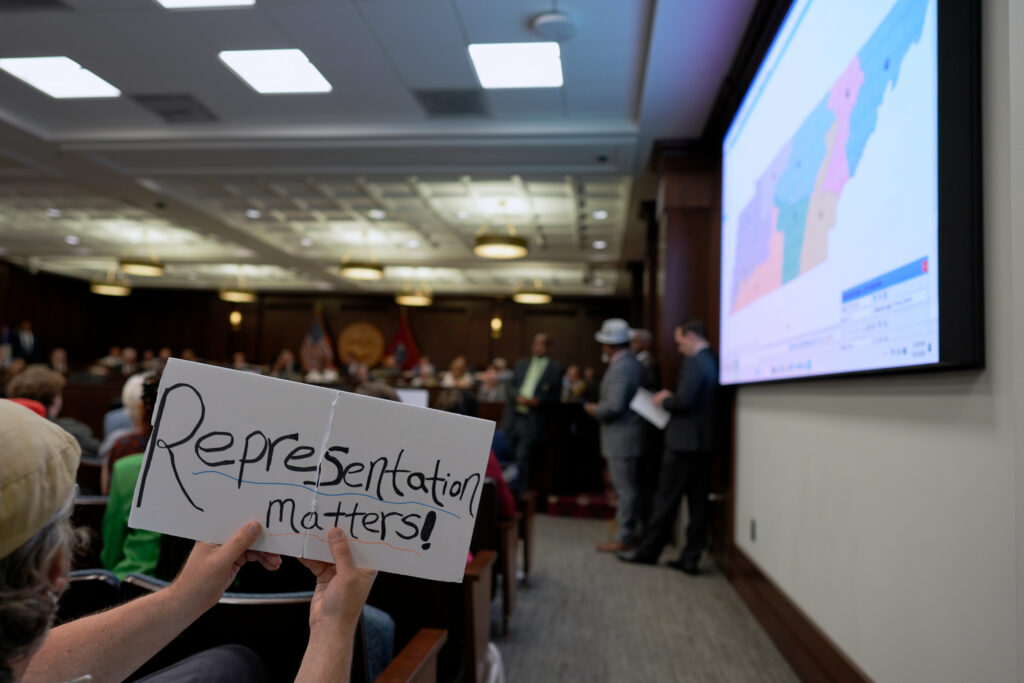
A federal court dismissed a lawsuit challenging a gerrymandered map adopted by Tennessee Republicans that eliminated what was the state’s one Black-majority congressional district, based in Memphis.
A three-judge panel Thursday ruled that the presumption that lawmakers acted in good faith outweighed pro-voting groups’ arguments that the map was deliberately drawn to dilute Black political power.
The court had already rejected a bid by plaintiffs to have the map blocked for the midterms, meaning Thursday’s ruling was not a surprise.
“Plaintiffs stress that they don’t need to ‘establish widespread racial hatred, or … show that partisan motivations were a sham or a pretext’ to prevail – just that ‘racial discrimination … was one of [the legislature’s] motivating factors’ in passing the map. Fair enough, but Plaintiffs haven’t met that standard,” the court wrote in a brief five-page order.
“Because when we evaluate whether the legislature was racially motivated, we apply the presumption of good faith,” it added.
Get updates straight to your inbox — for free
Join 350,000 readers who rely on our daily and weekly newsletters for the latest in voting, elections and democracy.
The ruling came from U.S. District Judge John Nalbandian, Chief U.S. District Judge William L. Campbell Jr., and U.S. District Judge Gregory Stivers. Nalbandian and Campbell were appointed by President Donald Trump, while Stivers was appointed by President Barack Obama. The ruling did not say how each judge voted.
Tennessee was one of the first states to redistrict for the 2026 midterms after the Supreme Court this spring gutted Section 2 of the Voting Rights Acts, a key tool in fighting racial discrimination, in its Louisiana v. Callais ruling.
The new map carves up Memphis, one of the largest predominantly Black cities in the country and home to Tennessee’s only Democratic congressional seat, between three separate districts. Democratic Rep. Steve Cohen, who represented the area in Congress for 20 years, announced after the map was passed that he will not seek reelection this year.
In challenging the gerrymander in court, pro-voting groups said the “White-dominated supermajority” in the Tennessee General Assembly adopted the map in violation of the 14th and 15th Amendments.
“Engaging the machinery of government to punish the Black citizens of Memphis for their political activities and expression by separating them out into different districts where their association will be less effective is unlawful and un-American,” plaintiffs argued in their complaint.
Tennessee Republicans have defended the map as being drawn based on U.S. Census data with the partisan goal of sending an all-Republican delegation to Congress.
But pro-voting groups said state lawmakers struggled to explain how it gleaned partisan information from the Census, which includes racial demographic data but not political data such as party affiliation or voting preferences.
“The White legislators who led the efforts gave bizarre, robotic answers to the most basic questions about the map they were sponsoring, and their attempts to avoid admitting the obvious racial targeting involved in destroying a longstanding, compact, Black-majority congressional district that had been based in Memphis for the better part of a century produced almost comical dishonesty,” the groups wrote in their complaint.
They also said that some Republican state legislators have made racist remarks over the years, including one current member who in 2023 asked during a committee hearing if “hanging by a tree” could be added to the state’s execution methods.
But in dismissing the lawsuit on Thursday, the judges set a seemingly impossible standard for proving racial discrimination.
“Their allegations of discriminatory purpose—which center on isolated comments by legislators and nebulous references to Tennessee’s racial history—don’t rebut [the] presumption [of good faith],” the judges wrote. “As we explained, that evidence might be ‘consistent with Plaintiffs’ story,’ but it’s not evidence of racial animus where the legislature’s political motivations provide the obvious alternative explanation.”
“Besides, ‘what motivates one legislator to make a speech about a statute is not necessarily what motivates scores of others to enact it,’” they added.