Virginia Democrats release proposed map aimed at picking up 4 congressional seats
 Prefer us on Google
to see more of our voting rights news coverage when you search.
Virginia Democrats have unveiled their plan to pick up four more seats in Congress, giving the public their first look at a map meant to counter President Donald Trump’s gerrymandering gains in GOP-controlled states.
Democrats are currently defending* their redistricting effort in court. But if the Virginia Supreme Court allows the plan to move forward, voters will get the final say on whether to use the new map in the 2026 midterm elections.
Get updates straight to your inbox — for free
Join 350,000 readers who rely on our daily and weekly newsletters for the latest in voting, elections and democracy.
If the proposed map released Thursday ultimately goes into effect, Virginia’s congressional delegation – currently made up of six Democrats and five Republicans – could look a lot more blue.
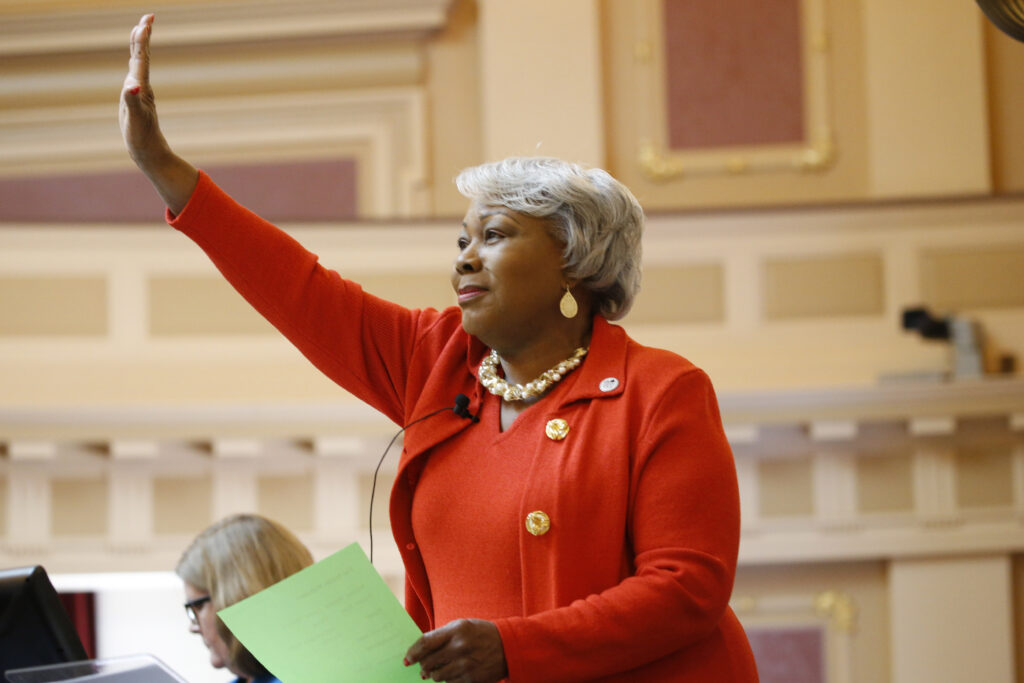
State Senate leader Louise Lucas (D), a forceful public voice for the aggressive “10-1” plan Democrats are putting forward, has spent months pushing back on fellow party members who advocated for more moderate gains.
“How about you all stay focused on the fascist in the White House and let us handle redistricting in Virginia,” Lucas said in a social post aimed at Virginia’s U.S. senators, Tim Kaine and Mark Warner.
She also shot down concerns from Virginia’s current House Democrats, who worried an ambitious map aimed at taking more seats would make it more difficult for them to get reelected.
“Anyone in the Congressional delegation who wants a seat needs to campaign for it and not expect a safe seat,” Lucas said.
It remains unclear how many seats Virginia Democrats would need to pick up in order to wipe out potential Republican gains in other states.
States typically redraw their congressional maps once every decade when new census data comes out. But last year, Trump demanded Republican-led states undertake rare, mid-decade redistricting to help the GOP keep its slim majority in the U.S. House of Representatives.
In response, Texas, North Carolina and Missouri sprang into action, drawing up new district lines designed to give Republicans more wins in 2026. Florida will enter the fray in April, even though voters passed a state ban on partisan and racial gerrymandering in 2010. Its congressional delegation is currently made up of 20 Republicans and eight Democrats.
Trump’s call for new congressional maps has ignited an unprecedented redistricting arms race across the country. Democrat-controlled states swiftly moved to redraw their maps, but have faced more procedural hurdles.
Unlike in the GOP-led states that redistricted – where partisan lawmakers hastily passed new maps without voter input – Democratic-led states have mostly sought voter approval before enacting new maps.
In Virginia, that means state lawmakers had to take an initial vote last year on a proposed constitutional amendment allowing them to redistrict, then pass the measure again last month.
Next, they will need to hold a special election for voters to consider the amendment.
Meanwhile, Republicans are challenging the Virginia redistricting plan in court. A state judge ruled last month in their favor, saying Democrats failed to follow procedural rules when taking their initial vote. Democrats appealed, arguing that the decision was “legally flawed, unprecedented, and the product of court-shopping designed to block Virginians from voting on their own Constitution.”
Rather than issuing its own ruling, Virginia’s state court of appeals sent the case to the state supreme court Wednesday, saying the unusual move was intended to speed up the legal process — that a matter of “such imperative public importance” requires a “prompt decision” from the state’s highest court.
*Intervening defendants are represented in the lawsuit by the Elias Law Group (ELG). ELG Chair Marc Elias is the founder of Democracy Docket.