Maryland Democrats take first step toward 2028 redistricting with special session
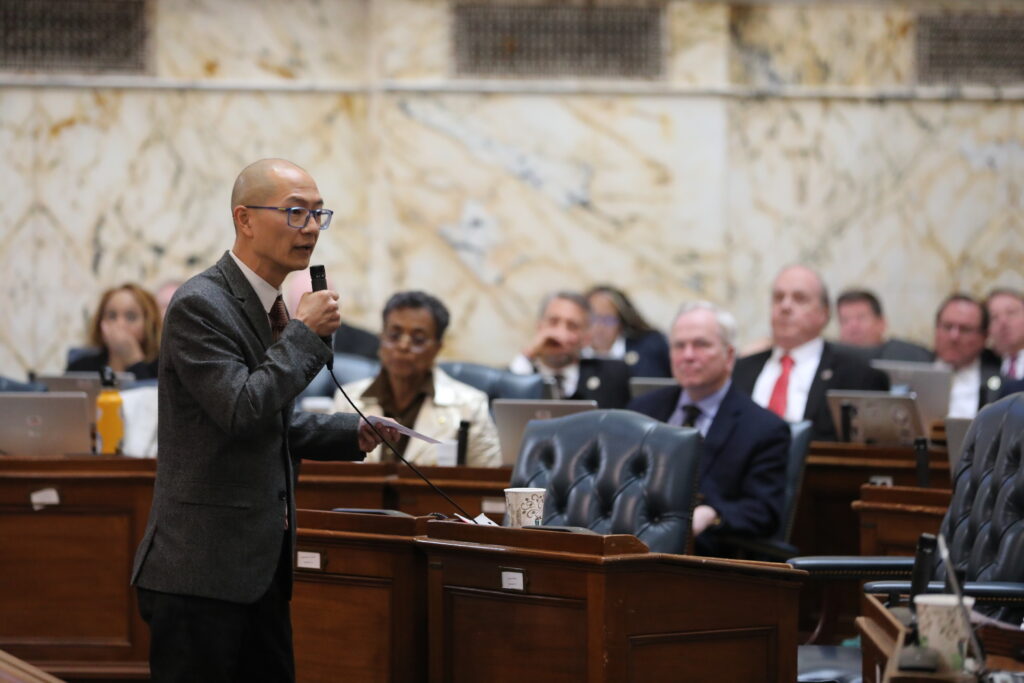
Maryland is the latest state to dive into the redistricting wars, as lawmakers are set to convene Monday to take the first steps toward redrawing the state’s congressional map ahead of the 2028 presidential election.
The Democratic-controlled legislature’s goal is to eliminate the state’s only GOP-held district, in order to counter Republican gerrymanders in Texas, Florida and other states.
House Majority Leader Del. David Moon (D) told Democracy Docket he’s been pushing his colleagues to take up redistricting since last summer, when President Donald Trump ordered Texas lawmakers to draw a new congressional map to help the GOP net extra House seat wins in this year’s midterm elections.
“I began ringing the alarm bells and trying to get not just Maryland leaders but Democratic leaders across the country to see what was going on and attempt to make all of our states equal with Texas,” Moon said.
Get updates straight to your inbox — for free
Join 350,000 readers who rely on our daily and weekly newsletters for the latest in voting, elections and democracy.
Last month, Democratic leadership in the Old Line State announced a special session to consider a bill amending the rules for drawing new congressional districts in the state’s constitution. The bill requires a three-fifths vote in both chambers to pass. Then it’ll be up to Maryland voters in November to decide whether to amend the state’s redistricting rules.
The rules for redistricting under Maryland’s constitution are somewhat specific: Maps are drawn so that “each legislative district shall consist of adjoining territory, be compact in form, and of substantially equal population.”
The state’s constitution also says that “due regard shall be given to natural boundaries and the boundaries of political subdivisions,” when lawmakers are drawing a new map.
But Democratic lawmakers have long argued that those conditions should only apply to redrawing the state’s legislative districts for representation in the General Assembly — not Congress. The rule change they’re looking to pass would explicitly override Republican claims that congressional maps are subject to the same state constitutional principles as state and local maps. It also would get around a 2022 state court ruling that interpreted the Democratic-drawn congressional map as an unconstitutional partisan gerrymander under the Maryland constitution.
In February, Maryland’s House of Delegates passed a new map that dismantles the state’s GOP-held U.S. House seat, long represented by Rep. Andy Harris (R-Md.). But the map stalled in the state Senate, where Senate President Bill Ferguson (D) said he opposed partisan gerrymandering. Ferguson expressed doubt that the new map would pass legal muster, and expressed concern that the effort could backfire and result in the GOP gaining seats.
Ferguson changed his tune not long after he won his June primary, in which he faced his first challenge in 12 years amid backlash over his redistricting stance.
“After recent court decisions weakened the federal Voting Rights Act and created new uncertainty around congressional redistricting, Maryland needs a clear legal path forward,” Ferguson said in a statement announcing the special session last month. “This special session will allow the General Assembly to do its part while ensuring that Maryland voters make the final decision.”
Moon said that his Democratic colleagues who were skeptical about redistricting quickly changed their minds after the Supreme Court’s ruling in Louisiana v. Callais, which gutted minority protections in the Voting Rights Act, and spurred a string of GOP gerrymanders in southern states.
“Not only did they gut the Voting Rights Act, but the glee and speed with which Southern Republican leaders undertook reopening mid-decade redistricting in their states, I think, made quite plain what was going on,” Moon said. “And the future of Black representation in the South is really called into question by a lot of the decisions that these leaders are making.”
Meanwhile, Maryland Republicans have launched a campaign against the burgeoning redistricting effort. Because Democrats have a supermajority in the Assembly, the bill to ask voters if they want to change the state’s redistricting rules is likely to pass the special session — so Republicans are focusing their efforts on convincing voters to reject the proposal in November’s election.
“Democrats called this session to silence Republican voices in Maryland’s congressional delegation, and we have no intention of helping them accomplish that by staying home,” Senate Minority Leader Stephen Hershey said in a statement. “If Democrats insist on using this Special Session for political theater, Republicans will use it to remind Marylanders what their government should actually be working on.”
Del. Mark Fisher, a member of Maryland’s far-right Freedom Caucus, said the special session is nothing more than Democrats trying to import “banana republic” politics into Maryland.
“This is being driven by House Speaker Joseline Peña-Melnyk, who immigrated to America from the Dominican Republic,” Fisher said on social media. “Instead of embracing the rule of law and fair democratic processes that define this country, she’s helping import the same corrupt, rule-changing, power-grabbing nonsense that has long plagued places like her homeland.”
Peña-Melnyk, a Democrat, has been one of the leading Maryland lawmakers pushing for the state to take up redistricting.
“It’s quite audacious to put out a racist statement like that,” Moon said in response to Fisher’s comment. “But I presume that this Freedom Caucus member would be saying the same things about what’s going on in Texas and Florida and other states.”