Trump’s DOJ launched a new ‘election integrity’ website. It’s riddled with errors
 Prefer us on Google
to see more of our voting rights news coverage when you search.
Hours before President Donald Trump delivered a primetime address brimming with debunked conspiracy theories about the 2020 presidential vote, his Department of Justice (DOJ) unveiled a new website tracking state-by-state efforts to supposedly protect American elections.
The site, branded as a joint initiative with the Department of Homeland Security (DHS), includes 243 completed “Enforcement Actions to Safeguard Election Integrity” across 50 states and Washington, D.C.
In fact, the Trump administration’s new “election integrity” website is so comprehensive that it includes completed actions from the future.
When the page launched Thursday, it claimed the department had “Inspected Federal Election Records to Ensure Only Eligible Americans Vote” in Florida, Kansas and South Dakota on Aug. 14, 2026.
As of Monday, that date was just under a month away, but the inspections were still listed as “completed.”
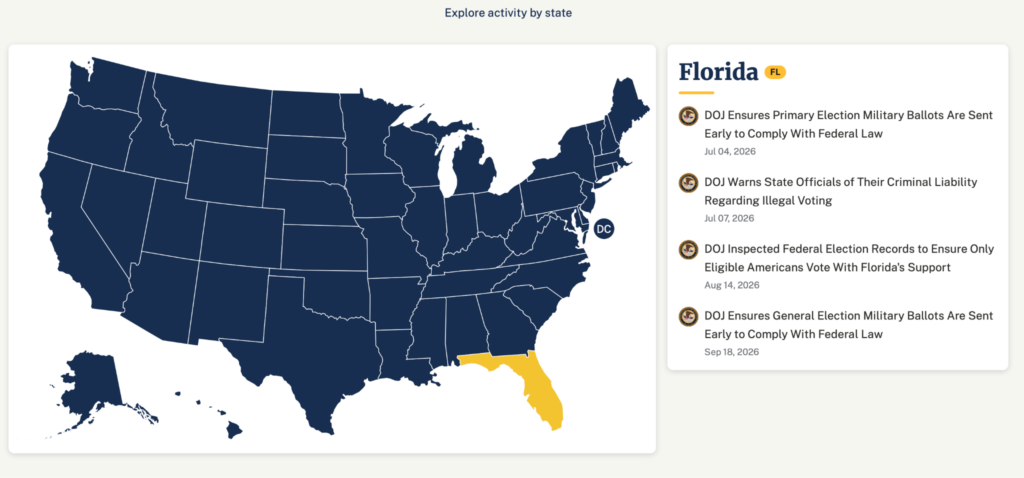
And the administration’s apparent ability to enforce federal election law across the space-time continuum was not limited to voter roll inspections. At launch last week, the site also used the present-tense “ensures” to describe future actions related to military ballots, including entries dated July 18 in Massachusetts and July 27 in Delaware.
Unless they’ve invented time travel, the DOJ may have some explaining to do.
And those are only the most temporally ambitious errors on the government website. It also contains an incorrect timeline, a blatant mischaracterization of a lawsuit and at least one county that does not exist.
Get updates straight to your inbox — for free
Join 350,000 readers who rely on our daily and weekly newsletters for the latest in voting, elections and democracy.
Take North Carolina, for example.
The site says the DOJ sued the state on March 27, 2025, then obtained a court order on May 27 requiring officials to correct more than 100,000 voter registrations that lacked required information.
The DOJ’s own records tell a different story.
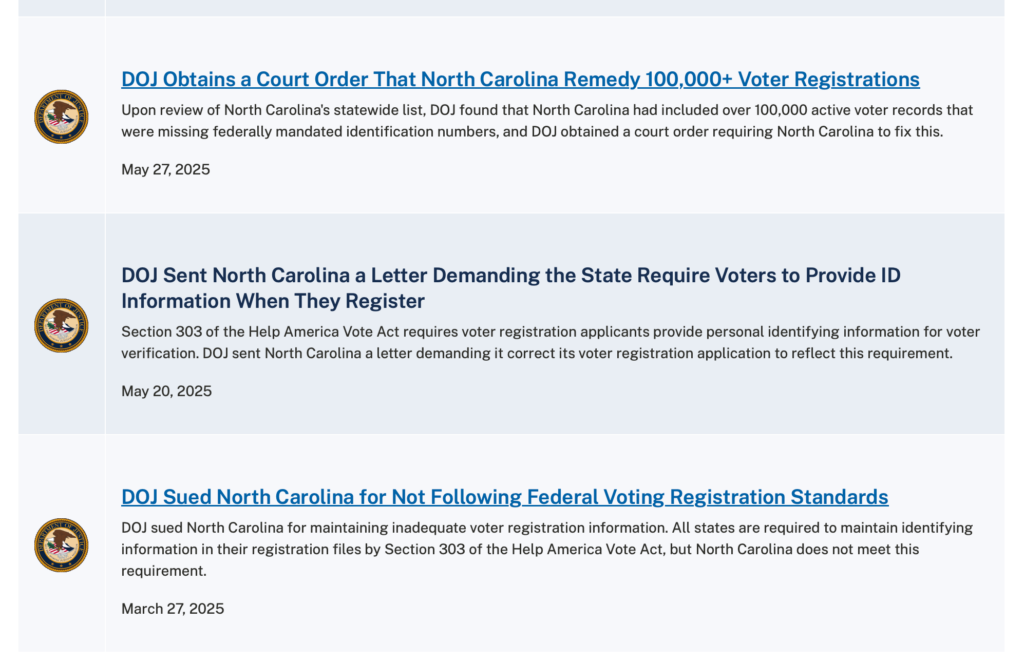
The department actually filed the lawsuit on May 27 — the same date the website assigns to the supposed court order. A judge didn’t approve the parties’ negotiated consent agreement until Sept. 8. And even that was a settlement approved months after the case began, not a merits ruling handed down on the day the DOJ sued.
The site’s March 27 date does not correspond with the filing date in the DOJ’s announcement. And it’s unclear what event — if any — took place on that day. But that date does fall two days after Trump signed his first anti-voting executive order, which a court permanently blocked last month.
Alabama fares no better in the DOJ’s chronicle.
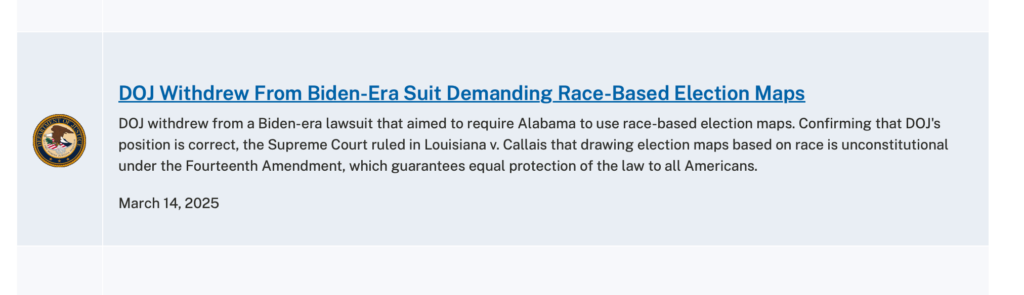
The website claims that, on March 14, 2025, the DOJ “Withdrew From Biden-Era Suit Demanding Race-Based Election Maps.” But the DOJ’s own announcement from that date says the department dismissed a lawsuit challenging Alabama’s pre-election voter-removal program. The case concerned an effort to purge thousands of voters right before the 2024 election — not the drawing of congressional or legislative maps benefiting minority voters.
Then there’s Massachusetts, where the federal government apparently discovered a new county.
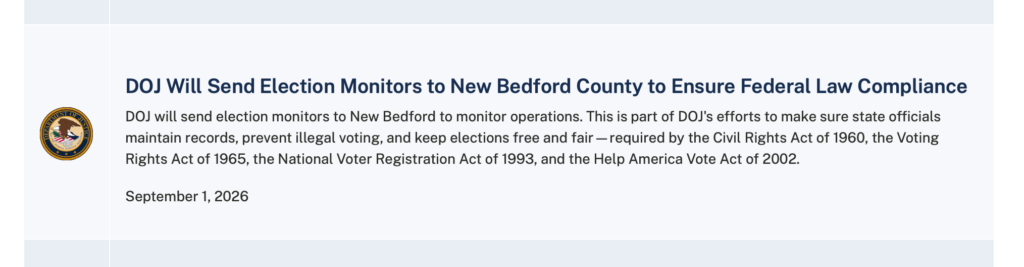
The site says the DOJ plans to send election monitors to “New Bedford County” on Sept. 1. But there’s no such place: New Bedford is a city in Bristol County.
But at least the DOJ got the future tense right in Massachusetts.
The errors would be embarrassing on any federal website. On this one, they also appear to serve an ideological purpose.
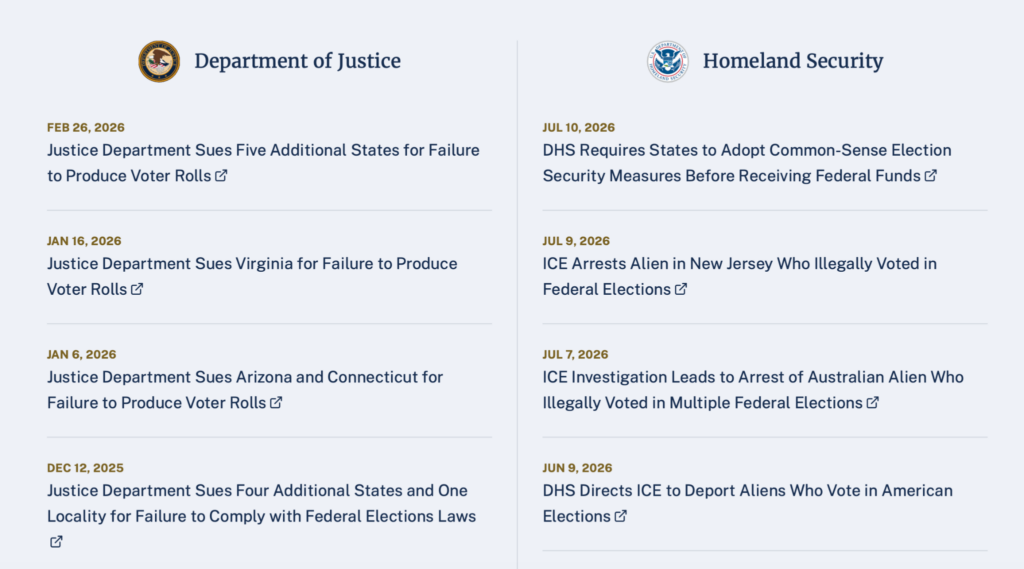
The site offers an official, highly selective history of the Trump administration’s escalating intervention in elections — presenting lawsuits, warning letters, inspections and arrests as major accomplishments. Its featured DOJ news section highlights announcement after announcement about states being sued for refusing to hand over voter rolls.
But it conveniently ignores what happened after those lawsuits were filed.
As of Friday, the DOJ had lost all 16 voter roll cases that had reached a district court ruling, plus one appeal. So far, no court has ordered any state to provide the department with its unredacted statewide voter file.
The latest defeat came in Connecticut, where the DOJ had demanded voters’ names, addresses, dates of birth and driver’s license or Social Security numbers. A Trump-appointed judge rejected the department’s legal theory, denied its motion to compel the records, dismissed the case and ordered it closed.
These embarrassing losses are nowhere to be found on any of the 16 states’ pages. The site simply says the DOJ sued for “Failing to Provide Federal Election Records,” adopting the department’s disputed legal characterization while omitting that the court ruled those records were not subject to its demand.
The administration’s new portal is not merely a DOJ publicity project.
It prominently displays the seals of both DOJ and DHS and calls itself “a joint initiative” of the two departments. Alongside the DOJ’s civil lawsuits, it promotes DHS funding directives, immigration arrests and deportation policies as election integrity work.
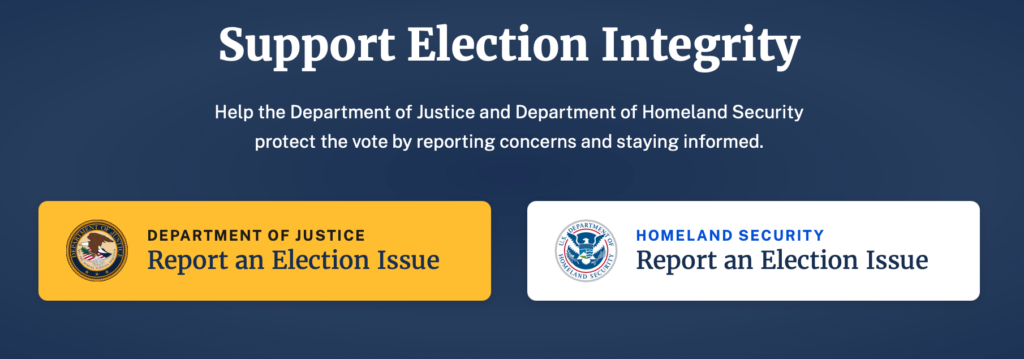
It also asks members of the public to help the DOJ and DHS “protect the vote by reporting concerns.” Its privacy notice says submitted information may be shared with federal, state or local law enforcement agencies.
That invitation carries added significance because the website debuted the same night Trump used a White House speech to revive false and unsupported claims about the 2020 election, to allege sweeping foreign interference and to demand passage of the anti-voting SAVE America Act.
Trump offered no evidence that foreign or domestic actors manipulated votes or changed the result of the election he lost. Election experts were quick to point out that the intelligence documents declassified by the administration actually refuted Trump’s claims.
The new DOJ website helps convert Trump’s rhetoric into federal infrastructure: a map portraying the administration’s campaign as a series of victories, links encouraging the public to report election suspicions and two powerful departments presented as partners in policing them.
The errors may be funny, but the federal campaign they advance is serious.
Still, a government website devoted to “election integrity” should probably get the dates, lawsuits and counties right. For now, the DOJ’s new page appears to need some “list maintenance” of its own.