‘Celebrate the accomplishment’: Trump’s election threats hit a wall as voters flock to polls
 Prefer us on Google
to see more of our voting rights news coverage when you search.
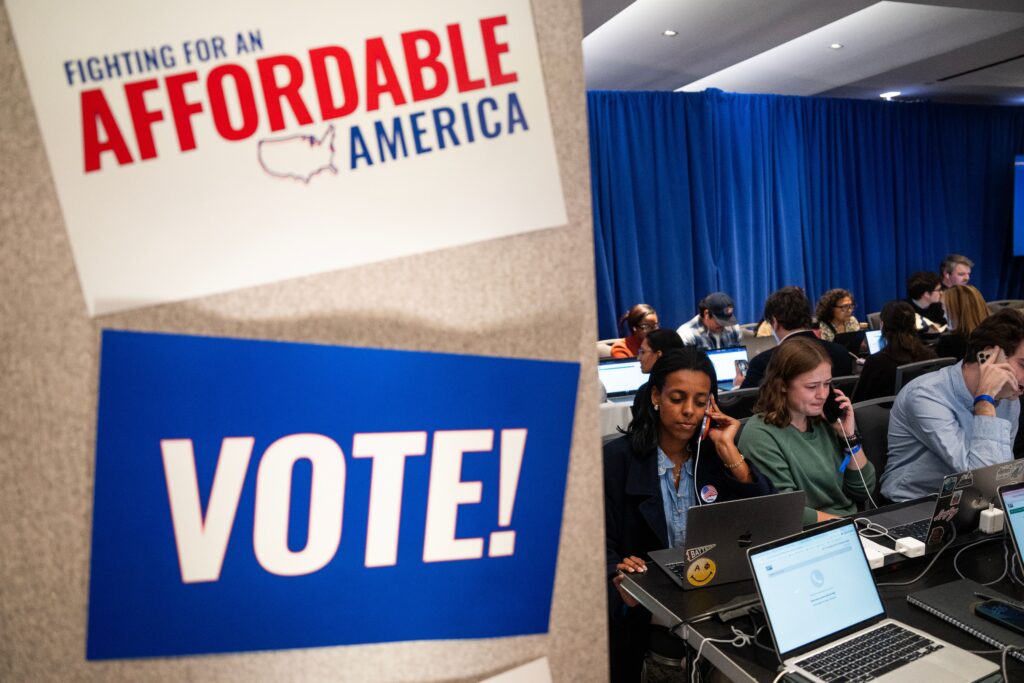
After months of the Trump administration’s escalating threats against election officials, attempts to interfere with voting and hints about sending law enforcement to polling places, Election Day unfolded largely as elections normally do: voters casting ballots, local officials addressing routine problems, and the most alarming scenarios involving voter intimidation and obstruction at the polls mostly failing to take shape.
Whatever happens in the post-election period, it’s a major victory for pro-democracy forces. But it didn’t happen without a fight.
Get updates straight to your inbox — for free
Join 350,000 readers who rely on our daily and weekly newsletters for the latest in voting, elections and democracy.
A sustained campaign of lawsuits and preparations by election officials and voting rights organizations had put the administration on the defensive even before polls opened. In the final days of the campaign, federal judges repeatedly rejected the Department of Justice’s (DOJ) attempts to intervene in state-run elections and restricted the authority of its personnel at polling places.
David Becker, executive director of the Center for Election Innovation & Research, said the relatively orderly Election Day reflected months of work to defend the voting process, including extensive preparation for possible federal interference, foreign threats and disinformation.
“I’ve been talking to election officials all over the country today since polls opened, and what we’re seeing is a remarkably smoothly run midterm election,” Becker said Tuesday. “With polls starting to close, Americans should celebrate the accomplishment of another successful Election Day. Voters across the country have reported an overwhelmingly smooth and convenient process to cast their ballots, and we expect that to continue in the final hours of voting.”
“This may be one of the most smooth I’ve ever seen so far,” Becker said. “We’re seeing elections go very normally with only minor problems.”
Voter turnout was also strong, with participation surpassing 2022 midterm levels states including Georgia, Michigan and North Carolina.
That didn’t mean Election Day was free of disruption.
In New York’s Westchester County, widespread ballot scanner failures forced officials to activate emergency procedures for securing and counting completed paper ballots. Other jurisdictions reported localized technical problems and delays.
But the bigger threat, ahead of time, was that the administration would find ways to obstruct voting at major polling sites. It launched what it called the largest election-monitoring effort in DOJ history Tuesday, deploying approximately 1,000 monitors and observers across all 50 states. And it repeatedly refused to rule out sending law enforcement to the polls.
As a result, not everything went smoothly. Michigan officials reported that some federal monitors in Dearborn and Flint acted outside the scope of their authority, prompting state officials to contact DOJ coordinators.
New Mexico officials likewise raised concerns after receiving reports that DOJ monitors in Bernalillo County asked unusual questions and questioned voters. State and local officials contacted the department about the conduct.
By and large, though, election-protection organizations reported a largely familiar set of Election Day problems.
Shaylyn Cochran, deputy executive director of the Lawyers’ Committee for Civil Rights Under Law, described reports involving inadequate polling-place signage, insufficient voter information and accessibility concerns for voters with disabilities.
“These issues are not new to our coalition; they are in fact common in every election cycle,” Cochran said, adding that voting rights organizations were coordinating with local officials to resolve problems as they arose.
A spokesperson for the pro-voting group Verified Voting similarly said the issues reported so far followed the general patterns seen in previous elections.
One factor in the smooth outcomes was that many of the Trump administration’s schemes were curtailed by legal restrictions.
In the weeks leading up to Election Day, DOJ tried to pressure states into segregating their ballots and withholding them from the count. But those efforts suffered repeated courtroom defeats, culminating Monday when the Supreme Court rejected the administration’s emergency bid to force California to segregate ballots from more than 20,000 people it alleged were likely noncitizens, after a federal district judge and appeals court had already refused to intervene.
The administration also lost its effort to interfere in Alaska’s closely watched Senate election — though it appears determined to continue the fight.
After the NAACP challenged DOJ’s plans to use personnel drawn from federal law-enforcement agencies, the department told a court that FBI and Immigration and Customs Enforcement personnel would not serve as election monitors. It also said the participating personnel would not act as law-enforcement officers.
On Monday, U.S. District Judge Reggie Walton ordered DOJ to ensure its monitors were unarmed, out of uniform and lacked arrest authority.
The extent to which litigation and organizing deterred particular federal actions is difficult to measure. But the court orders, agency commitments and state-level preparations established concrete boundaries before voters arrived at the polls.
And the broad pushback meant that by Election Day, administration officials were at pains to stress that they wouldn’t do anything to interfere with voting.
Homeland Security Secretary Markwayne Mullin told a reporter Tuesday afternoon that his department had not deployed ICE agents to polling places.
“We didn’t. You guys are saying that. We’ve never said that,” Mullin said. But when pressed about his earlier suggestion that agents could be deployed in response to threats, Mullin acknowledged: “If there was threats, that would be different.”
For Becker, the day reflected the failure of the administration’s efforts to disrupt election administration.
“I’ve been saying for months that this election would go smoothly,” he said. “That despite the efforts of the administration to attempt to interfere, they were failing and they were going to continue to fail. And I’ve been wrong a lot in my life, but fortunately, I was not wrong about that. That has actually played out.”
Becker also pointed to reports of substantial voter participation.
“If there were individuals in the administration who thought they could scare voters away from this election, they’re going to be disappointed,” he said. “They failed.”
The relatively orderly conduct of voting does not resolve the disputes still ahead.
Ballot counting will continue after Election Day. Close races may produce new litigation, contested results and renewed efforts to challenge election officials’ decisions. The administration’s broader campaign to obtain voter information and expand federal involvement in state elections has not ended.
As Cochran noted, Election Day is only one part of the process.
“Election season continues after today, and we’re going to continue to remain vigilant,” she said.