The midterms are over, but Trump’s legal assault on voting continues. Here’s where those cases stand
 Prefer us on Google
to see more of our voting rights news coverage when you search.
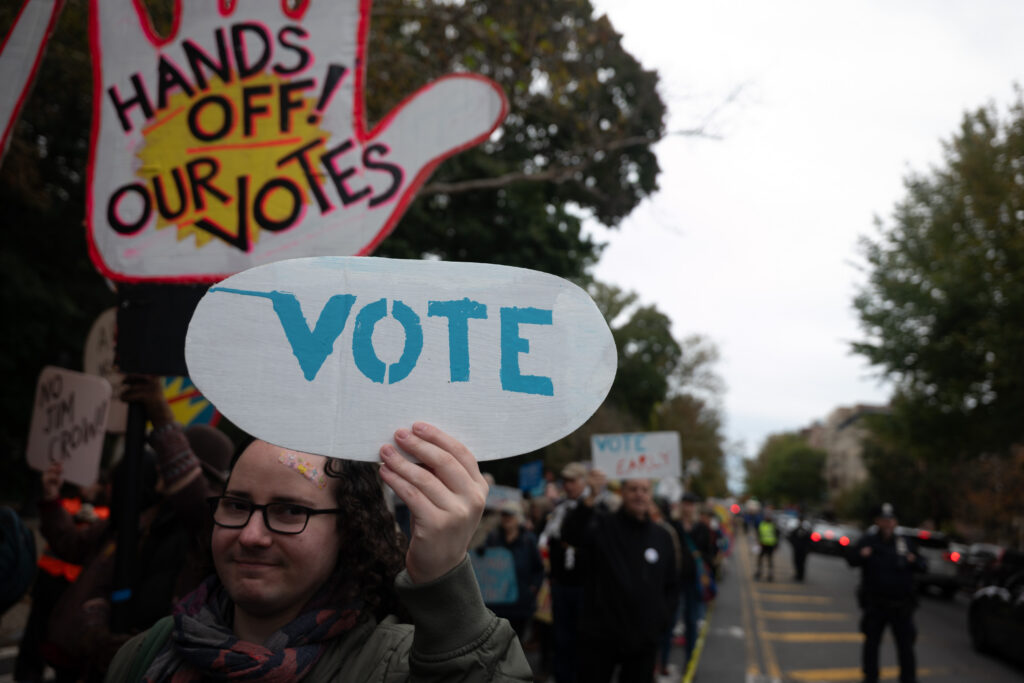
President Donald Trump’s attempt to subvert the midterm election was blocked by the courts in a flurry of temporary orders ahead of Election Day, but ongoing litigation will determine whether he can enact his sweeping attacks on voting for 2028.
Trump showed no signs of turning away from his anti-voting crusade after last week’s historic blue wave. After initially saying he would accept the results, Trump quickly reverted to his familiar playbook of sowing doubt about the integrity of the elections as the Republican finger-pointing over the losses intensified.
Several lawsuits over his election interference schemes are ongoing, including major cases involving Trump’s anti-mail voting executive order, his push to build a national voter roll database and his demand for state citizenship lists.
Here’s a closer look at where these major voting-related cases stand.
Trump’s anti-mail voting order
In March, Trump directed the U.S. Postal Service (USPS) to establish new requirements for handling mail ballots. Months later, USPS issued a rule imposing new standards, including requiring states to design new envelopes with trackable barcodes, or the mail service would refuse to deliver ballots to voters.
Prominent voting rights groups and 24 blue state attorneys general are challenging the directive as unconstitutional overreach that usurps states’ power to administer elections. The Democratic Senatorial Campaign Committee and other Democratic organizations* also filed a lawsuit challenging the order.
Ultimately, the U.S. Supreme Court blocked the USPS changes from going into effect before the midterms. Now, the fight returns to the lower courts. But the Trump administration is in a weakened position after judges on both sides of the political spectrum cast doubt on the legality of the administration’s action.
Get updates straight to your inbox — for free
Join 350,000 readers who rely on our daily and weekly newsletters for the latest in voting, elections and democracy.
Trump’s push for state citizenship lists
Another part of Trump’s March executive order instructed the Department of Homeland Security (DHS) to work with the Social Security Administration to create lists of verified U.S. citizens eligible to vote in all 50 states.
The Electronic Privacy Information Center (EPIC) sued DHS and the U.S. Citizenship and Immigration Services over the lists. The privacy advocacy nonprofit argues the lists violate federal law by sharing and disseminating millions of Americans’ sensitive personal information. The group also says the administration’s actions transgress the Constitution’s separation of powers.
U.S. District Judge Paula Xinis, who was appointed by President Barack Obama, is overseeing the case. Xinis heard arguments in late September and appeared skeptical of the administration’s defense. She could issue a ruling at any time.
Trump’s effort to build a national voter roll database
Common Cause and some of its members sued the Department of Justice (DOJ) over its effort to build a national voter database after the department demanded states turn over their unredacted voter rolls, which contain sensitive personal information such as Social Security numbers.
In October, U.S. District Judge Sparkle Sooknanan, an appointee of President Joe Biden, struck down the DOJ’s “list maintenance policy,” which sought to compare and cull state rolls against federal immigration and Social Security data. She determined that the Trump administration unlawfully exceeded its authority and violated privacy laws.
The DOJ has appealed Sooknanan’s ruling to the D.C. Circuit.
The DOJ is 0-28 in district courts in its push to obtain unredacted state voter rolls. Cases against Hawaii and Idaho are stayed pending a ruling by the 9th Circuit Court of Appeals. The 9th Circuit is also considering appeals of the DOJ’s losses in California and Oregon.
Trump’s use of taxpayer funds for propaganda ads
In the weeks leading up to the midterms, Trump directed the administration to use federal funds for propaganda ads promoting himself and his policies.
Pro-democracy groups and the Democratic National Committee filed separate lawsuits saying the administration illegally diverted $20 million Congress appropriated for immigration enforcement to pay for the ads. Trump defended the ad buys as a “standard thing to do,” and the White House called the partisan, political ads “public service announcements.”
U.S. District Judge Jennifer Rochon and U.S. District Judge Loren L. AliKhan issued temporary restraining orders barring the administration from developing or airing the ads. At first, the administration said the ads would stop, but the ads kept airing even after Rochon issued her order. Then, plaintiffs notified both courts that a third-party PAC, MAGA, Inc., started running identical taxpayer-funded ads under its partisan label. Rochon then extended her temporary restraining order to bar third-party dissemination. AliKhan issued her own temporary restraining order explicitly barring any party from airing the political ads. On Friday, Rochon will hold a hearing on pro-democracy groups’ request for a preliminary injunction to further block the political ads from airing as the lawsuits play out.
*The Elias Law Group (ELG) represents the plaintiffs in these cases. ELG Firm Chair Marc Elias is the founder of Democracy Docket.