‘Everyone has this data’: Security experts debunk Trump’s ‘absurd’ China voter file claims
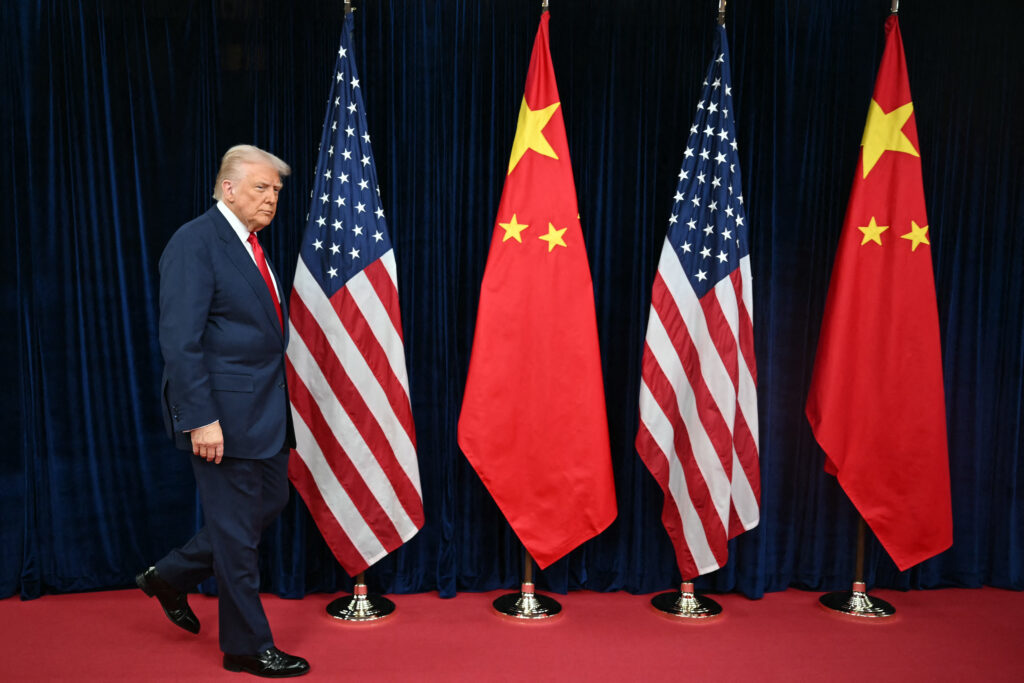
Voting and cybersecurity experts strongly pushed back on President Donald Trump’s assertions in a speech Thursday night that China accessed U.S. voter registration data.
In fact, one told Democracy Docket that the president’s claims were “complete bull****.”
Without providing evidence, Trump asserted in a primetime address that China bought, stole or hacked tens of millions of voter data records across 18 states in the lead-up to the 2020 election. He also alleged that a “deep state” conspiracy withheld that information from him during his first term.
That “illicit acquisition” of the records was “the largest compromise of election data in history,” Trump said.
In reality, experts told Democracy Docket that the voter records China possessed likely came from publicly available sources that anyone — including foreign governments — could have legally obtained. And there were no signs whatsoever that anything China did interfered with elections themselves.
Get updates straight to your inbox — for free
Join 350,000 readers who rely on our daily and weekly newsletters for the latest in voting, elections and democracy.
“Everyone has this data,” David Becker, executive director of the Center for Election Innovation & Research and a former DOJ Voting Rights attorney, said. “It would be a shock if China didn’t have this data.”
That’s because public voter registration records are among the easiest data points that can be obtained on Americans.
In most states, public registration data — which often includes names, addresses and party affiliation — is either fully public or available to a wide range of entities, including political parties, political campaigns, researchers and journalists, for a small fee.
In states like North Carolina, for example, anyone with an internet connection can access public versions of their voter rolls.
“Every piece of voter data Trump mentions here, as well as which elections each voter voted in, is readily available in Kentucky for a small fee,” Rep. Thomas Massie (R-Ky.) said while reacting to the president’s claims Friday.
“This is absurd,” the representative added.
It’s long been known that, as part of its standing policy to vacuum up as much personal data on Americans as possible, the Chinese government often gathers publicly available U.S. voter registration data, Lawrence Norden, a vice president at the Brennan Center for Justice, told Democracy Docket.
The intelligence community’s foreign threat assessment on the 2020 election, which Trump attempted to undermine in his speech, reported just that.
“China probably also continued longstanding efforts to gather information on US voters,” the assessment, which was prepared in the final months of Trump’s first term, concluded. “We assess Beijing probably sought to use this information to predict electoral outcomes and to inform its efforts to influence US policy toward China under either election outcome, as it has during all election cycles since at least 2008.”
“As with the rest of the speech, there was nothing really new here,” Norden said. Trump was “kind of taking bits and pieces of information, distorting them, not providing context, and using them to promote the same debunked conspiracy theories that he’s been promoting for the past five years.”
However, Norden added that he believes Trump has “clear intentions” to now use those claims “as a justification for taking control of elections or passing voter suppression laws.”
Others agreed.
“I mean, this is random Trump bull****,” Bruce Schneier, a security technologist at Harvard University, told Democracy Docket. “He wants to destroy democracy, and this is the next step.”
Though lobbed at China, Trump’s allegations were fundamentally meant to attack and undermine trust in state voter registration systems, part of his broader effort to federalize the creation and maintenance of state voter registration rolls — and therefore control who can and cannot vote.
The Department of Justice (DOJ) under acting Attorney General Todd Blanche, Trump’s former defense attorney, has sued 30 states and Washington, D.C. to force them to hand over their unredacted private voter registration rolls.
The DOJ has refused to concretely state what it intends to do with those records or what steps it would take to protect the sensitive data if it were allowed to have them. So far, no court has ruled in the department’s favor in those lawsuits. The department has dropped its suit against Oklahoma.
Separately, the Department of Homeland Security is attempting to force states to verify their private voter rolls using an error-prone federal database that has falsely identified eligible voters as noncitizens.
Voting advocates have warned that the database risks disenfranchising Americans by giving the executive branch and political incumbents the authority to monitor and directly shape state voter registration lists.
What so-called evidence the White House did provide to back Trump’s claims — heavily redacted declassified documents, often from unspecified federal agencies — directly refuted the president’s claims.
In one 2022 alert, an unidentified federal intelligence agency warned that a person or entity linked to the Chinese government had downloaded that year “publicly available registration information” on voters in six states — Colorado, Connecticut, Florida, Michigan, Oklahoma and Rhode Island.
However, the registration data, which spanned 2013 to 2021, did not come from state election websites. Instead, the alert noted, it came from U.S. commercial websites.
The agency warned that election security organizations “should be aware that U.S. State voter registration information may be hosted on websites outside the control of government agencies, and that [advanced persistent threat] actors may harvest voter registration information outside the monitoring of election security organizations.”
In a separate 2019 alert from an unidentified agency, U.S. intelligence officials warned that people or organizations with links to the Chinese government possessed a document listing major data breaches in previous years, including leaks involving voter data.
The agency’s alert did not allege, as Trump asserted, that China obtained data potentially exposed through the breaches. The alert instead likely served as a warning that Chinese intelligence officials were using the list of breaches as a guide in their search for exposed personal data.
Schneier, the security technologist, said it was unremarkable that China would possess this list.
“I [also] have a list of major data breaches in recent years,” he told Democracy Docket. “It’s just so stupid.”
The documents also do not indicate that foreign governments interfered with voter records. If they had, both Becker and Schneier noted that election and security experts would have immediately noticed.
“If they flipped registration records, we would know about it. Because you’d be going to the polls, and you’d have your own registration. It would be something we would know. You can’t do that in secret because it has visible effects,” Schneier said.
Ultimately, Becker said, Trump’s claims about registration data again indicate that he and officials around him do not understand U.S. elections.
“The administration really seems to misunderstand what you can do with this data,” Becker said. “I could have a list of all the students at a particular university. That doesn’t mean I can change their grades.”