Trump DOJ took a victory lap in Connecticut. Then it became their 16th straight voter roll loss
Earlier this year, President Donald Trump’s Department of Justice (DOJ) celebrated a win after a federal judge simply ordered Connecticut to respond to its voter roll lawsuit.
Now, months later, that same Trump-appointed judge has denied DOJ’s demand for the state’s unredacted voter rolls.
U.S. District Judge Kari Dooley became the 16th judge Friday to rule against the DOJ’s nationwide campaign to obtain states’ sensitive voter registration data, with zero judges ruling for the government. She concluded that Connecticut’s statewide voter registration list is not covered by Title III of the Civil Rights Act of 1960, the law the DOJ invoked to demand voters’ names, dates of birth, addresses and social security numbers.
“The SVRL is a record created by the state,” Dooley wrote. “It is not a record that comes into the state’s possession at all.”
Dooley is now the seventh Trump-appointed judge to reject the DOJ’s voter roll campaign. Combined with three judges appointed by former President George W. Bush, 10 Republican-appointed judges, or two-thirds, have ruled against the department, underscoring that its mounting losses have firmly crossed ideological lines.
Get updates straight to your inbox — for free
Join 350,000 readers who rely on our daily and weekly newsletters for the latest in voting, elections and democracy.
The ruling presents an awkward reversal for DOJ officials who treated an early procedural order in the case as though they had already won on the merits.
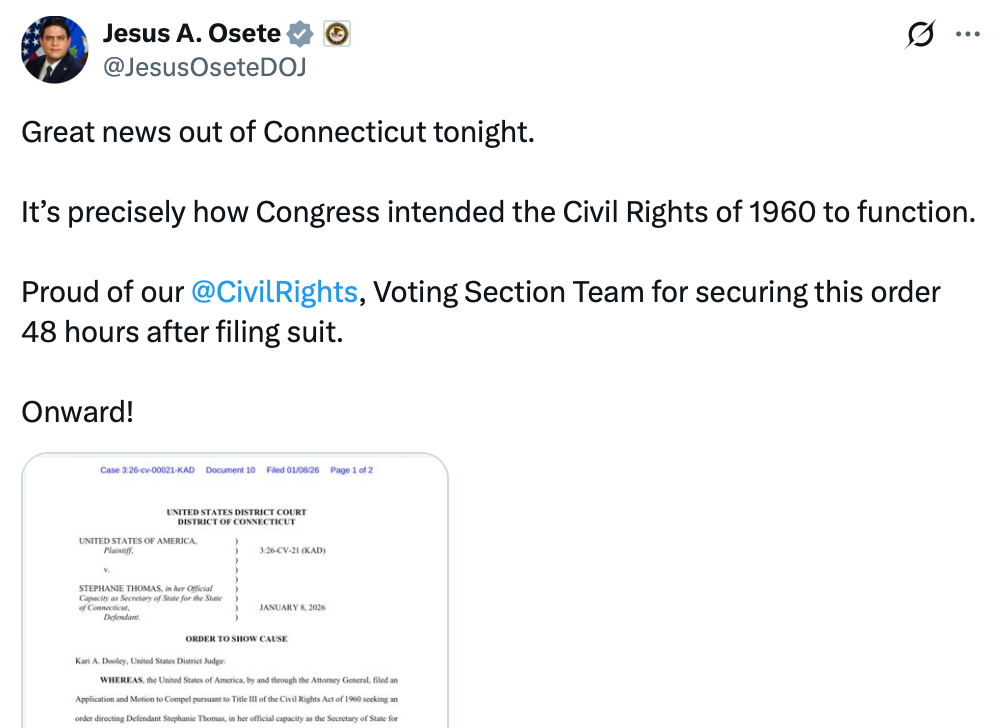
Two days after the DOJ filed their suit in January, Dooley issued an order to show cause directing Connecticut Secretary of State Stephanie Thomas (D) to respond and explain why she should not be required to produce the voter file.
The order did not compel Connecticut to surrender any records or decide whether DOJ’s legal claims were valid. But that did not stop senior department officials from taking a victory lap.
“Great news out of Connecticut tonight,” Principal Deputy Assistant Attorney General Jesus Osete wrote on social media at the time. “It’s precisely how Congress intended the Civil Rights [Act] of 1960 to function.”
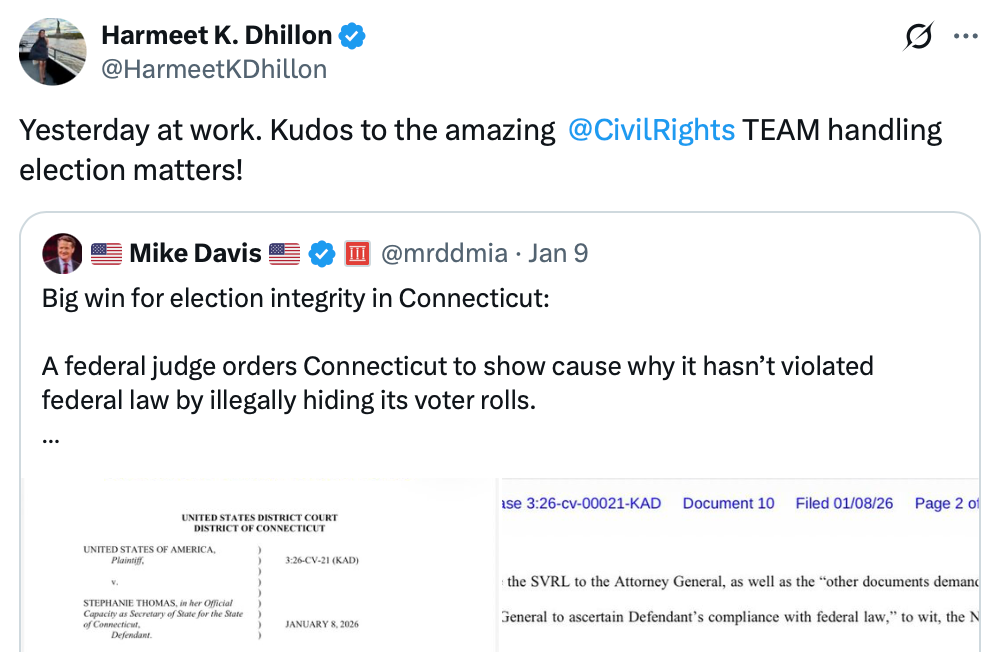
Assistant Attorney General Harmeet Dhillon also celebrated, amplifying a right-wing post that called the show cause order a “Big win for election integrity in Connecticut.”
“Kudos to the amazing @CivilRights TEAM handling election matters!” Dhillon wrote.
Dooley’s final ruling made clear that the supposed victory was only an instruction for Connecticut to answer the DOJ’s demand. In a footnote, the judge acknowledged that her earlier handling of the case had “perhaps unnecessarily injected some confusion” about the proper procedure.
DOJ officials, who had treated that procedural step as a major win, appear to have been among those confused.
After considering Connecticut’s response, Dooley sided squarely against the department.
She found that Title III covers records election officials receive and must preserve, not the constantly changing voter database that state and local officials create and update. Treating the voter roll as a protected, unchangeable record would also clash with other federal laws requiring election officials to add eligible voters, update addresses and remove people who are no longer eligible.
Although the DOJ insisted that the growing number of courts reaching that conclusion were all wrong, Dooley said “it is a fairly straightforward reading of Title III that compels this result.”
The ruling brings the DOJ’s record to 0-16 in district courts and 0-1 on appeal. No court has ordered a state to provide the department with an unredacted statewide voter file.