Trump fired the entire Election Assistance Commission. Now what?
 Prefer us on Google
to see more of our voting rights news coverage when you search.
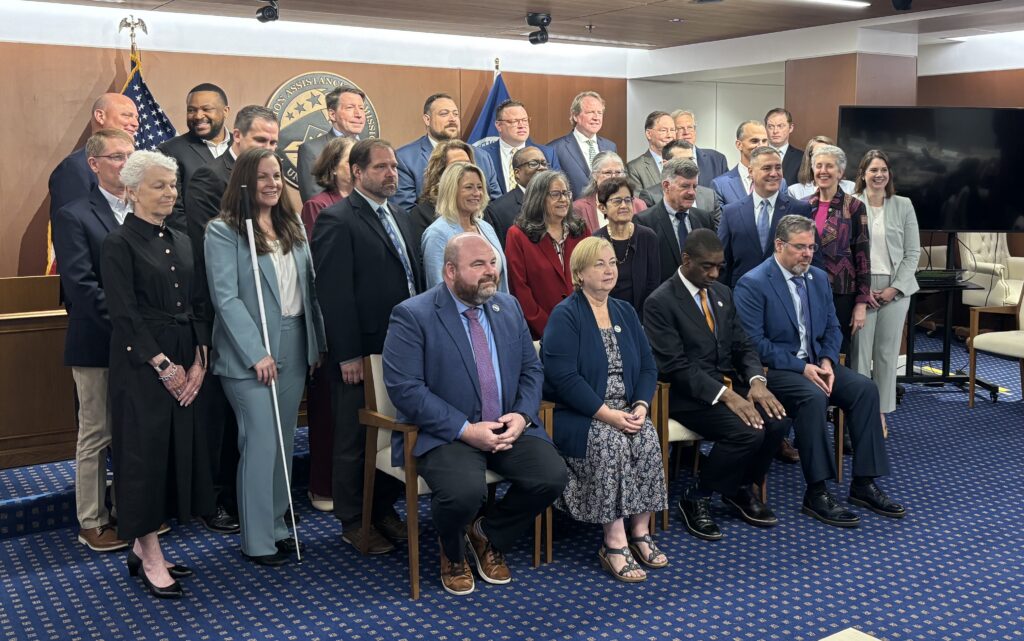
President Donald Trump launched his latest attack on voting last night when he ousted the three remaining commissioners of the U.S. Election Assistance Commission (EAC).
The defenestration leaves the bipartisan and mostly advisory federal agency, which was created to help states administer elections, without leadership just months before the 2026 midterm elections.
But while the dismissals represent a dangerous attempt by the president to exert control over elections — a power which the U.S. Constitution explicitly reserves for the states and Congress — most experts say that much of the EAC’s work on the 2026 elections has already been conducted.
Still, that’s cold comfort to election administrators unnerved by the sudden firings.
“We’re in uncharted territory here,” said Dustin Czarny, the elections commissioner for Onondaga County, New York, and a member of the EAC’s Local Leadership Council. “There has been a constant state of turmoil with federal agencies during this presidency.”
Many observers have assumed that the immediate impact of Trump’s firings would be to kneecap the EAC’s ability to take any new official actions without a quorum of commissioners to authorize them. But legal precedent suggests that might not be true — the commission’s executive director may be able to take official acts.
Moreover, courts have already blocked the administration’s only goals that ostensibly could benefit from his gutting of the EAC.
“In the immediate future, there’s not real impact,” said Cisco Aguilar, Nevada’s secretary of state and Democratic Association of Secretaries of State chair.
Longer term, however, Aguilar and others worry a prolonged lack of leadership could damage the EAC and eventually the integrity of U.S. elections.
Alarming precedent, murky implications
Trump has yet to explain his reasoning for targeting the EAC leadership. His main interaction with the agency was a March 2025 executive order that tried to direct the EAC to add a documentary proof of citizenship requirement to the federal voter application form it administers. But federal courts quickly blocked that effort as unconstitutional.
The New York Times quoted an unidentified White House source who suggested the president believed the three commissioners weren’t “totally aligned with the important task of securing America’s elections and ensuring every legal vote is counted.”
Regardless of how effective Trump’s action will be, experts say its implication is clear: The administration is once again trying to undermine the nation’s long tradition of politically neutral election administration.
“This is yet another assault by the president and his administration on the integrity of voting,” said Rick Hasen, a professor at the UCLA School of Law. “We can rattle off many of the other things: The attempt to weaponize the Post Office against delivering mail-in ballots from states that don’t meet Trump’s approval, the hollowing out of [the Cybersecurity and Infrastructure Security Agency], the multiple executive orders purporting to change rules for mail-in ballots and other things, the earlier efforts to force the EAC to change the federal form.”
“All of these things are aimed at both changing how Americans vote and inserting a federal role in Trump’s image on elections that have traditionally been run by states and localities, and also a way of delegitimizing the election system as a whole, which could benefit Trump in the event that Democrats win in midterm elections,” Hasen added.
Get updates straight to your inbox — for free
Join 350,000 readers who rely on our daily and weekly newsletters for the latest in voting, elections and democracy.
Maureen Edobor, a professor at the Washington and Lee School of Law, echoed that view.
“The EAC was created by Congress to provide independent, bipartisan assistance and resources to state and local election officials, not to serve as an instrument of presidential election policy,” she said. “Whatever one thinks about requiring documentary proof of citizenship to register to vote, the firings underscore the importance of preserving the EAC’s independence and bipartisan character at a particularly consequential moment for election administration and preserving confidence in the integrity of elections.”
Moreover, removing the EAC commissioners was just Trump’s opening gambit in a renewed attempt to impose his will on the agency, legal experts agreed.
“Trump is going to try to take some other action, whether it’s directing the EAC to change the federal form for voter registration, or whether that is trying to appoint new commissioners without getting congressional approval to do those kinds of things,” Hasen said.
Those potential next steps, plus the dismissals themselves, raise numerous legal questions, some of which may ultimately require the U.S. Supreme Court to settle.
“In the 49 states that require voter registration, applicants already attest under penalty of perjury that they are U.S. citizens, and falsely claiming citizenship is a federal crime,” said Edobor. “Against that backdrop, these removals raise legitimate questions about whether the Administration is attempting to accomplish through an administrative agency what Congress has thus far declined to enact through the SAVE Act” — an aggressive anti-voting bill endorsed by Trump that has stalled in the Senate.
As a preliminary matter, Trump may lack the legal authority to fire the commissioners — although they were all still serving past the official end of their terms. The Supreme Court recently overturned nine decades of precedent in Trump v. Slaughter, allowing the president to remove leaders of independent agencies like the Federal Trade Commission (FTC) at will. But it’s unclear whether that ruling covers expressly bipartisan agencies like the EAC.
The same day the Court handed down Slaughter, the justices ruled that the president cannot fire a Federal Reserve governor, arguing that the Fed was structured to ensure independence from the political branches. Commissions with even numbers of Democratic and Republican appointees, like the EAC, could arguably be more like the Fed than the FTC.
Whether a court would need to consider those weighty constitutional questions isn’t clear here, as all of the commissioners dismissed Thursday were still serving well after their terms had ended.
Either of the two Democratic commissioners could potentially challenge their dismissal before a federal judge. But if they did — and if the court didn’t hold their expired terms against them — the issue would presumably quickly find itself before the Supreme Court, perhaps on the emergency docket this summer.
Moreover, even though a lack of a quorum on an independent board like the EAC usually prevents an agency from engaging in any new official acts that weren’t previously authorized, there is legal precedent suggesting that the EAC’s executive director may still be able to issue final agency actions.
In Kobach v. U.S. Election Assistance Commission, the 10th Circuit Court of Appeals implicitly held that a final agency action issued by the EAC, even though it lacked a quorum, was valid.
In that 2014 case, the Kansas and Arizona secretaries of state petitioned the EAC to add documentary proof of citizenship to the federal registration form. But the EAC deferred on those petitions because it lacked a quorum of commissioners at the time. The secretaries then sued, saying the EAC’s failure to act violated federal administrative laws. The district court ordered the EAC to issue a final agency action, and the executive director did, denying the requests.
After the district court then ruled that the EAC was obligated to approve the petitions, the circuit court reversed. But in doing so, it only vacated the lower court’s decision; it did not invalidate the executive director’s final agency action to deny the requests.
Sean Morales-Doyle, director of voting rights and elections at the Brennan Center for Justice, doubts the EAC’s executive director could take official actions without a quorum or a court order.
“Without any commissioners, the EAC is functionally useless, or at least it can’t do anything of great significance,” he said.
More firings, appointments coming?
There are also legal and practical challenges ahead.
If the EAC’s executive director attempted to issue some kind of controversial agency action without a quorum, it would likely be challenged in court. In that hypothetical lawsuit, a judge could decide that it’s only acceptable for a quorumless EAC to take final actions when a court orders them to do so.
Moreover, if EAC executive director Brianna Schletz, a lifelong federal servant unlikely to blindly follow Trump’s dictates, can take agency actions without the commissioners, it’s likely that she’ll be the next one fired. EAC General Counsel Camden Kelliher would then step into the role.
Still, even if Trump appointed acting commissioners — or somehow convinced Senate Republicans to quickly spend their rapidly diminishing floor time confirming nominees, rather than passing legislation important for their reelection campaigns — the EAC’s structure would also frustrate Trump’s desires.
At its heart, the EAC is a deliberative body between the federal government, states, local election officials and non-governmental partners. The EAC can’t do much without input from its multiple advisory bodies made up of those officials, who would likely oppose Trump’s directives. The EAC’s Technical Guidelines Development Committee did just that last year, after Trump’s executive order directed some changes to voting machine certification guidelines.
And the thing Trump wants the EAC to do — add documentary proof of citizenship to the federal form — has already been repeatedly blocked by the courts, Morales-Doyle noted. “Whether or not those commissioners are there, multiple courts have said that the president can’t order the EAC to do the things that he ordered them to do,” he said.
Even if the executive director can’t adopt new policies or launch new programs, the EAC will be able to continue its existing work: Disbursing funds, certifying voting systems, and convening its meetings and advisory boards.
None of this would have much impact on the midterms. Most of the agency’s grants have already gone out, and the voting systems that’ll be used in November were certified long ago.
“While this is another troubling attempt to expand powers beyond [what] the Constitution may grant, it actually will have very little, if any, impact on the election,” David Becker, executive director of the Center for Election Innovation and Research, wrote on social media. “I’ve talked to dozens of election officials of both parties all over the country since the EAC dismissals, and not one is concerned. It changes nothing about their work, which proceeds without federal support (and perhaps despite attempted federal interference), with or without the EAC.”
While the practical impact on the upcoming elections will be muted, the long-term effects could be sizable, officials said.
“[The EAC commissioners] don’t have a role in the certification of election results,” Czarny said. “Their role is more in providing voter assistance, providing voter education, providing training, and even things like social media toolkits that boards of elections use.”
“If this is a prolonged absence, where the Election Assistance Commission cannot act, then training is going to come to a halt, the new [voting system] guidelines are going to come to a halt as we’re trying to certify new equipment,” Czarny added.
Aguilar noted that the Help America Vote Act grants, which the EAC handles, have already been allocated for the current year, and don’t amount to a ton of money for local officials anyway.
The real purpose of beheading the EAC, Aguilar thinks, isn’t to ensure implementation of Trump’s long-sought policy goals.
“It’s a bit of a tantrum by the president,” he said.
After suffering a series of legal setbacks as courts have consistently found the administration’s attempts to interfere with elections unlawful, Trump’s just lashing out blindly.
“He’s just mad because he’s not winning,” Aguilar said, noting the threatening letters the Department of Justice recently sent to election officials. “His ego is bruised.”
Trump and his allies “scream about the safety and security of the elections,” Aguilar noted, but striking out at the EAC only undermines election security. The EAC plays an important role in election cybersecurity, issuing technical guidelines and certifying voting machines.
“What they say they’re trying to do, they’re actually doing the very opposite of it and creating chaos. But I think that’s the mantra of this administration,” Aguilar said. “What they care about is creating drama, to then create chaos among the voters, so that voters are self-selecting out.”
“Again,” he added, “this president wants to choose his voters rather than the voters choosing the president.”
Matt Cohen and Jacob Knutson contributed to this report.