Trump attempts to use U.S. Census Bureau to revive 2020 election lies, advance attack on voting
 Prefer us on Google
to see more of our voting rights news coverage when you search.
President Donald Trump and the White House are pushing a statistically dodgy U.S. Census Bureau report that claims thousands of noncitizens voted in the 2020 election as part of Trump’s latest attempt to revive false claims that he won the long-settled race and argue for new federal voting restrictions.
But according to voting experts and former Census Bureau employees, the analysis the president cites relies on an incomplete commercial voter file and record-matching methods that raise serious concerns about the accuracy of its conclusions.
“This alleged analysis based on Census data fails the laugh test,” David Becker, executive director of the Center for Election Innovation & Research and a former DOJ voting rights attorney, said in a statement Wednesday.
“The administration does not provide a sufficient explanation of how it arrived at these numbers — and for good reason. Census data cannot be reliably matched to public voter data, as it lacks any unique matching identifiers to compare to those public voter records. Any possible effort to ‘match’ such data would result in large numbers of false matches,” Becker added.
Get updates straight to your inbox — for free
Join 350,000 readers who rely on our daily and weekly newsletters for the latest in voting, elections and democracy.
Trump announced the supposed findings in a Truth Social post Tuesday afternoon that included graphics from the Census analysis. Though the analysis provides no information on which candidate the alleged illegal voters supported, Trump also claimed that the findings proved the long-debunked claim that he, rather than former President Joe Biden, won the 2020 presidential election.
“The Census Bureau has begun checking the Voter Records from 2020 against their Citizenship Records. On the first 128,000,000 Voters, the Census Bureau proves that over 24,000 Noncitizens voted illegally!” Trump wrote. “I WON THE ELECTION! We must pass THE SAVE AMERICA ACT.”
The official White House account later amplified Trump’s post and the Census graphics and added a banner calling for passage of the SAVE America Act, which would disenfranchise millions of eligible voters if it became law.
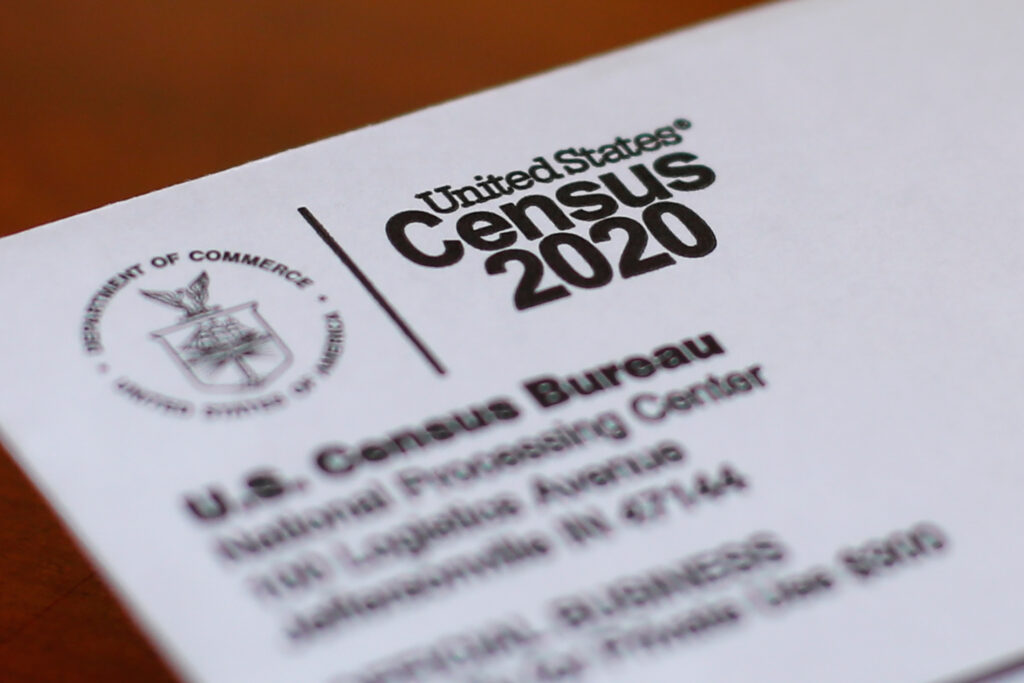
Shortly after Trump’s post went live, the Census Bureau published a short seven-page report called “Noncitizen Voting in the 2020 Election, A Beginning Analysis,” which provided more detail than the graphics the president shared.
The report states that Census researchers determined “with high confidence” that more than 128 million records represented citizens and 24,000 represented people who were noncitizens at the time of the November 2020 election. More than 32 million records remain to be analyzed.
Notably, the report was unauthored. That was a significant red flag for Misty Heggeness, a former senior advisor for the Census Bureau who is now a professor and research scientist at the University of Kansas.
“I would not take that report as robust or high-quality work unless the Census Bureau actually put author names on it,” Heggeness told Democracy Docket in an emailed statement. “Otherwise, it seems suspect of any integrity or rigor, and it’s impossible to validate quality. I would ask the Census Bureau if any career staff were involved in writing the report or doing the analysis — those are the statisticians the larger society can trust.”
The report says the researchers used a commercial database produced by a firm called DataClear that combines state voter registration rolls with vote history data. A vote history flag indicates whether a person participated in the 2020 election, although it does not reveal whom that person voted for.
That commercial database was then linked to a collection of federal records from agencies, including U.S. Citizenship and Immigration Services, Immigration and Customs Enforcement, the State Department and the Social Security Administration. These federal records included green card, visa and other immigration records on noncitizens.
But that process is not a simple comparison between two comprehensive government lists, as Trump’s description of the report suggests.
There is no single federal database containing the current citizenship status of every U.S. citizen.
Instead, Census uses what it calls a “Person Identification Validation System” to attempt to link records belonging to the same person. When a usable Social Security number is available, the system verifies it against other identifying information. When one is not available, it can search using a person’s name, date of birth, sex and address, then score possible matches and assign an anonymous identifier when the match crosses a confidence threshold. The new report says it uses only “high-confidence” classes of matches.
Record matching, however, is fallible. The Census Bureau previously published research in 2014 specifically devoted to measuring false matches in the same identification system.
Though the new report references that prior research, it does not provide an estimated false-match rate for the linkages that produced the 24,000 figure and repeatedly describes its matches as “high confidence.”
Census researchers have previously warned that the likelihood of successfully linking administrative records can vary across demographic groups, potentially introducing bias when researchers analyze only records they can confidently match.
That limitation is particularly significant when the result in question is relatively small compared with the enormous volume of records being searched: A mistaken link between an eligible citizen’s voter record and another person’s immigration record could produce a false positive.
The report also does not address another obvious danger: mistaking a naturalized citizen for a noncitizen due to an older immigration record.
Under the report’s methodology, someone who appears in a federal noncitizen database enters a pool for further review. The Census Bureau then searches for evidence showing that the person had become a citizen by Election Day. The report says approximately 63,800 people who had once held green cards but naturalized before the 2020 election were found through that process and excluded from the noncitizen count.
But the reliability of that safeguard ultimately depends on the completeness, accuracy and successful linkage of the underlying citizenship records.
If evidence of a person’s citizenship is missing or fails to link correctly, the methodology can treat the existing noncitizen record as evidence of the person’s status at the time they voted. The report does not estimate how frequently such a misclassification could occur.
The voter data used by Census itself has another significant limitation.
DataClear’s commercial file captures 146.7 million people flagged as voting in 2020, compared with 159.9 million ballots reported by states to the U.S. Election Assistance Commission in the benchmark Census used — coverage of 91.7%. Coverage also varies by state, from 97.1% in New Jersey to just 74.5% in Utah. Census explicitly says its comparison with the official federal benchmark is a comparison of overall numbers, “not of individuals.”
That creates another unanswered question.
The report states that more than 32 million records still need to be analyzed, but the commercial voter file itself is missing more than 13 million of the voting records included in Census’ official benchmark. The methodology says every federal record is connected to a voter through a match to the DataClear file. The report does not explain how the Census Bureau will analyze voters who are absent from that commercial file.
Further, Trump’s immense leap from a preliminary record-matching analysis to “I WON THE ELECTION!” is unsupported by the Census report itself.
Nothing in the Census report identifies whom any of the 24,000 people voted for. The report provides state totals of supposed illegal voters — including roughly 1,100 in Arizona, 1,000 in Pennsylvania, 600 in Michigan, 500 in Wisconsin, 400 in Georgia and 250 in Nevada — but no candidate choices.
Biden received over 7 million more votes than Trump and won the Electoral College 306-232 in 2020, a result certified by Congress after states certified their respective results.
“Even given this shoddy and opaque methodology, the number of alleged noncitizens keeps getting smaller,” Becker said. “Now that number is only 24,000 out of 128 million records. Even assuming these numbers are credible, and they are not, that figure would represent less than 0.02% of all voters in 2020.”
“That said, it is good to see the administration now admit that these numbers are so small that they could not have altered the outcome of the 2020 election. All of the numbers cited in the Census analysis are smaller than the margins of victory in each state and would not have been enough to change the winner of any state in 2020,” he added.
Trump’s promotion of the Census report comes at a moment when his administration is conducting a broader campaign to cast noncitizen voting as a widespread threat, despite how exceptionally rare it actually is.
Last month, the Department of Homeland Security claimed that more than 250,000 potential noncitizens were registered to vote across California, New Jersey, Nevada and Pennsylvania. DHS did not publicly explain how it generated those numbers or allege that all — or any — of the people it identified had actually voted.
Election officials in several of those states demanded that DHS show its work. Nevada Secretary of State Francisco Aguilar (D) contested how DHS claimed to match Social Security numbers with publicly available Nevada voter records that do not contain them. Pennsylvania Secretary of State Al Schmidt (R) similarly demanded the department disclose its methodology and warned that faulty matching systems can incorrectly identify eligible citizens as noncitizens. California Secretary of State Shirley Weber (D) said her state had not supplied its statewide voter file to DHS and questioned where the department obtained its data.
That DHS analysis is separate from the new Census report, which describes a different record linkage process. But both have become part of the administration’s campaign for stricter federal voting rules.
Noncitizen voting in federal elections is already illegal. A recent Reuters examination of federal court records found only 129 people have been charged under the federal law prohibiting noncitizen voting since Congress enacted it in 1996, with just 73 convicted or pleading guilty.
The review found no evidence of the coordinated, widespread noncitizen voting scheme Trump and his allies have repeatedly alleged.
Trump is nevertheless using the new Census numbers to demand passage of the SAVE America Act, legislation that would require strict documentary proof of U.S. citizenship and photo identification to register and vote in federal elections. The bill was introduced in January but has remained stalled in the Senate.
The Census Bureau and White House did not respond to Democracy Docket’s questions about the source and methodology behind the analysis, its potential error rate or the basis for Trump’s claim that the findings prove he won the 2020 election.
For all the authority Trump has tried to attach to the new Census figures, the bureau itself calls the work only a “beginning analysis.” Its published methodology raises questions that will require further scrutiny as millions of records remain to be analyzed.
And whatever the final number proves to be, the data released so far does not establish the central claim Trump is using it to promote: that he won an election the certified results show he lost.
Jacob Knutson contributed reporting to this story.