Tennessee Democrats rebuke ‘racist’ new gerrymander as GOP begins session to dismantle only majority-Black district
 Prefer us on Google
to see more of our voting rights news coverage when you search.
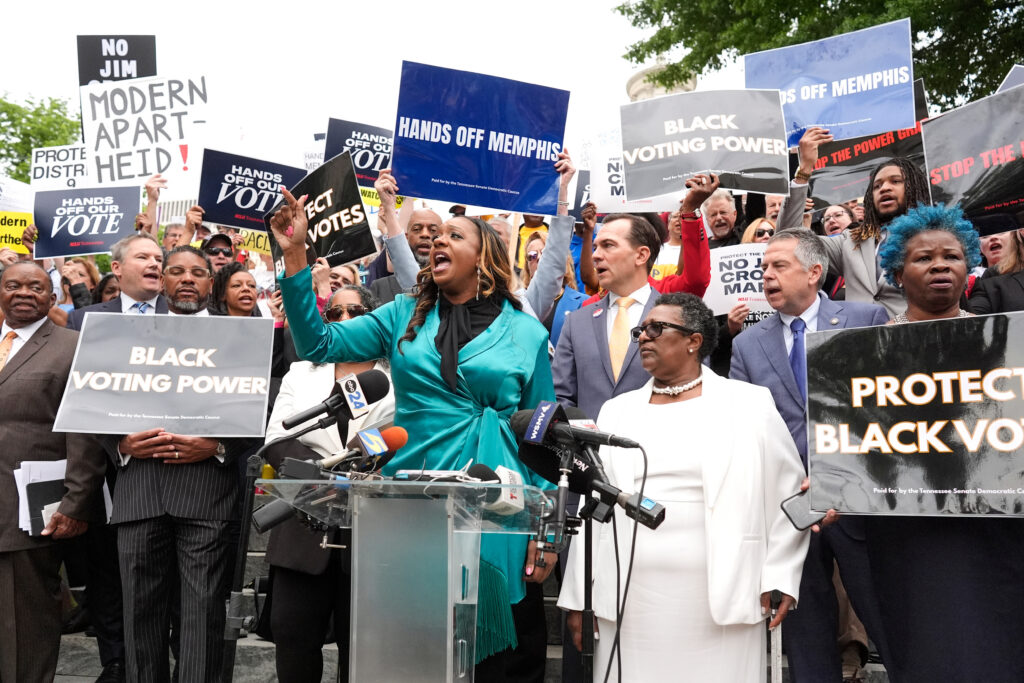
Democratic lawmakers, civil rights leaders and protesters converged on the Tennessee State Capitol Tuesday as Republicans began work to enact a new congressional gerrymander just days after the Supreme Court gutted the Voting Rights Act — a move voting advocates say would dismantle Black voting power in the state.
Inside the Tennessee Senate a routine procedural session instead became an emotional confrontation — one that Democrats framed not as ordinary politics, but as a defining civil rights moment.
“I do not respect, Mr. Speaker, the purpose for which this session has been called,” state Sen. Jeff Yarbro (D) said. “What we should do is just do nothing and go home.”
Yarbro called the special session an “abomination” that “attacks Black political power,” rejecting both the policy and the process driving it.
Get updates straight to your inbox — for free
Join 350,000 readers who rely on our daily and weekly newsletters for the latest in voting, elections and democracy.
Republicans are preparing to redraw Tennessee’s congressional map in a way that would likely break apart Memphis — the state’s only majority-Black district and its last Democratic-held seat.
Protesters gathered outside the Capitol could be heard chanting and shouting during the proceedings, their voices bleeding into the Senate floor as lawmakers spoke.
Democrats responded to the opening of the special session with especially forceful language.
“Thank you Mr. Speaker, but I’m not thankful to be here. I never thought in my lifetime as the youngest African American to ever serve in this body, in the history of this state, that I’d be standing in a body surrounded by my colleagues who are going to erase the vote of my city and Black people in Memphis,” state Sen. London Lamar (D) said. “Enough of beating around the bush. I need you to know this will be one of the most racist actions taken in the modern history of this legislature that you are participating in this week. Intentionally breaking state law to take my community’s vote is downright disgusting and offensive.”
She described a direct throughline from past disenfranchisement to the present moment — invoking her grandmother, who lived through a time when Black Americans were denied the right to vote.
“This is an opportunity for you to have some courage, show some courage. Y’all know this is wrong,” Lamar said. “You don’t have to do it.”
Other lawmakers echoed that framing, arguing the effort is not just a partisan maneuver but an explicit attempt to dilute the political voice of Black voters in a majority-Black city.
“There’s no way to sugarcoat eliminating a district that is 61 percent black and breaking it up into three different districts,” state Sen. Raumesh Akbari (D) said. “You are deliberately trying to silence the voices of a community. You cannot call it anything but racism.”
The debate repeatedly returned to personal history. Black lawmakers invoked ancestors who had fought in wars, lived through segregation and struggled for the right to vote, placing the proposed map squarely in the lineage of those battles.
That message was reinforced outside the chamber and beyond the state.
In a letter sent to Tennessee legislative leaders, Martin Luther King III warned the redistricting effort would dismantle hard-won protections rooted in the Civil Rights Movement.
“Do not dismantle the only Congressional district that provides Black voters in Memphis a fair opportunity to have a voice in our democracy,” King III wrote. “Do not take this nation back to the days of Jim Crow.”
He called the special session “not fair,” and warned that the “resulting disenfranchisement of Black voters would run contrary to everything that my father, Dr. Martin Luther King, Jr., fought for.”
King III urged lawmakers to reject the push entirely.
Despite the intensity of the moment — inside the chamber and outside its doors — Republican leadership moved quickly to keep the process on track. After the speeches concluded, the Senate adopted its schedule and adjourned until the next morning, setting the stage for rapid movement on a new map.
The special session was called by Gov. Bill Lee (R) just two days after the Supreme Court’s ruling, which essentially ended key protections of the Voting Rights Act and opened the door for states to gerrymander maps in ways that devastate Black voting power.
Louisiana and Alabama have also begun working to enact their own gerrymander that would dismantle Black political power in their respective state.