Gov. Landry signs Louisiana gerrymander into law, erasing majority-Black district
 Prefer us on Google
to see more of our voting rights news coverage when you search.
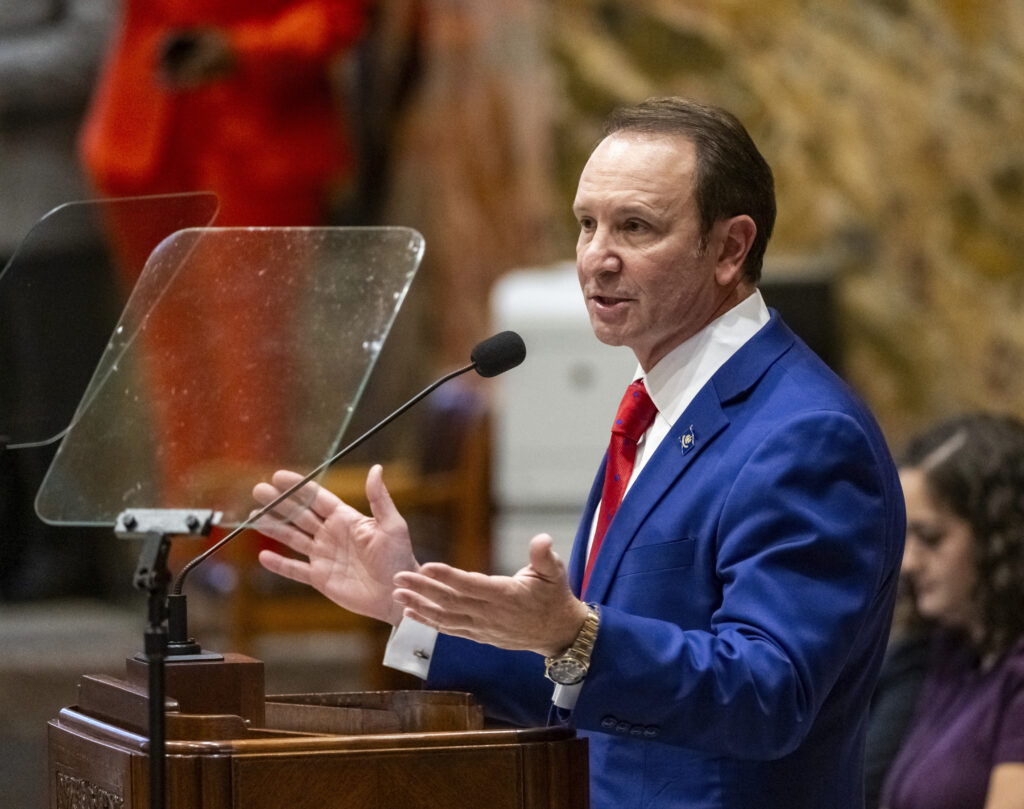
Gov. Jeff Landry (R) signed a new congressional map into law Friday that eliminates one of the state’s two majority-Black congressional seats.*
While lawsuits could still ultimately block this redistricting, the vote likely caps years of litigation, legislation, and Louisiana ping-ponging between alternate congressional maps.
Still, a group of conservative white Louisianans has signalled that it will challenge the new map in the hopes of getting one that goes even further to eviscerate Black representation, by eliminating not just one but both of Louisiana’s majority-Black districts.
The latest chapter in this saga began last month, when the U.S. Supreme Court struck down the state’s current map in Louisiana v. Callais. After Louisiana enacted a congressional map in 2021 that packed most of the state’s Black residents — roughly a third of Louisiana’s population — into one of its six U.S. House districts, voters sued, saying it violated the Voting Rights Act (VRA).
A federal court agreed, ordering a new map ahead of the 2024 elections that offered two majority-Black districts. But Bert Callais and a few other “non-African American voters” then challenged that map in a lawsuit that eventually landed in front of the Supreme Court.
In Callais, the court’s six Republican-appointed justices kneecapped the VRA, the law that codified the 15th Amendment’s extension of voting rights to all races. The court said court-ordered remedial maps must accommodate all of the state’s “nonracial goals,” including “political goals.”
Get updates straight to your inbox — for free
Join 350,000 readers who rely on our daily and weekly newsletters for the latest in voting, elections and democracy.
Combined with a narrowing of the judicial test used to determine a VRA violation, the ruling blew up the last remaining statutory dam holding back the flood of GOP gerrymanders that has inundated the South in its wake. Landry suspended an ongoing congressional election the day after the ruling so lawmakers could pass the new map — a slightly tweaked version of the map Louisiana adopted in 2021 — before November’s midterm elections.
Republican lawmakers in Tennessee and Alabama also rushed to pass or re-adopt new maps after Callais, each reducing the power of Black voters. In South Carolina, Republicans decided that erasing Rep. Jim Clyburn’s (D) district might backfire, ultimately opting against a redraw after weeks of contentious debate.
But Louisiana Republicans had no such fears Friday. The House passed the bill Thursday, and it now moves to the governor’s desk.
Friday’s debate ahead of the vote was muted — the Senate had already passed a version of the bill, but because the House amended it, they needed to vote again. As such, the body moved relatively quickly to adopt the new map.
Democrats questioned the bill’s sponsor, Sen. Jay Morris (R), probing for cracks in his contentions that race played no role in drafting the map.
“Would you agree with the fact that District 2 [represented by Rep. Troy Carter (D-La.)] is a racially gerrymandered district?” Sen. Sam L. Jenkins Jr. asked.
“Absolutely not,” Morris said. “I purposely put more Democrats into District 2 to make the remaining districts better performing for Republicans.”
Morris repeated that he did not look at racial population data in drawing the map.
“If you don’t have those numbers, how do you know these districts are not racially gerrymandered?” Sen. W. Jay Luneau asked. “I mean, if just because you didn’t do it intentionally, if it was done just the same, then wouldn’t it be problematic?”
No, Morris responded, saying he was following the court’s ruling in Callais, ignoring race and focusing just on partisanship. Morris declined to amend his bill to include each district’s racial demographics.
Lawsuits may block some of those redraws from being used in November — Alabama’s new map was enjoined in a decision the state has asked the Supreme Court to reverse. But more redraws are likely to follow in the coming years, including state legislative maps stripping Black voters’ ability to pick their local representatives.
In all these states, Republican lawmakers have endeavored to cast their remapping efforts as purely partisan. While Callais made it harder to challenge racist voting laws and maps, blatantly discriminatory maps are still illegal.
The Supreme Court held that courts cannot block partisan gerrymandering in 2019’s Common Cause v. Rucho. But while Rucho held that partisan gerrymandering is merely a nonjusticiable political question, Callais essentially blessed the practice by making it illegal for a court order to unintentionally undermine politically-motivated electoral maps. As a result, Democrats and Republicans are now locked in a gerrymandering war across the nation that will see states adopting new maps every election cycle.
*This story has been updated to reflect Gov. Landry’s signing of the congressional map bill.